 (s.m.) The latest pastoral letter from the Latin patriarch of Jerusalem, Pierbattista Pizzaballa – reported on by Settimo Cielo in the previous post – has drawn much attention not only in the Christian camp, but also among the Jews of Israel and the diaspora.
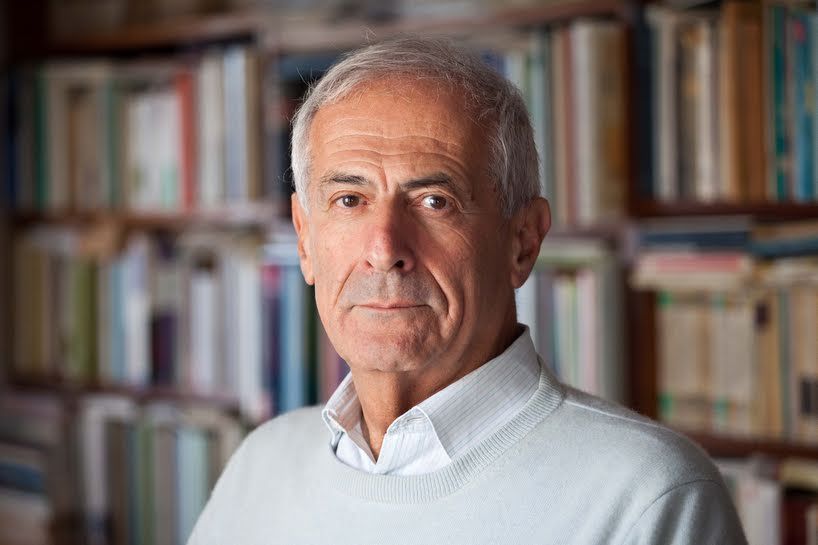
The following is a commentary sent to us by one of the most authoritative Israelites, Sergio Della Pergola (in the photo), professor emeritus at the Hebrew University of Jerusalem and a world-renowned scholar of the demography and sociology of Judaism.
Della Pergola fully grasps and respects the biblical and theological angle, before and more than geopolitical, of Pizzaballa’s letter.
Yet he cannot help but identify, in the dozens of pages of the text, judgments that are also political, in particular on that decisive “watershed” which was the massacre of Jewish civilians carried out by Hamas on October 7, 2023.
And it is precisely the two lines in which Pizzaballa writes that the massacre, with the subsequent war in Gaza, “for the Palestinians represents another dramatic phase in a long history of humiliation and displacement” that lead Della Pergola to say that this blatantly erroneous judgment is enough to “close the way to any possible future joint reflection or dialogue between the Catholic and Jewish sides about October 7, on the before and after.”
The only, and uncertain. spaces of dialogue that Della Pergola sees Pizzaballa opening up are if anything with his Muslim counterparts, certainly not with Judaism. And in fact the cardinal himself acknowledges, in one passage of the letter, his difficulty understanding even the small number of Jews of the Catholic faith living in Israel, to whom he promises more moments of encounter to break their “solitude” in “a Church in which they do not feel completely at home.”
Not to mention the various currents that divide Judaism, some of which are hostile to Christians even to the point of violence and completely closed to any dialogue. A dialogue that took its first steps with Vatican Council II, but is still largely undeveloped.
*
“The cardinal did not understand or chose not to understand”
by Sergio Della Pergola
Cardinal Pierbattista Pizzaballa’s pastoral letter, “They returned to Jerusalem with great joy,” prompts some reflections from the perspective of a Jew living in Israel.
Cardinal Pizzaballa has carried out the role of Latin patriarch of Jerusalem since November 2020, after having been apostolic administrator of the same patriarchate from 2016 to 2020 and custodian of the Holy Land from 2004 to 2016. Previously, from 1995 to 1999, he had studied for his doctorate at the Hebrew University of Jerusalem, and from 1990 – upon his ordination as a priest – had studied biblical theology at the Studium Biblicum Franciscanum in Jerusalem. The cardinal has lived in Jerusalem for over 36 years, speaks fluent Hebrew (in addition to Arabic), and knows the city and the surrounding country like few others. He is undoubtedly the most longstanding and knowledgeable Catholic observer of Jerusalem, Israel, and Palestine. He has been an influential voice of the Roman Catholic Apostolic Church as a member of the Sacred College since 2023, following his appointment as cardinal by Pope Francis. No one understands and analyzes better than he the complexities of the political system of the State of Israel, as well as the Jewish diaspora, which – like it or not – is inextricably involved in the state’s decisions and dilemmas. These premises drive the reader’s expectations.
A highly detailed, refined, and analytical document like the pastoral letter of the patriarch of the Holy Land does not seem to be simply a diocesan document to be distributed to a few thousand faithful, because this is the size of the Catholic population out of the 15 million total inhabitants of the territory of Israel and Palestine (in addition to the 11.5 million in Jordan and 1.5 million in Cyprus) where Pizzaballa carries out his diocesan ministry. It seems more plausible, instead, to think of it as a summary of the impressions and reflections developed over 35 years of pastoral activity, almost as if it were handing down a legacy, a program, to everyone. “Its purpose,” one reads there, is “to help each person reflect on how to live our Christian faith in this land today in the light of the Gospel.”
The document is explicitly a spiritual guide and not a geopolitical analysis. One might wonder, however, to what point the two sides can remain disconnected, and how much the concrete reality can be ignored, if the document is to retain its relevance. The reality is that the Catholic Church – leaving aside Jordan and Cyprus for the moment – operates in the State of Israel, where there is a Jewish majority, and in the West Bank and Gaza, where there is an Arab Muslim majority. The legal, institutional, and political conditions of these places are different, but in any case they are crucial to the Church’s ability to operate and to the fate of Catholics in the region.
Reading the document, one might get the impression that Jerusalem is the most important place in the world for the Catholic faith, and one might therefore ask what the role of Rome may be in this regard. Why isn’t Jerusalem the central see of Catholicism, with the papacy and the curia ? If the crucial sites of the past are located in Jerusalem, and the future awaits the descent of a new Jerusalem from the heavens, why isn’t the spiritual capital here ?
It is clear, however, that in the ideal vision presented here, no secular earthly authority can have any relevance, and only the spiritual utopia guides the analysis and the perspective of the resulting actions. The modern city of Jerusalem is thus defined as “ours,” a prelude to the true and definitive “polis,” the heavenly Jerusalem. In the letter there is no trace of the State of Israel, and the Palestinian Authority does not exist. The document completely ignores these entities, without even justifying the omission. In the ideal world depicted here, they simply do not exist and cannot interfere in the discourse, which is purely spiritual, torn from the geopolitical context. Or perhaps it makes the political choice of being torn from the earthly context, which, however, is the only one that truly exists in everyday life.
In the opening of the first part of the letter, Pizzaballa states that “October 7, 2023, and the war in Gaza meant something different and disruptive for each of the two peoples living in this land.” In the following order : “For the Palestinians, these events represent yet another dramatic phase in a long history of humiliation and displacement. For the Israelis, on the other hand, these events represent something unprecedented, a violence that has brought back the horrors that occurred in Europe eighty years ago.”
Here Pizzaballa loses me as a reader, when he thus describes events that unfolded in a dramatically reversed order, and with different actors. October 7 is, indeed, a historic “watershed,” but pay heed, in a completely different way than the cardinal describes it. For Jews, October 7 represents a brief repeat of the Shoah, eighty years after the true and unique Shoah : a barbaric and monstrous massacre of civilians in their homes. But for Muslims, it represents the choice of unheard-of violence to assert their absolute and exclusive ownership of the territory, to obliterate Israel and erect an Islamic Caliphate in its place. The reversal of the order of events and the twisting of the facts constitutes an important narrative choice. Given that there are more than two possible narratives, the choice made here for the one excludes the possibility of the second. The cardinal’s choice closes the way to any possible future joint reflection or dialogue between the Catholic and Jewish sides about October 7, on the before and after. Or perhaps, we don’t know, it opens or seeks to open new perspectives for dialogue between the Catholic and Islamic sides.
October 7 is an ineliminable historical moment. But the cardinal did not understand or chose not to understand. The result is that the reading of all the subsequent pages of the document is literally aggrieved by this colossal error as to the course. October 7 is an immeasurable and irreversible discriminant. In reading the subsequent pages of the document, the reader will inevitably be drawn toward the search for other assertions of political interest within a text that, as we have already noted, means to be eminently theological. And perhaps because of the special care taken to seek them out, these political positions will indeed emerge abundantly and always in the expected direction : that is, pursuing a narrative unilaterally critical of Israel and, subtly, of the Jewish people. There are almost no references, critical or otherwise, to the Muslim world, which nevertheless clearly predominates in the Middle East, as well as within the diocesan boundaries of Cyprus-Israel-Palestine-Jordan.
So we find the critical stance regarding the discrimination and persecution that Palestinians are supposedly suffering at the hands of Israel, without even the slightest allusion to the phenomenon of terrorism and subversive Islamic movements that, among other things, do not respect even the order established by the authorities of Arab countries. The persecution of Christian communities is not even mentioned. The fear expressed on other occasions by Cardinal Pizzaballa himself regarding the abuses of Islamic extremists is ignored. Instead, we find a small, obligatory contribution to the new strand of the criticism of technology, with the assertion that people have died in war by the decision of an algorithm. But by the same logic, one could say that the lives of many people have been spared by the decision of an algorithm.
In short, Israel is identified with oppression, discrimination, materialistic appropriation, as the quasi-illegitimate holder of a universal good, Jerusalem, which should instead be shared with all humanity. But would it be conceivable, symmetrically, to share Vatican City with Jews and Muslims ?
We find no mention of the fact that under the Israeli regime, Christian communities have grown numerically, while under the Palestinian regime they have greatly diminished. In the Palestinian territories, the cities historically with a Christian majority – which by statute should have a Christian mayor – today instead host a Muslim majority.
In terms of Christian-Jewish interreligious dialogue, no point of debate emerges, no basis on which to develop a potential conversation on shared themes. The Jewish counterpart is simply ignored. Jerusalem is indeed a city to be shared, in the face of the competing claims of Israelis and Palestinians. The small and vulnerable Christian community does not possess military or economic power, but in the end it will inherit the land. That there might be someone else who cultivates ideals of spiritual pedigree pertaining to the same land – and how to make these competing ideals compatible – is not taken into consideration. There are no elder brothers.
(Translated by Matthew Sherry : traduttore@hotmail.com)
— — — —
Sandro Magister is past “vaticanista” of the Italian weekly L’Espresso.
The latest articles in English of his blog Settimo Cielo are on this page.
But the full archive of Settimo Cielo in English, from 2017 to today, is accessible.
As is the complete index of the blog www.chiesa, which preceded it.