 (s.m.) Since May 11, the letter has also been available in bookstores, printed by Libreria Editrice Vaticana with the title “They returned to Jerusalem with great joy,” taken from the Gospel account of the disciples of Emmaus.
This is the latest letter to the faithful from the patriarch of the Holy Land, Cardinal Pierbattista Pizzaballa. A longer letter than usual and very special, as said from the very first lines. Not yet another analysis or denunciation of a “situation of conflict – political, military, spiritual – a conflict we fear will continue for years to come,” but a tool for reflection “to be read slowly within our ecclesial contexts, our communities, monasteries, and families” to “help each person reflect on how to live our Christian faith in this land today in the light of the Gospel.”
What is immediately striking is the very strong consonance between this letter and Pope Leo’s vision of the world and history, powerfully inspired by Augustine’s City of God.
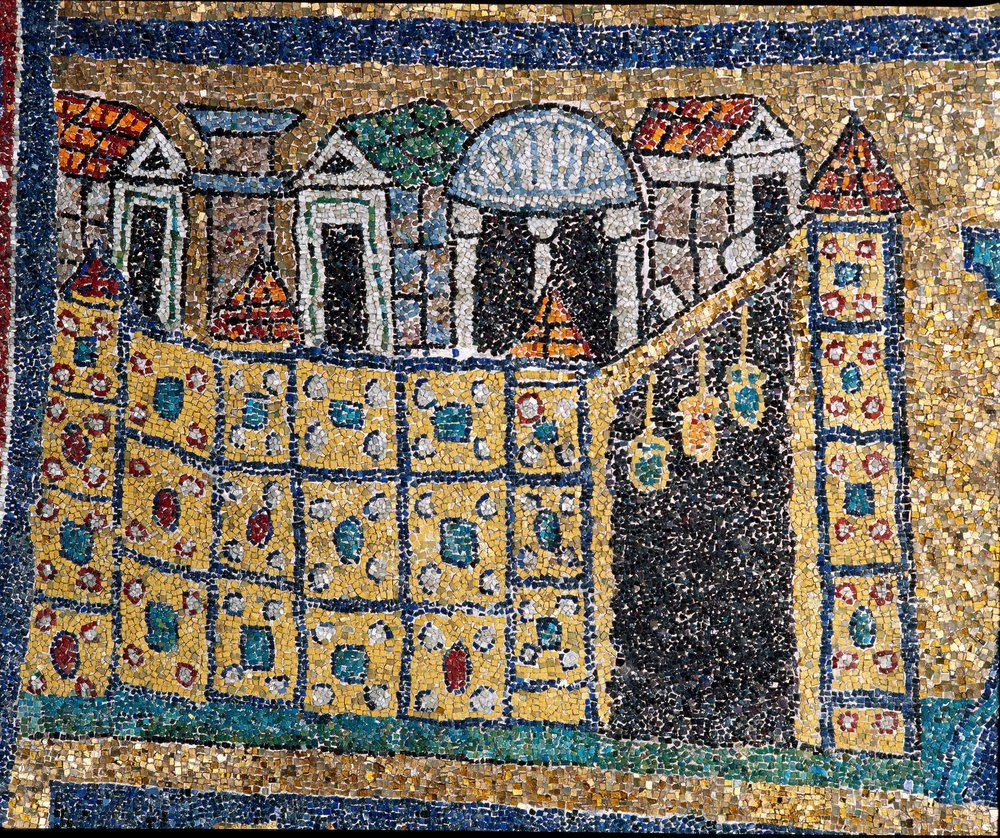
Just as for Augustine and Leo, humanity is called to live in the earthly city, where proud self-love reigns, but with the heart and the mind turned to the heavenly city, where love for God and neighbor reigns, so for Pizzaballa the events of the present time must be lived in the light of the Jerusalem “that descends from Heaven,” described in the last two chapters of Revelation (in the photo, the heavenly Jerusalem in a 9th-century mosaic in the Roman basilica of Saint Praxedes).
And in fact, the letter from the patriarch of the Holy Land is constructed precisely on this bipolar layout. Its first part bears the title : “Reading the reality : considering the present.” The second part is titled “Vocation : God’s dream named Jerusalem.” With a third part dedicated to “living here and now the way of the heavenly Jerusalem.”
Pizzaballa’s description of the current situation in the Holy Land is very realistic : “’Coexistence,’ ‘dialogue,’ ‘justice,’ ‘human rights,’ ‘two peoples and two states’: these terms, which for years have nourished our discourse, today seem worn-out and devoid of meaning.”
But if the gaze is extended to the entire history, read “according to the Scriptures,” the vision changes. If the history of humanity begins in a garden, Eden, in a state of primordial innocence but also of solitude, history ends in a city, the new Jerusalem, which “is not a return to an idyllic and isolated past, but the building of a communal, complex, and reconciled future. The end of the story points toward a mature society – a ‘city,’ in fact.”
Written in simple and compelling prose, Pizzaballa’s letter is worth reading in its entirety. To summarize it would deprive it of its expressive power and the richness of its contemporary references. It can be found on the website of the Latin patriarchate of Jerusalem in five languages : Italian, English, Spanish, French, and Arabic.
> “They returned to Jerusalem with great joy”
But in the meantime, here is a sample. Below are three excerpts from the letter’s second section, plus another excerpt from the third section.
*
From the letter of the patriarch of the Holy Land to the faithful. Four excerpts
by Pierbattista Pizzaballa
The first city mentioned in the Bible is built by Cain (Gen 4:17). After killing his brother, he builds a refuge : a place meant to set a limit to violence, where he can attempt to rebuild lost fraternal relations. In Scripture, the city thus arises as a human attempt to restore coexistence where relationships have been shattered.
The last city in the Bible, by contrast, is the New Jerusalem that descends from heaven (Rev. 21 – 22). Between these two poles – the city-refuge built by humanity out of fear, and the city-gift that descends from God out of love – the whole story of salvation unfolds.
*
“Then I saw a new heaven and a new earth ; for the first heaven and the first earth had passed away, and the sea was no more.” (Rev. 21:1)
The first thing John sees is not the City, but a “New Heaven.” Jerusalem has a heaven. This may sound trite or obvious, but it is its most eloquent distinguishing feature. Its antagonist, Babylon, in Revelation, is also described in every detail. Yet, in Babylon, the sky is never seen. It is a city without heaven, and therefore without God – enclosed within a purely human and earthly horizon, and thus doomed to ruin.
Jerusalem’s heaven, moreover, is quite special : it is a “new” heaven. This is not the first time John speaks of heaven. In chapter 4 of Revelation, the visions begin with a significant announcement : the visionary glimpses an open door in heaven (Rev. 4:1). Heaven is new, then, first of all because it is open. It was opened because the Son of Man, who descended from Heaven, returned to Heaven after the Resurrection, taking humanity with him (cf. Jn. 1:51). The new Heaven is a Heaven already inhabited by humanity.
In this passage, we find an important indication : to build the city, to weave authentic relationships among ourselves and our communities, we must begin with an awareness of God’s presence, with the primacy of God, with faith. God must not be excluded. Jerusalem is not just a matter of political boundaries or technical arrangements. Its main identity – the most important characteristic of the city and of the entire Holy Land – is that of being the place of God’s revelation, the place where faiths are at home.
Even today, this dimension is made tangible and visible, especially in what is considered the Holy Basin, where almost all the main Holy Places are concentrated : the Old City and the Mount of Olives. The public celebrations of the different religious communities, marked by different and sometimes overlapping times, transform the city, especially at certain times of the year, resulting in an extraordinary symphony of different prayers, songs, and liturgies.
It is also common, at the first light of dawn or in the silence of night, to meet men and women of all ages – Jews, Christians, and Muslims – walking through the city’s streets, wrapped in their different cloaks and heading to their respective Holy Places, to join the religious men and women who pray there day and night. The prayers of the different religious communities ultimately set the rhythm of the entire city : they are its breath and light. This is the city’s most beautiful and engaging identity, its most precious characteristic, to be cherished and preserved.
Ignoring this “vertical” dimension of our land, the religious and spiritual sensitivity of the communities that belong to it – Jewish, Muslim, and Christian – is the deepest reason for the failure of the coexistence agreements that have taken place in recent decades. Future ones will also be doomed to failure if the specific, prophetic character of Jerusalem is not taken into account. It must be, first and foremost, a house of prayer for all peoples (cf. Is 56:7).
We do not want to challenge, rather we do indeed confirm, the necessity of the various existing Status Quo accords, which are important for regulating relations among the various communities in the city. However, I believe there is also a need for the courage to embrace a new vision, to build new models of life and relationships where common faith in God becomes an opportunity for encounter rather than for exclusion. Faith opens us to Heaven and the world, where all believers feel urged to bring humanity to God. No project of coexistence in the Holy Land can ignore the vertical dimension, the awareness that this land is, first of all, the place of Revelation.
*
“It has a great, high wall with twelve gates, and at the gates twelve angels, and on the gates are inscribed the names of the twelve tribes of the Israelites : … And the wall of the City has twelve foundations, and on them are the twelve names of the twelve apostles of the Lamb.” (Rev. 21:12 – 14)
What stands out in this description is an apparent inconsistency. The names of the twelve apostles are placed as the foundation of the building, while the names of the twelve tribes of Israel appear on the doors. Chronologically, one would expect the reverse : Israel comes before the apostles. Yet, in the vision of Revelation, the old and the new are neither opposed nor overlapping but are instead recomposed into a redeemed unity. God does not erase history but recreates it by laying new foundations in which nothing is lost, and everything finds its proper place.
Jerusalem thus becomes the fulfillment for both the twelve tribes and the twelve apostles. Only within this City can each one find the meaning of his own history and mission.
This is also a decisive point for us today. Violence often arises from the inability to reread one’s history in a redeeming way. This occurs when memory becomes a hermetically sealed narrative, constructed against the other and defended as an exclusive possession. The earlier preoccupation with ownership as a criterion for defining relationships is also reflected in the relationship with historical memory. There is a tendency to want to own the narrative of events, treating it as territory to be defended, while constantly questioning the other’s historical narrative. In doing so, memory no longer helps improve relationships but instead becomes “toxic memory” that pollutes them. Denying the historical memory of the other is a subtle but powerful form of exclusion.
What is needed instead is a rethinking of the very concepts of “history” and “memory,” and consequently, also of the categories of “guilt,” “justice,” and “forgiveness.” These are what place the religious sphere in direct contact with the moral, social, and political spheres. It is not a matter of denying the facts of the past, but of verifying their interpretations so that these do not violently determine today’s choices. Only through this honest reexamination can one redeem one’s historical understanding for the benefit of all humanity. Schools, universities, cultural centers, movements, and the media bear the primary responsibility for this mission to rethink and heal our collective memory. They can help build a different, positive, and inclusive historical narrative.
This purification is not a diplomatic operation or a political compromise ; it is a deeply spiritual act because it touches the roots of identity and pain. It requires us to allow ourselves to be redeemed by God so that we, in turn, can become instruments and channels of healing for others. Only a redeemed memory can generate a different future. The mission of the Church is to promote a true “purification of historical memory.” St. John Paul II forcefully recalled this during the Jubilee of 2000, when he spoke of the need to purify memory as a deeply spiritual act, capable of touching the roots of identity and pain.
I am well aware that this is an unacceptable topic for many. For some, it may be “too Christian”; for others, it may seem utopian or even something to be outrightly rejected. However, this is the contribution, the mission, that the Lamb leaves to us. It is the witness to which we are called, the “promise and prophecy” that must sustain our pilgrimage in the Holy City, in our Church : to dare to envision a future not born of possession, fear, or vindication, but of the redemption of history. What kind of Church would we be if we did not have the courage to point to a world that is not yet here, but which God promises us, and which we already glimpse on the horizon ?
*
In the first part of this Letter, we spoke of skepticism. It is a widespread sentiment in our communities : skepticism concerning institutions, politics, words, and sometimes even concerning the future. We must recognize, however, that skepticism, when it becomes a permanent attitude, ends up paralyzing us. We are called to respond to this skepticism with trust.
This is not a naïve optimism or an attitude that ignores the harshness of reality. Christian trust is born of faith and is a choice that runs counter to the grain. It is the certainty that God has not abandoned history to chaos and remains close to those who suffer, those who are persecuted, those who are rejected. It is the conviction that a life spent, given for love, is never lost.
Let us think of Abraham and Sarah. Humanly, there was no longer any prospect for them. Yet God visited them and entrusted them with a promise. Trust always comes from a visit from God. Therefore, we must pray that the Lord may continue to visit our communities, our families, our hearts. Only in this way can a hope that does not disappoint be born.
In concrete terms, this trust drives us to support and make visible all the initiatives, people, and organizations in our region that continue to believe in others and promote the art of encounter. But it is not enough to simply follow what others do : we are called to become promoters of this style of presence ourselves, personally embracing the courage of unity.
Some might think these are insignificant gestures, because “nothing will ever change here.” However, even if that were the case, we cannot give up making a difference. We want to be that small, sometimes uncomfortable, presence that refuses to be guided by narratives of hate, but that, with meekness and determination, affirms its own : Christians do not hate. This is our testimony, and it is already a prophecy.
— — — —
Sandro Magister is past “vaticanista” of the Italian weekly L’Espresso.
The latest articles in English of his blog Settimo Cielo are on this page.
But the full archive of Settimo Cielo in English, from 2017 to today, is accessible.
As is the complete index of the blog www.chiesa, which preceded it.