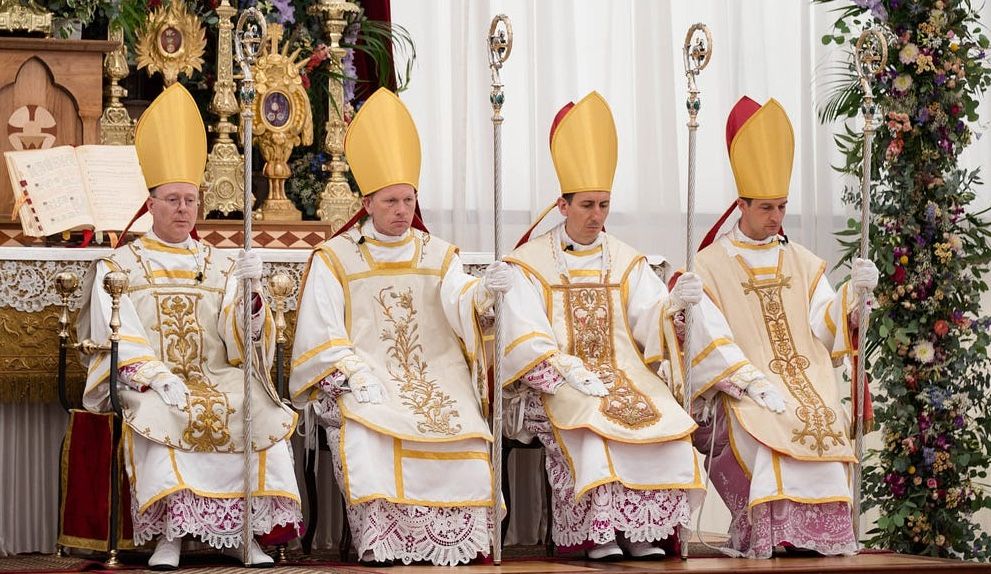
 (s.m.) Settimo Cielo has not published anything as yet on the case, covered widely by the world media, of the schism and excommunication that have hit the Priestly Society of Saint Pius X, founded in 1970 by Archbishop Marcel Lefebvre, because of the ordination on July 1 of four bishops without the pope’s authorization (in the photo).
A similar schism, with the relative excommunication, had already struck the Society on June 30, 1988, then too on account of the ordination of four bishops without papal mandate.
And a few days later, on July 13 of that year, the then prefect of the congregation for the doctrine of the faith, Cardinal Joseph Ratzinger, who was visiting Chile, gave a speech in Spanish to the Chilean bishops in Santiago, analyzing the “deeper causes” of the rupture.
Many years later, that analysis by Ratzinger appears extraordinarily topical. Settimo Cielo offers it to its readers as a key to interpreting the facts, with thanks to the one who first rediscovered and reintroduced it, the Chilean Luis Badilla Morales, in his youth an active opponent of the Pinochet dictatorship and later an important voice of Vatican Radio during the years in which it was directed by Father Federico Lombardi.
Among the reasons for the schism, it is not surprising that Ratzinger should single out the Lefebvrists’ repulsion of the conciliar liturgical reform and their taking refuge in the liturgy of the old rite. This is still an unresolved issue that involves a large part of the Catholic Church worldwide and that saw opposing attempts at resolution by both Benedict XVI and Francis, and on which Leo has foreshadowed a course of wise rebalancing.
The path entered upon by pope Robert F. Prevost remains to be traveled, but it has already received the approval of authoritative churchmen belonging to the camp most attentive to Tradition.
One of these is Cardinal Robert Sarah, former prefect of the dicastery for divine worship, who dedicated his latest book – published in 2025 in the United States by Ignatius Press and in recent days in Italy by Cantagalli – precisely to sacred music and liturgy, in dialogue with Peter Carter, director of the Catholic Sacred Music Project, under the title : The Song of the Lamb.
With accents very much akin to those of Ratzinger, theologian, liturgist, and pope.
*
Reflections on the Deeper Causes of the Lefebvre Case
by Joseph Ratzinger
Santiago, Chile, July 13, 1988
Without a doubt, the problem posed by Lefebvre does not end with the rupture of June 30. It would be too comfortable to give in to a kind of triumphalism and think that this problem ceased to be such the moment Lefebvre’s movement clearly separated from the Church. A Christian never can or should rejoice over a disunion. While the blame certainly cannot be laid on the Holy See, it is our duty to ask ourselves what mistakes we have made, what mistakes we are making. The standards by which we judge the past, since the appearance of the decree on ecumenism of Vatican II, must, as is logical, also apply to the present.
One of the fundamental discoveries of the theology of ecumenism is that schisms can be produced only when, in the Church, certain truths and values of the Christian faith are no longer lived and loved. The marginalized truth is broken away, uprooted from the totality of the ecclesial structure, and around it the new movement is formed. We ought to be made to reflect by the fact that not a few men, beyond the more restricted circle of the members of Lefebvre’s fraternity, see in this man a kind of guide, or at least a useful exemplar. It is not enough to refer to political motives, or nostalgia, or other secondary cultural reasons. These causes would not be sufficient to attract also, and in a special way, young people from many different countries and under completely different political or cultural conditions. Certainly, the narrow, one-sided vision is evident everywhere ; however, the phenomenon as a whole would not be thinkable if there were not also positive elements at play, which generally do not find sufficient vital space in today’s Church.
Because of all this, we ought to consider this situation primarily as an opportunity for an examination of conscience. We must be willing to seriously question ourselves over the shortcomings in our pastoral ministry, which are denounced by all these events. In this way we can offer a place for those who are seeking and asking within the Church, and thus succeed in making schism superfluous, from the very interior of the Church.
I would like to present three aspects that, in my opinion, have an important role in this respect.
A. The sacred and the profane
There are many reasons that may have motivated many people to seek refuge in the old liturgy. A first and important one is that there they find the dignity of the sacred safeguarded.
After the Council, many intentionally elevated “desacralization” to the level of a program, explaining that the New Testament had abolished Temple worship : the Temple veil torn at the moment of Christ’s death on the cross signified – according to them – the end of the sacred. Jesus’ death outside the walls, that is, in the public sphere, is now the true worship. Worship, if it exists, takes place in the non-sacredness of everyday life, in lived love. On the basis of these arguments, sacred vestments were set aside ; churches were stripped, to the extent possible, of the splendor that recalls the sacred ; and the liturgy was reduced, as much as it could be, to the language and gestures of ordinary life, through greetings, common signs of friendship, and the like.
However, with such theories and practices the real connection between the Old and New Testaments was completely disregarded ; it had been forgotten that this world is not yet the Kingdom of God and that “the Holy One of God” (Jn 6:69) remains in contradiction with the world ; that we need purification in order to approach Him ; that the profane, even after the death and resurrection of Jesus, has not become the holy. The Risen One appeared only to those who let their hearts be opened to Him, to the Holy One : he did not reveal himself to everyone. A new space of worship has been opened in this world, to which we are now all directed ; to that worship which consists in coming to the community of the Risen One, at whose feet the women prostrated themselves and worshiped him (Mt 28:9).
I do not want to develop this point more at this time, but just to go right to the conclusion : we must recover the dimension of the sacred in the liturgy. The liturgy is not a festival, it is not a pleasant get-together. It does not matter, not by a long shot, whether the priest is able to convey fanciful impressions or imaginative fantasies. The liturgy is the presence of the thrice-holy God among us ; it is the burning bush, and it is God’s Covenant with man in Jesus Christ, dead and risen. The greatness of the liturgy does not lie in its offering interesting entertainment, but in that we come to be touched by the Totally-Other, whom we cannot cause to come. He comes because he wills. Said otherwise, the essential in the liturgy is the mystery, which is realized in the common rite of the Church ; everything else lessens it. Men experience this vividly and feel deceived when the mystery turns into amusement, when the main actor in the liturgy is no longer the living God, but the priest or the liturgical presenter.
B. The non-arbitrariness of the faith and its continuity
To defend Vatican Council II, against Archbishop Lefebvre, as valid and binding for the Church is and will continue to be a necessity. However, there is a narrow-minded attitude that isolates Vatican II and has provoked opposition. Many expositions give the impression that after Vatican II everything changed and that what came before can no longer be valid, or at best will only be so in light of Vatican II. The Second Vatican Council is not treated as part of the totality of the Church’s living Tradition, but rather outright as the end of Tradition and a starting all over from zero. The truth is that the Council itself did not define any dogma and consciously sought to express itself on a more modest level, simply as a pastoral Council ; however, many interpret it as if it were almost the superdogma that takes importance away from everything else.
This impression is reinforced especially by events that occur in ordinary life. What was once considered the most sacred – the transmitted form for the liturgy – suddenly appears the most forbidden and the only thing that surely must be rejected. Criticism of the measures of the post-conciliar season is not tolerated, but when ancient rules or great truths of the faith are at stake – for example, the bodily virginity of Mary, the bodily resurrection of Jesus, the immortality of the soul, etc. – there is no reaction at all, or only an extremely muted one. I myself witnessed, when I was a professor, how the same bishop who before the Council had dismissed an irreproachable professor for his somewhat brusque manner of speaking, after the Council found himself unable to dismiss another professor who openly denied some fundamental truths of the faith. All this leads many to wonder whether the Church of today is really the same as yesterday, or whether it has been exchanged for another without notice. The only way to make Vatican II credible is to present it clearly for what it is : a part of the whole and sole Tradition.
C. The unicity of the truth
Leaving the liturgical question aside for now, the central points of the conflict are currently the attack on the decree on religious freedom and on the alleged spirit of Assisi. On these Lefebvre draws the boundaries between his position and that of the Catholic Church today. It goes without saying that his assertions on this terrain cannot be accepted. But we will not deal with his errors here ; rather, we wish to ask ourselves where the lack of clarity lies within ourselves.
For Lefebvre, it is a matter of the fight against ideological liberalism, against the relativization of truth. Obviously, we do not agree with him that the text of the Council on religious freedom or the Assisi prayer, according to the pope’s expressed intentions, are relativizations [of truth]. However, it is true that in the spiritual movement of the post-conciliar era there was often a forgetting, even a suppression of the question of truth ; perhaps here we come to the crucial problem of today’s theology and pastoral care.
“Truth” suddenly appeared as too high a claim, a “triumphalism” that could no longer be allowed. This process takes place in a clear way in the crisis into which the missionary ideal and practice have fallen. If we do not aim for truth in proclaiming our faith, and if this truth is no longer essential to man’s salvation, then the missions lose their meaning. In effect, the conclusion was and is deduced that in the future it need only be sought that Christians be good Christians, Muslims good Muslims, Hindus good Hindus, etc. But how can it be known when someone is a “good” Christian or a “good” Muslim ? The idea that all religions are, properly speaking, ultimately just symbols of the incomprehensible is rapidly gaining ground in theology as well and has already permeated liturgical practice. Wherever this phenomenon is produced, faith as such is abandoned, since it consists precisely in that I entrust myself to the truth inasmuch as it is recognized. So we certainly have every reason to return to good sense in this as well. If we manage to demonstrate and live the totality of Catholicism again in these points, then we can hope that Lefebvre’s schism will not be of long duration.
(Translated by Matthew Sherry : traduttore@hotmail.com)
— — — —
Sandro Magister is past “vaticanista” of the Italian weekly L’Espresso.
The latest articles in English of his blog Settimo Cielo are on this page.
But the full archive of Settimo Cielo in English, from 2017 to today, is accessible.
As is the complete index of the blog www.chiesa, which preceded it.