by Sandro Magister
 That morning of Thursday, March 5, Pope Leo’s schedule was packed with high-level meetings : with the president of Austria, the president of Singapore, the governor of Canada, the president of the World Bank.
But also peeking out on the list of audiences were the names of two “professors” unknown to most : Stephen Bullivant and Stephen Cranney.
Yet for the good governance of the Church, the pope was more concerned with listening to them than to those illustrious heads of state. For the same reasons that a few days before, the authoritative cardinal Walter Brandmüller had launched his dramatic appeal from Settimo Cielo : “For the love of God : Lay down your arms !”
The arms are those with which, for decades, the war has been fought in Catholic Church for and against the celebration of the Mass in the old rite, or Tridentine, as it is often called in reference to the Council of Trent. With mutual accusations, some of them very serious, and with the ultra-traditionalist Priestly Fraternity of Saint Pius X, founded by Archbishop Marcel Lefebvre (1905 – 1991), on the verge of rupture if it proceeds as announced to ordain five new bishops on July 1, in disobedience to Rome.
In 2007, Benedict XVI had tried to calm the conflict with the motu proprio “Summorum Pontificum,” convinced as he was that “the two forms of the use of the Roman Rite,” that is, the old and the new, “would enrich one another.”
But Francis, his successor, was of the opposite view. For him the celebration of the Mass in the old rite was just a source of division and coincided with “a rejection not only of the liturgical reform, but of the Vatican Council II itself.” And on July 16, 2021, with the motu proprio “Traditionis custodes,” he restored the new post-conciliar missal to the status of “the unique expression of the lex orandi of the Roman Rite,” leaving the old rite only minimal residual space.
In support of his closure, Francis cited – without publishing them – the responses to a questionnaire he had sent the previous year to the bishops of the whole world.
But in reality, the responses, around a thousand from the more than three thousand dioceses surveyed, attested in the majority to a good relationship between the old and the new rite, with fruits deemed positive, as became known in the summer of 2025 thanks to the publication of the official results of the consultation by two expert vaticanisti, the American Diane Montagna and the Italian Saverio Gaeta.
Pope Leo has not yet spoken. The issue was on the agenda at the consistory he convened on January 7 and 8, with an introductory report signed by Cardinal Arthur Roche, this also very hostile to the old rite, but it was postponed to a later date.
And Leo’s meeting on March 5 with Bullivant and Cranney was desired by him precisely with a view to a peacemaking action on a point as essential to the life of the Church as the celebration of the Eucharist.
To this end, Leo is interested first of all in clearing the battlefield of the inappropriate weapons wielded by both sides : in particular, the accusations against traditionalists of bordering on heresy, which, however, have dubious foundations in reality, having never been certified by real field research.
Bullivant and Cranney are, in fact, the first scholars to undertake a study of this sort, of a scientific character. Bullivant is professor of theology and sociology of religion at St. Mary’s University in London, while Cranney, who is not Catholic, is a researcher at the Institute for the Studies of Religion at Baylor University in Texas. Both will release a book this fall, published by Oxford University Press, entitled “Trads : Latin Mass Catholics in the United States,” which will indeed be the first major sociological study of Catholics who love the Mass in the old rite.
The two scholars previewed some of their research findings in an article on “Substack,” in which they warn right away that the survey ordered in 2020 by Pope Francis had nothing scientific about it, regardless of the use that was made of it afterward.
In particular, they point out that no reliable verification had ever been carried out on the main accusation leveled against the lovers of the old rite : that of not accepting what was established by the Vatican Council II.
Because instead, according to the surveys and interviews conducted by the two scholars on representative samples of Catholics who prefer the Mass in the old rite, among them there is a clear majority of those who accept the Council, broken down as follows in declaring their agreement or disagreement with the statement “I accept the teachings of Vatican II.”
22% Strongly agreed
27% Agreed
15% Somewhat agreed
15 % Neither agreed nor disagreed
10% Somewhat disagreed
7% Disagreed
4% Strongly disagreed
Of course, although a minority, there is also a significant portion who say they disagree with the Council. But Bullivant and Cranney note that it emerges from the interviews that this rejection is directed not so much against the Vatican II documents as such, but rather against the way they were subsequently implemented and interpreted.
Moreover, on the cornerstones of Catholic doctrine, lovers of the Mass in the old rite are much more faithful than Catholics in general.
For example, 95 percent of respondents agreed with the statement “I believe the Pope is the Vicar of Jesus Christ.” This despite the fact that the pope in office at the time of the survey was Francis, the most punitive toward them.
Even more widespread, at 98 percent, is the percentage of those interviewed who believe in the real presence of the body and blood of Christ in the bread and wine of the Mass, when instead, according to a survey by the Pew Research Center, a good 69 percent of Catholics in general consider the Eucharist only a symbol.
Moreover, lovers of the Mass in the old rite are decidedly pro-life. For 85 percent of those interviewed, abortion should be illegal in all cases, and for 13 percent in most cases, while for only 1 percent it should be legal in all cases and for 1.6 percent in most cases.
The research conducted by Bullivant and Cranney focuses primarily on the United States, one of the regions of the world where the Mass in the old rite is most celebrated. It also allowed them to verify its diffusion.
In the United States, the number of parishes of the Priestly Fraternity of Saint Pius X is rather small, with only 103 churches, while nearly 500 normal parishes offer Mass celebrations in the old rite. And there were many more, over 800, before Pope Francis put drastic limits on these celebrations.
In short, Bullivant and Cranney write, “the caricature of the TLM [Traditional Latin Mass] community as near-schismatics threatening the authority of the papacy is itself questionable Indeed, “they hold onto the beliefs of the Catholic faith more consistently than the wider population of Catholics, including regular Novus Ordo Mass-goers.”
And they conclude : “This is a case where sociology and its scientific methods can help the Church make decisions based on facts rather than just impressions or anecdotes.”
As for Pope Leo, who wanted to receive the two scholars in audience, there is value in what one of his confreres who knows him well, Fr. Joseph L. Farrell, prior general of the Order of St. Augustine, said about him in presenting on March 18 a book published by Cantagalli entitled : Leo XIV. Who do you say that I am?:
“He is a methodical man, like a good mathematician : first he listens, then he thoroughly analyzes the idea or argument in question, consults with others, and finally makes a decision.”
And that he already has a path and goal of pacification in mind is clearly evident in what cardinal secretary of state Pietro Parolin wrote in his name in the letter that he sent on March 18 to the plenary assembly of the French bishops underway in Lourdes, which says among other things :
“It is concerning that a painful wound continues to persist within the Church regarding the celebration of the Mass, the very sacrament of unity. Healing it requires a renewed openness to one another, with deeper understanding of each other’s sensitivities — a perspective that can allow brothers, enriched by their diversity, to welcome one another in charity and in the unity of faith. May the Holy Spirit inspire you with practical solutions that generously include those sincerely attached to the ‘Vetus Ordo,’ in harmony with the directives of the Second Vatican Council regarding the Liturgy”.
(Translated by Matthew Sherry : traduttore@hotmail.com)
— — — —
Many wishes for a happy Easter from Sandro Magister !
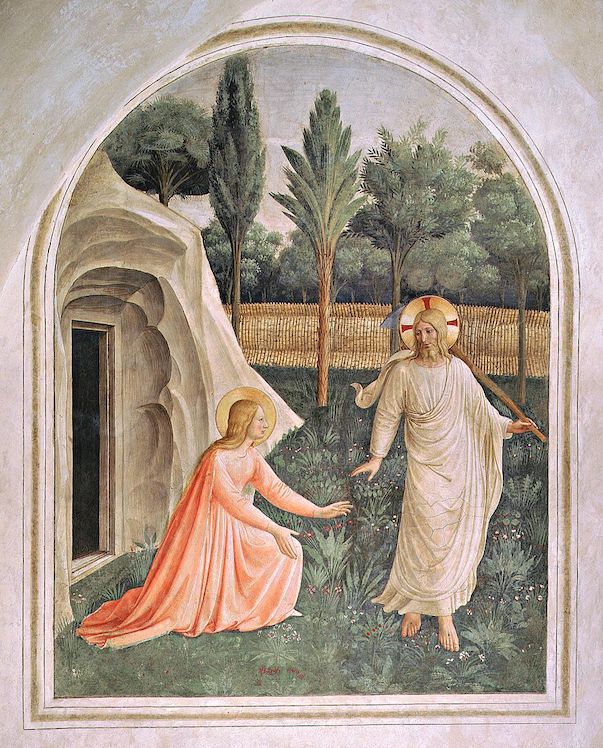
“Et resurrexit tertia die, secundum Scripturas.”
In the painting by Blessed Angelico, the appearance of the risen Christ to Mary Magdalene, Florence, Convent of San Marco, 1438 – 1446.
— — — —
Sandro Magister is past “vaticanista” of the Italian weekly L’Espresso.
The latest articles in English of his blog Settimo Cielo are on this page.
But the full archive of Settimo Cielo in English, from 2017 to today, is accessible.
As is the complete index of the blog www.chiesa, which preceded it.