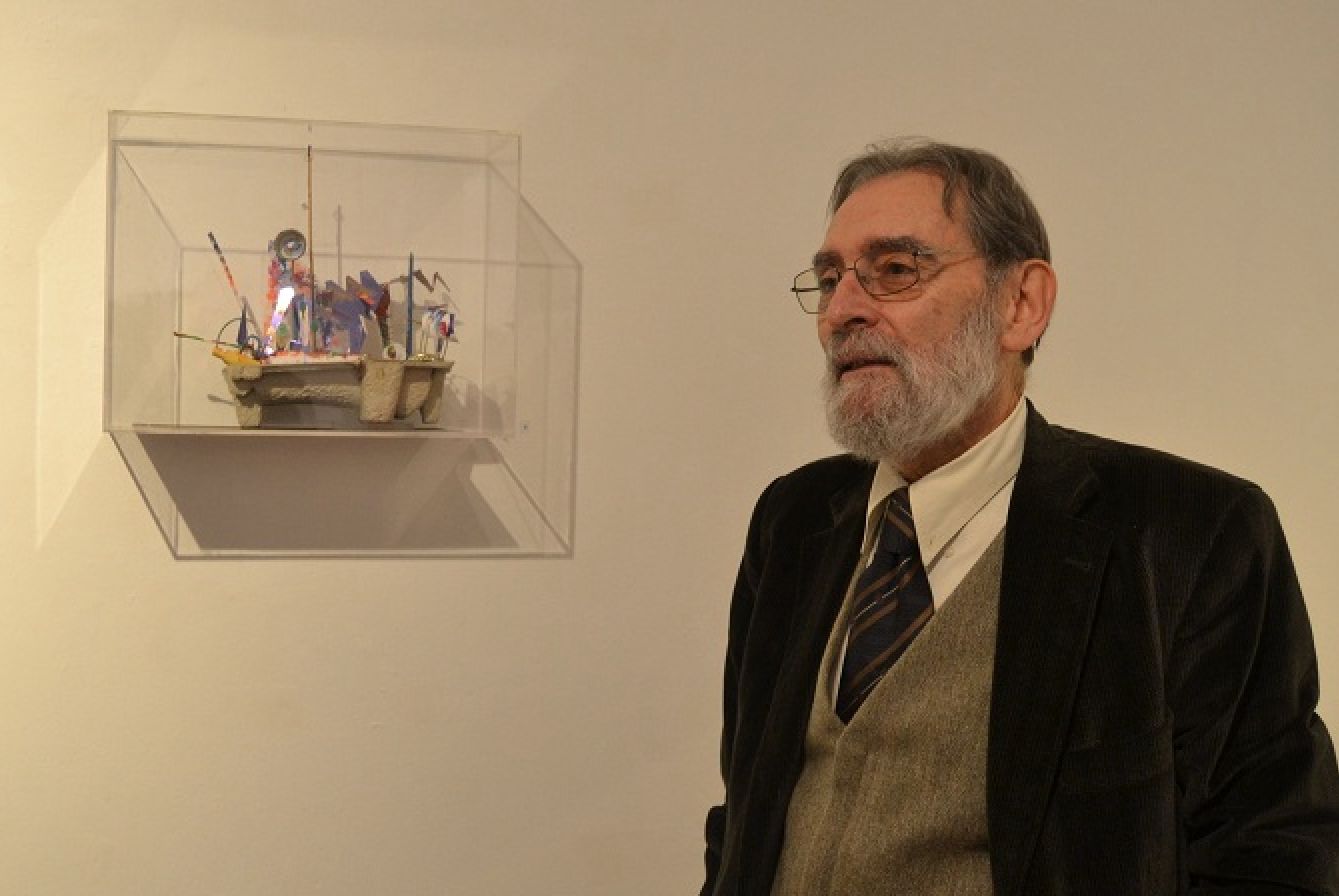
 (s.m.) Published as received. The author of the note, Pietro De Marco (in the photo), 85, a distinguished scholar of philosophy, theology, and history, taught sociology of religion at the University of Florence and at the Theological Faculty of Central Italy.
*
“Are there really only the ‘humiliated Palestinians’?”
by Pietro De Marco
Dear Magister, I am truly grateful for the emphasis you have given to the important pastoral letter of the Latin patriarch of Jerusalem, Pierbattista Pizzaballa, and for publishing the contrasting comments from the Jewish side, by Professor Sergio Della Pergola and Rabbi Alon Goshen-Gottstein.
The image of Jerusalem at the end of time is, in effect, a horizon of marvelous hope. It reminded me that I began contributing to your blog way back in late 2002, proposing a method of theological acceptance and recognition between the two Israeli and Palestinian peoples, or better yet, between their sacred ordinances, and a brief project on Jerusalem. I add – for the reader – that this was not a utopian exercise, which I do not care for, but rather an analogical extension of the high Catholic model of the Concordats to the case of Jerusalem.
But I come to the point. After reading the two commentaries, it must be said that Della Pergola is right on some points, against the opinion of Goshen-Gottstein, who irenically defends the document even against all evidence : from the banal question of whether or not the pastoral letter is a text addressed to everyone – and it certainly is, since, despite its form, everyone can read it, and in the history of the Church, important pastoral letters are universally read – to the delicate point, almost at the outset, of the dual significance of October 7, 2023, for Jews and Palestinians.
The nature of the patriarch’s text – certainly to be contextualized “within the lived social and spiritual reality of the [Christian and Catholic] community,” as Goshen-Gottstein argues – does not render his words innocuous. The incriminated phrase, in which Pizzaballa writes that October 7 – the attack on Israel – “for the Palestinians represents yet another dramatic phase in a long history of humiliation and displacement,” is not an unexceptionably “neutral” way of presenting things. And it is not true that awaiting something more in keeping with the facts is a presumption and a problem on the part of Della Pergola, but not of the ordinary reader. Goshen-Gottstein’s dialectical witticisms do not measure up to the issue, which goes far beyond the letter and involves rights and duties of the Church’s public discourse.
First of all, the patriarch’s phrase is ambiguous : does “yet another dramatic phase” designate the consequences of Hamas’s bloody raid, or rather the Israeli response ? Or is Hamas’s raid itself to be set in series with a long history of oppression, a history that from humiliation and oppression would turn into reaction and violence ? The two interpretations have long been implemented and are easily mixed up by pro-Hamas justificationism.
Naturally, I am the one mentioning Hamas here, a name with which I simplify the mixed composition of the October 7 raiders. Since the pastoral letter lacks this determination, indeed any reference, even a nuanced one, to terrorist organizations based in the Strip, the phrase sounds abstract, pietistic – there are only humiliated Palestinians – extraneous to the truth of the specific facts as well as the entire current and historical situation of relations between Israel and the population of Gaza, including its armed, trained, and fortified components.
If it is true that a dramatic increase in suffering has marked the Palestinians since then, while for the Israelis there is (only?) the trauma of the unprecedented – their own borders violated, ordinary inhabitants (and not soldiers in combat) kidnapped or killed – this state of things has its specific causes in an attack without which nothing would have happened and in a regional power, Iran, on which much, if not everything, depends when it comes to threats to the security and the very existence of Israel.
Without the military response in Gaza, the October 7 raid as such, with the addition of long, costly, and humiliating – for Israel – negotiations for the ransom of the kidnapped, would have turned into a tremendous weakening of the public stability of Israeli society, which has always necessarily been a fighting corps.
A “spiritual” discourse in the merely “religious” context of a very “sui generis” Catholic community, such as that attributed to Cardinal Pizzaballa, cannot, must not touch on these topics ? Are there really only the “humiliated Palestinians,” which, of course, is a good topic for preaching ? When Della Pergola vigorously objects to this and more, it is impossible to count him wrong. I would perhaps contest his pessimism about the future but also the present relations between the Church and Israel.
But Della Pergola’s difficulty with Pizzaballa has long been a Catholic question, at least for some of us. I wrote way back in 2009 that the international community and Europe, and I now add the Church, by dissociating themselves from Israel and making it look as if engaged in a private war, to present themselves as “innocent” to the Muslim world and to the Third and Fourth Worlds in general, were presenting themselves and declaring themselves as powerless, contributing to the strengthening of paramilitary and terrorist jihadism. All of this was duly verified, but it was a banal prediction.
I say now, insistently : can the Catholic Church, Catholic reason, pretend to ignore the historical factuality, taking refuge in exhortations in which, truly, all cows are black, or colorless, as one pleases ? A “religious” exhortation – an ambiguous term – which, among other things, is not its style, but rather that of Protestant pacifisms.
While I still have reason and life, I will not cease to say that it cannot. It is against the truth. If for cogent reasons the truth cannot be told (I see Patriarch Pizzaballa say to me, “You cannot even remotely imagine the situation a Christian authority finds itself in here”), on certain points it would be better to remain silent. For long centuries the Catholic hierarchy was not very talkative on peace and war, leaving the decision to apply the “ius ad bellum” to the temporal sovereign, who assumed responsibility for it.
But the most worrying factors in the recent Catholic reality are others. There is a trend that the pontificate of pope Jorge Mario Bergoglio contributed to legitimizing instead of curbing : the contamination of an “enlightened” secular spirit, of progressive utopianism, of legitimate Christian optimism, and of the primacy of speaking for the benefit of the global media. The resulting speech inevitably becomes “langue de bois,” “political cant,” a manner with guaranteed media results but no political ones.
I say “Christian optimism,” and I mean that this is not always a virtue. I read in the pastoral letter (at the beginning of part two) that Cain built a city to regenerate a supportive community there. I am taken aback : this does not seem like the correct interpretation of that passage from Genesis. An accomplished, non-conservative Hebraist like Luca Mazzinghi wrote some time ago : “Attributing the construction of the first city in history to Cain betrays a negative judgment on the city itself, seen as a place of violence ; violence is at the heart of Cain’s sin and that of another of his descendants, the vengeful Lamech, who takes revenge ‘seventy-seven times’ on those who have offended him (cf. Genesis 4:23 – 24). All this prevents us from having an irenic view of the city – of any city.”
I see that even recent exegesis tends to trivialize the matter : having built a city would have no particular meaning other than the literal one. Augustine saw Cain’s city as the first “civitas,” not the “civitas Dei.” Now, why sugarcoat things ? Were Gaza City and other settlements, with their networks of tunnels, factories, and weapons depots, concentrations of fighters – all known to the inhabitants – agapeic communities ? Neither were and are other cities.
The only holy community is the Jerusalem of Revelation. Certainly, the Church “in mysterio” sets out to converge with it. This tension of an admittedly small Church toward the model of the heavenly Jerusalem is beautifully, I would say magnificently, expressed in the pastoral letter, and does not deserve Della Pergola’s polemical remarks (“If Jerusalem is everything to you, why then are you in Rome?”), which however bespeak the Jew’s legitimate jealousy with regard to Jerusalem, the Beloved.
In short, if Christian optimism is fundamentally to be promoted – and what more and better can a pastor do in an afflicted community ? – the public and “political” word (as it always is) of the Catholic Church must free itself from a speaking and a seeing subordinate to the enlightened classes, for decades “humanitarians” for anti-Judaism, which seem to facilitate its reception but impede, and certainly seriously hinder, its sovereign freedom and duties of clarity, its own, not that induced by universal gossip.
(Translated by Matthew Sherry : traduttore@hotmail.com)
— — — —
Sandro Magister is past “vaticanista” of the Italian weekly L’Espresso.
The latest articles in English of his blog Settimo Cielo are on this page.
But the full archive of Settimo Cielo in English, from 2017 to today, is accessible.
As is the complete index of the blog www.chiesa, which preceded it.