 The 28-point peace plan endorsed by Donald Trump, which is heavily biased in favor of Vladimir Putin, includes among its provisions, along with the introduction of Russian as an official language in Ukraine, the full recognition of the “local section of the Russian Orthodox Church.”
This is a demand that Putin considers essential, having made it back in the very brief and fruitless meeting held in Istanbul on June 2 between Russian and Ukrainian emissaries, reiterating it two days later in his telephone conversation with Pope Leo XIV.
But this touches a raw nerve in religious life in Ukraine. In August of 2024, in fact, a law was passed in Kyiv, no. 3894, which Patriarch Kirill immediately branded from Moscow as “the worst persecution of Christians since the times of Nero and Diocletian.”
And from Rome, Pope Francis also raised his protest, at the end of the Angelus on August 25 : “Please, let no Christian Church be abolished directly or indirectly. Churches are not to be touched!”
Essentially, the new law bans any religious organization in Ukraine that has its “center” in Russia and is “governed” by Russia. Thereby putting on the line the existence of the more populous of the Orthodox Churches present in Ukraine, the one historically affiliated with the Moscow Patriarchate, which instead has no ties to the other, younger Orthodox Church founded in Ukraine in 2018 with the approval of the ecumenical patriarch of Constantinople, with the consequent bitter rift between him and Kirill.
The procedure required by law to ascertain that Church’s effective and ongoing subjugation to Moscow and consequently decide on its ban has not yet been concluded, but in the meantime a very heated controversy has arisen, in Ukraine and beyond.
The heads of other Christian Churches present in Ukraine, including the major archbishop of the Greek Catholic Church, Sviatoslav Shevchuk, expressed their approval of law no. 3894, in the name of “the right and duty of the state to ensure national security, responding to the possible exploitation of religious organizations by aggressor states.”
While many independent and competent observers and analysts believe that it will be hard for this illiberal law, as devised, to pass muster with the international conventions guaranteeing religious freedom, to which Ukraine has also acceded.
But the controversy is even more heated within the very Church that is at risk of being eradicated. The contention has come out of hiding into public view, and has been expressed in opposing statements by authoritative clerics. Two in particular : Metropolitan Sylvester, rector of the Kyiv Theological Academy and archbishop of Bilhorod on the Black Sea coast, not far from Odessa, and Metropolitan Theodosiy, archbishop of Cherkasy in the middle of the country.
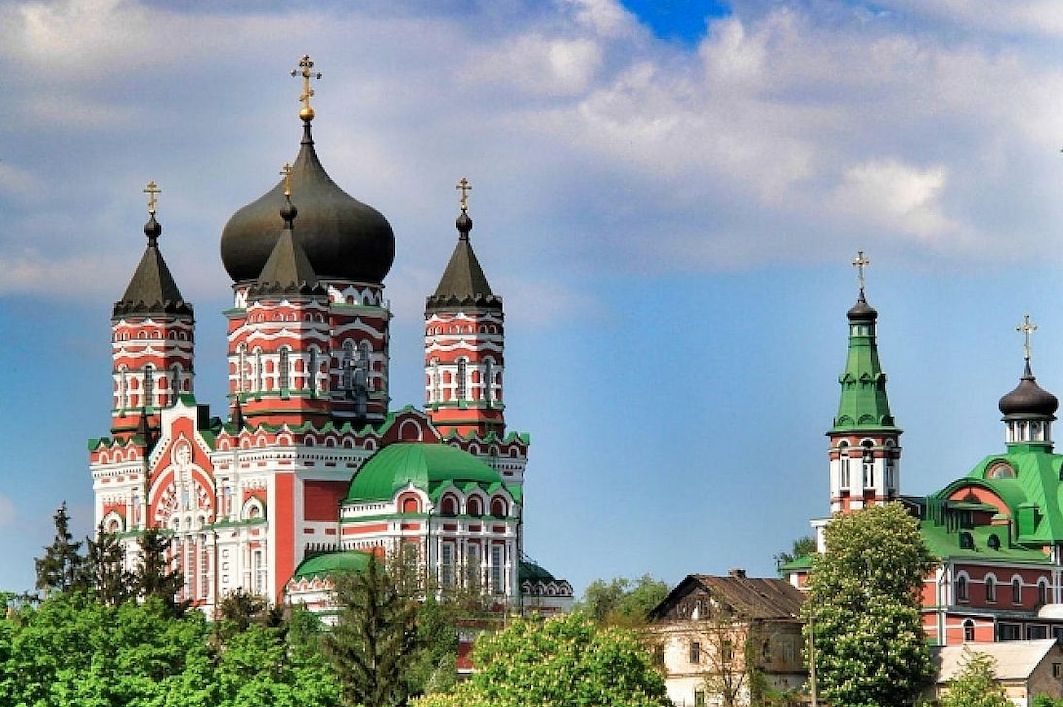
Sylvester represents the great majority of the Ukrainian Orthodox Church, which broke with the mother Church following the Russian aggression of February 2022. And he fully supports what was decided by the Synod of this same Church, headed by Metropolitan Onufriy, on May 27, 2022, at the Feofaniya Monastery in Kyiv (in the photo).
On that occasion, every formula of dependence on the Russian Patriarchate was eliminated from the statutes of this Orthodox Church, it was decided to no longer receive the holy chrism each year from the Church of Moscow, and permission was given to omit from the liturgies the name of Patriarch Kirill, already spontaneously dropped by a large number of bishops and priests after the beginning of the aggression.
What the Synod could not decide – though aspiring to do so – was autocephaly, that is, a state of full autonomy for that same Church. This is because in the Orthodox world any autocephaly, to be valid, must be approved by other sister Churches, in a process that can take years.
But that this is the goal of Metropolitan Onufriy and most of his bishops was confirmed by the solemn liturgy held at the Kyiv Theological Academy on May 27, 2025, the third anniversary of that previous Synod, with Onufriy once again reaffirming “the unequivocal separation from the Church of Moscow” and the hope that “the entire family of ‘autocephalous’ Orthodox Churches will support us morally, approve our independence and register it with due distinction.”
But the trouble is that not even these repeated and convinced acts of independence have sheltered this Ukrainian Orthodox Church from the rigors of law no. 3894, according to which, to ban it, it is sufficient that its dependence continue to be written – as it is – in the statutes of the Moscow Patriarchate.
But there’s more. From Moscow, Patriarch Kirill also translates into practice this claimed supremacy of his.
Of the 53 eparchies, or dioceses, of the Ukrainian Orthodox Church, 10 have now ended up under Russian occupation in the eastern regions of the country : Berdiansk, Horlivka, Dzhankoi, Donetsk, Luhansk, Nova Kakhovka, Rovenkiv, Severodonetsk, Simferopol, and Theodosia. And for each of them neither the Synod nor Metropolitan Onufriy is able any longer to decide anything, to the point of having authorized the respective bishops to act on their own initiative, pending the resumption of contact.
But in fact these 10 dioceses are already fully in the grip of the Moscow Patriarchate, which has even begun removing some of their bishops – starting with Metropolitan Hilarion of Donetsk and Mariupol – and appointing its own of Russian nationality. From Kyiv, Onufriy refuses to recognize these developments, but realistically these dioceses are now considered lost, as it is unlikely that those territories will be restored to Ukraine.
In any case, the highhandedness of the Moscow Patriarchate does nothing but intensify the opposition to Russia in Ukraine, both political and religious. In the judgment of Metropolitan Sylvester, the Russian aggression has marked a “point of no return.” After the end of the war it will no longer be possible or even thinkable that the Ukrainian Orthodox Church should resume canonical subordination to Moscow.
Yet this resumption is precisely the aspiration of that pro-Russian minority of Ukrainian Orthodox given voice to in the public debate by Metropolitan Theodosiy.
Indeed, in Theodosiy’s opinion the Ukrainian Orthodox Church’s subordination to Moscow has not been affected even by the decisions made by the Synod of May 27, 2022 : a Synod, he said, “not free,” conducted under political pressure and even “under threat of arms.” Accusations publicly denied by a dozen bishops but sarcastically reissued on Russian-language Telegram channels, all on Theodosiy’s side.
But if that were really the case – Sylvester objected to Theodosiy – the victory would go precisely to those who want to apply to the Ukrainian Orthodox Church, since it is still formally subordinate to Moscow, the rigors of law no. 3894.
To better understand what could happen if this law were implemented, it must be kept in mind that the Ukrainian Orthodox Church, with the Kyiv Metropolitanate as its administrative body, does not have the status of a legal person, but is recognized as the religious association of the several thousand legal persons that are its dioceses, parishes, monasteries, seminaries, schools, confraternities, and so on.
If, therefore, the investigative organ that embodies law no. 3894 were to determine that even a small number of these legal entities act in subordination to the Moscow Patriarchate, the Kyiv Metropolitanate under which they are grouped would also lose its state registration, if it did nothing to eliminate such subordination.
And vice versa, if the investigation were to accept the thesis that the Kyiv Metropolitanate is still formally affiliated with Moscow, the ban would be applied not only to the metropolitanate but to the thousands of dioceses, parishes, etc. associated with it.
In short, in the design of a postwar Ukraine this uncertainty over the future of its larger Orthodox Church must also be resolved. Certainly not by giving in to the demands of Putin and Kirill.
(Translated by Matthew Sherry : traduttore@hotmail.com)
— — — —
Sandro Magister is past “vaticanista” of the Italian weekly L’Espresso.
The latest articles in English of his blog Settimo Cielo are on this page.
But the full archive of Settimo Cielo in English, from 2017 to today, is accessible.
As is the complete index of the blog www.chiesa, which preceded it.