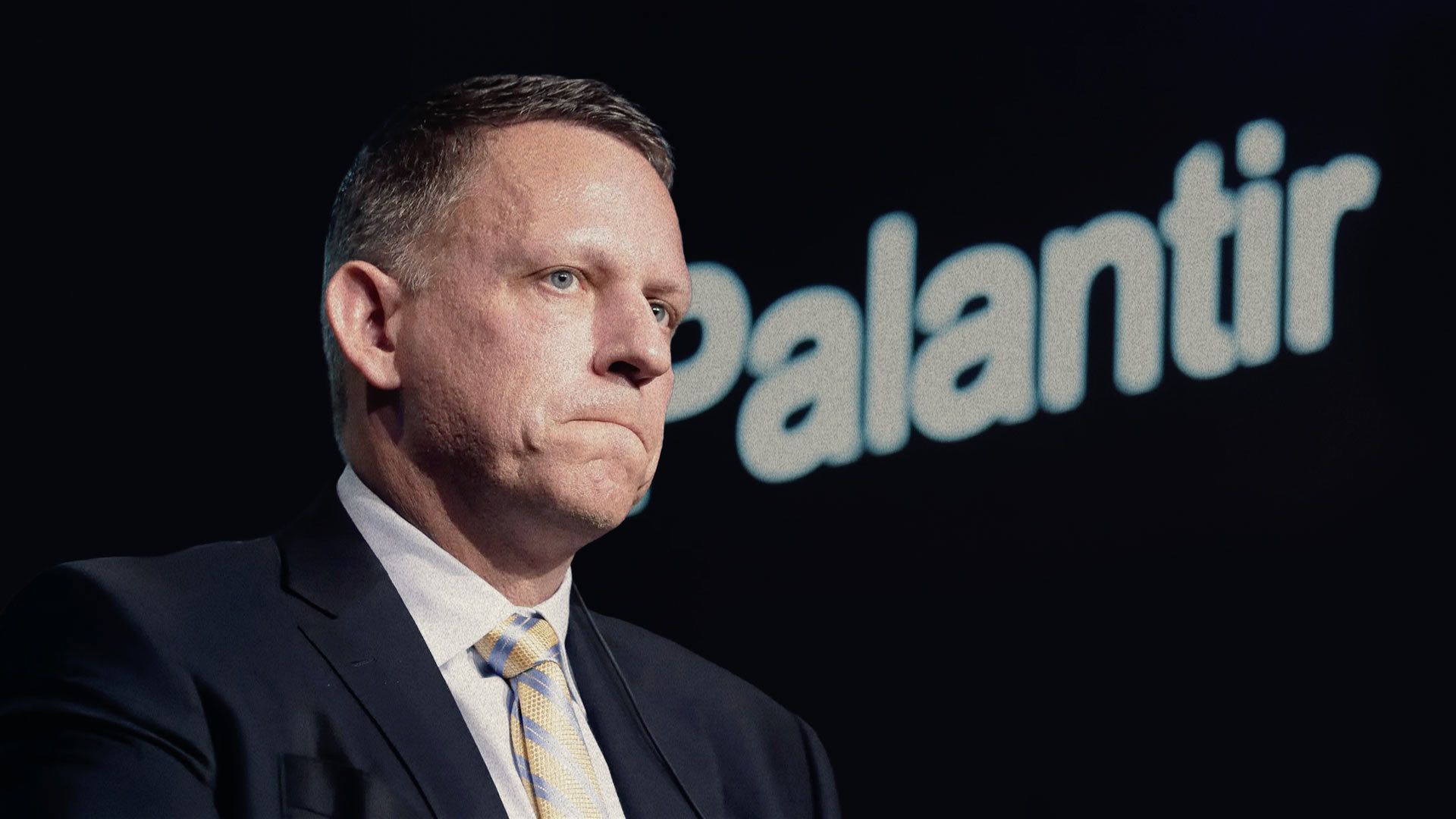
 Published by Harper, the book has come out in which United States Vice President JD Vance tells the story of his conversion to Catholicism : “Communion : Finding My Way Back to the Faith.”
Born and raised Protestant, gone over to atheism in 2006, and finally baptized in the Catholic Church in 2019, Vance recalls as one of his turning points having heard a talk by Peter Thiel (in the photo), a leading Silicon Valley entrepreneur and founder of Palantir, a genius of artificial intelligence but also passionate about philosophy and theology, who “openly identified as a Christian.”
Thiel played a decisive role in promoting Vance’s political career, particularly in bringing him closer to Donald Trump, but he was also his teacher in inspiring his marked attention to the French anthropologist and philosopher René Girard (1923 – 2015), long a professor at Stanford, and his scapegoat theory.
In short, at the heart of this theory is the idea that human desire is fundamentally mimetic and therefore prone to violence against those who share the same desires. But while for Girard, the sacrifice of the scapegoat is the cure for this violence, for Thiel, technological monopoly is the only way out of the mimetic violence of the market.
This view of Thiel’s, initially tested with Facebook and PayPal, marked a cultural shift in Silicon Valley, shared by a growing group of entrepreneurs : from Elon Musk with Tesla and SpaceX, to Reid Hoffman with LinkedIn, to Chad Hurley, Steve Chen, and Jawed Karim with YouTube.
On the horizon, this new culture sees the rise of a sort of post-humanism, in which technology surpasses the biological and social limits of the human being.
But how compatible is this new culture, which Vance also breathes, with the Christian faith and its vision of man ?
A critical response to this question comes in an essay published in France in “Le Grand Continent” and then in Italy in “La Rivista del Clero Italiano,” published by the Catholic University of Milan, by the Franciscan Paolo Benanti, a renowned scholar of artificial intelligence and an advisor to Pope Leo, who touched on precisely these questions in his recent encyclical “Magnifica humanitas.”
So let us go over Benanti’s critical analysis.
Peter Thiel, he writes, “understood before many others that in the digital age, true power no longer lies in control of the means of production, but in control of the means of imitation and connection.”
What is happening is now clear : “Facebook has invaded human relationships. LinkedIn has mapped and structured the professional world. YouTube has democratized video production. Palantir – founded by Thiel with the support of the CIA – has introduced the logic of data analysis into the very heart of intelligence and military apparatuses.”
Thus, “a new sovereignty has been established : computational power.” These enterprises “are not just an economic model ; they constitute an asymmetric act of war against the established order.”
The creation of parallel economic universes constitutes the most tangible expression of this : “PayPal is born to make the traditional banking system obsolete ; Amazon disintegrates physical commerce ; Google takes away the media’s monopoly on access to knowledge ; Tesla challenges the automotive industry based on fossil fuels.”
The question that follows then is this : “How can such alternative and disruptive power still be integrated into democratic structures?”
Indeed, Benanti writes, “Thiel’s heresy doesn’t stop at economics : it extends to the very structure of political power, drawing on the prophecy formulated by William Rees-Mogg and James Dale Davidson in 1997’s “The Sovereign Individual,” the book with a preface by Thiel that is venerated in Silicon Valley as a sort of founding text,” which “depicts a world in which democratic politics is only a vestige.”
But there’s more. And it is here that Thiel the theologian takes the field, in his recent essay in “First Things,” entitled “Voyages to the End of the World,” written with Sam Wolfe, in which “the contestation of democracy takes on an explicitly apocalyptic form.”
Benanti, who reviewed this essay in a previous article in “Le Grand Continent,” writes : “Thiel rereads scientific modernity – inaugurated with Francis Bacon’s “New Atlantis” – not as a process of emancipation, but rather as a sacrilegious project aimed at abolishing God.”
In placing the figure of Bacon’s ruler beside the biblical Antichrist who falsely promises peace and security, Thiel “seems to consider this fate inescapable.”
His view of history is not linear, but cyclical. “What Thiel envisions is not the Christian ‘parousia,’ that is, the final event that redeems history by interrupting it, but a simple rebirth within the Girardian cycle of mimetic violence.”
Salvation can come – Thiel theorizes – “only from a centralized, all-encompassing power, from a despotic world government.”
And this is Palantir’s mission : “a machine capable of identifying and neutralizing threats before mimetic violence explodes.” And at the same time “Salomon’s House,” which “confers on an elite an almost divine power of surveillance and prediction.”
Cloaked in theology, this would be Thiel’s “political heresy.” Benanti concludes : “By accepting Thiel’s technology, particularly through Palantir, institutions implicitly adopt his diagnosis : society is a mimetic mass incapable of self-government, and the only alternative to apocalypse is a technocratic order imposed by an elite of sovereigns.”
In the future race for the presidency of the United States, how much credence will the Catholic JD Vance want to give to this heresy of his teacher Thiel ?
(Translated by Matthew Sherry : traduttore@hotmail.com)
— — — —
Sandro Magister is past “vaticanista” of the Italian weekly L’Espresso.
The latest articles in English of his blog Settimo Cielo are on this page.
But the full archive of Settimo Cielo in English, from 2017 to today, is accessible.
As is the complete index of the blog www.chiesa, which preceded it.