 The broad and dense pastoral letter from the Latin patriarch of Jerusalem, Cardinal Pierbattista Pizzaballa, published on April 25 of this year, has drawn much attention in the Christian community, also in the upper ranks of the Church. Proof of this is the opening editorial in the latest issue of “La Civiltà Cattolica,” printed, as always, with the “visa” of the highest Vatican authorities and signed by the Jew and Jesuit David Neuhaus, entirely dedicated to highlighting the letter’s essential elements and its statement of hope : “The Church of Jerusalem, small and resilient, finds itself living here and now the way of the heavenly Jerusalem : being a welcoming place, an Easter light that illuminates the darkness of resentment ; being a home with open doors, an instrument of healing in the world.”
Neuhaus is known for having written a number of times, with undeniable expertise, on the Israeli-Palestinian question. Regarding the final solution to the interminable conflict, for some time he has been skeptical of the “two peoples, two states” hypothesis. His hope is for a single state for both peoples, with equal rights for all. But he is also disliked by many Jews for having equated early Zionism with late nineteenth century European colonialism.
In his editorial, Neuhaus also introduces interesting information on the composite nature of the diocese to which Pizzaballa addressed the pastoral letter.
He notes that ten years ago, when Pizzaballa was put at the head of the Latin patriarchate of Jerusalem, “although he spoke fluent Hebrew, he did not know Arabic, and the pastoral life of the largely Arabic-speaking local Church was a challenge for him.”
This is because “the parishes, spread across four territories, are clearly distinct from each other on the political, social, and cultural levels. Most of them are Arabic-speaking and are located in Jordan, Palestine, and Israel. Among the faithful are Palestinians – who in Palestine live under occupation, in Israel as citizens, sometimes perceived as ‘second-class,’ of a state that defines itself as Jewish, and in Jordan as Jordanian citizens displaced from their Palestinian homeland – and Jordanian faithful, many of whom come from Christian Bedouin clans. Moreover, in Israel there are small Hebrew-speaking communities. Far more numerous, however, are the vibrant but precarious communities of migrant workers, refugees, and asylum seekers, present throughout the territory of the diocese.”
But there’s more. Patriarch Pizzaballa’s pastoral letter has also sparked conflicting assessments among Jews in Israel and the diaspora.
On May 19, Settimo Cielo published the harshly critical commentary of one of the most authoritative Israelites, Sergio Della Pergola, professor emeritus at the Hebrew University of Jerusalem and a world-renowned scholar of Jewish demography and sociology.
Entirely unacceptable for Della Pergola is above all that passage in which Pizzaballa writes that October, 7, 2023 and the subsequent war in Gaza “for the Palestinians represent yet another dramatic phase in a long history of humiliation and displacement.”
The fact that Pizzaballa, a few days after that October 7, had offered his life in exchange for the release of the Jewish children held hostage in Gaza did not attenuate Della Pergola’s criticism, for whom the patriarch’s letter “closes the way to any possible future joint reflection or dialogue between the Catholic and Jewish sides about October 7, on the before and after.”
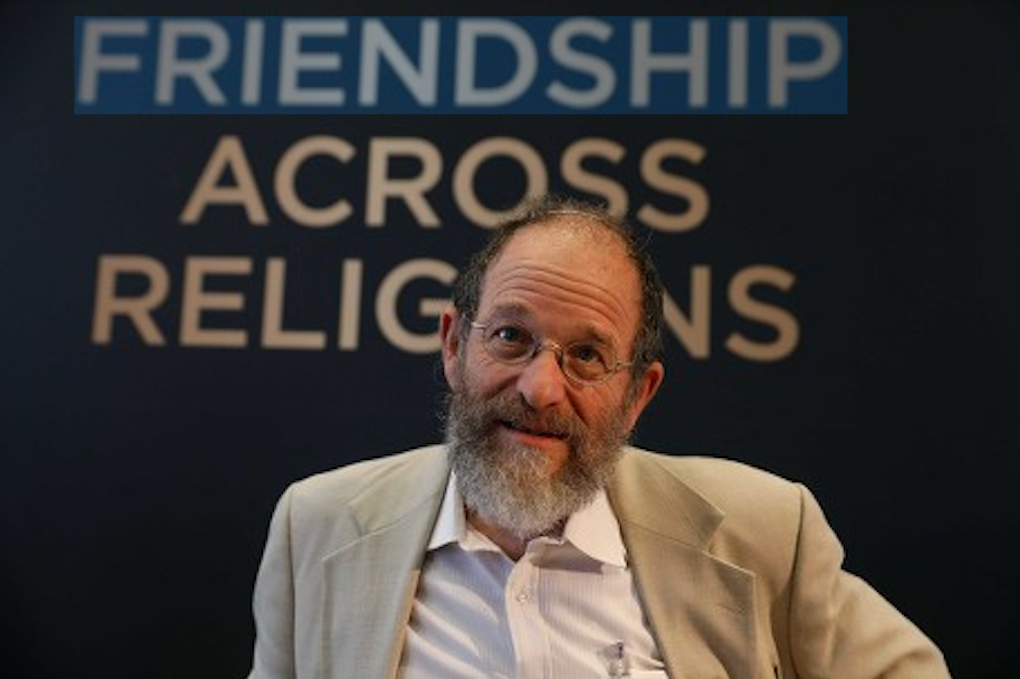
But such is not the thinking of another eminent Israeli scholar, Rabbi Alon Goshen-Gottstein (in the photo, copyright Rex Shutterstock), founder and director of the Elijah Interfaith Institute and highly engaged in the dialogue between Jews and Christians, who has sent to Settimo Cielo a timely reply to Della Pergola, which he entitled : “We Must Learn to Hear What the Other is Really Saying.”
This title, Goshen-Gottstein writes, “refers to the obligation to truly hear what the other is saying and not to project upon him our own interests and world views.” But “this hermeneutical approach, which would seem basic to any reading of a text belonging to another religious tradition, is seriously lacking in the response issued by Prof. Della Pergola,” perhaps on account of his academic specialization in demography and statistics, when instead “it may require a theologian, or a person with better training in the reading of religious texts, especially of the faith of the other, to appreciate the message of the Cardinal’s letter in context and to correct the distortions that Della Pergola attributes to it.”
In his reply, it is interesting first of all to note how Goshen-Gottstein summarizes Pizzaballa’s pastoral letter and identifies its “core.”
In its first part, he writes, the letter reviews “a multitude of issues, too many, in my opinion,” that “provide the background for a spiritual message Pizzaballa seeks to offer his community.”
The second part of the letter instead constitutes “its core and justification. Based on a reading of the book of Revelation, the final book in the Christian canon, the Cardinal seeks a way of relating heavenly and earthly Jerusalem.” But take note : “not within the context of the political realities of the Christian community but within the lived social and spiritual reality of the community.” Because Pizzaballa’s theological outlook “is highly rarified,” also “as a contribution to contemporary theological thinking,” to the point that “I ask myself how many within the community, even within its leadership, are capable of following the nuanced and refined spiritual view.”
Finally, in its third part, the letter “seeks to translate the message of the second section into practical guidelines for how the Christian community should live as a minority in this land.” With a fundamental role accorded to interreligious dialogue.
In the whole letter, “perhaps too long at nearly 18,000 words,” the “core” is therefore the second part, biblical in character. “In short, this is an internal document with a clear spiritual vision intended to give hope and meaning to the local Christian community.”
Having set out these important preliminaries, Goshen-Gottstein then reviews the main points of contrast between his interpretation of the pastoral letter and that of Della Pergola.
The first point of contrast is Della Pergola’s skepticism about the real nature of the letter, which he says “does not seem like a simple diocesan document to be distributed to a few thousand faithful,” but rather “a summary of the reflections developed over 35 years of pastoral activity, almost as if it were a legacy, a program, to be handed down to everyone.”
In Goshen-Gottstein’s judgment, Della Pergola is wrong to favor his demographic assessments on the small number of the faithful to the point of doubting that Pizzaballa’s letter is truly addressed to them, but is instead something more ambitious, for a much wider audience.
A second point of contrast is Della Pergola’s recognition that the letter “is explicitly a spiritual guide and not a geopolitical analysis,” but at the same time doubting that “the two sides can remain disconnected.”
Goshen-Gottstein agrees that “the core challenge of this letter” is precisely “whether politics and spirituality can be fully divorced,” But “it does not invalidate the attempt” of Pizzaballa to “highlight the challenge and open the door to further reflection. It may be that the ability or inability to separate, and then reintegrate, both domains, is itself a point of divergence between a Jewish and a Christian perspective. This is where one needs to listen to the other, not to invalidate the other.”
Another point of contrast is identified where Della Pergola gathers from the document “the impression that Jerusalem is the most important place in the world for the Catholic faith, and one might therefore ask what role Rome plays in this regard.”
And here Goshen-Gottstein objects that Della Pergola “is unable to distinguish between a spiritual and a political message.” A misconception all the more “curious, inasmuch as 2,000 years of Jewish exile have actually taught us Jews how to live in such a split reality.”
But there is yet another point that marks the strongest cause of contrast between the two eminent Israelites.
This is the point on which Della Pergola wrote verbatim, in his commentary published on Settimo Cielo :
“In the opening of the first part of the letter, Pizzaballa states that ‘October 7, 2023, and the war in Gaza meant something different and disruptive for each of the two peoples living in this land.’ In the following order : ‘For the Palestinians, these events represent yet another dramatic phase in a long history of humiliation and displacement. For the Israelis, on the other hand, these events represent something unprecedented, a violence that has brought back the horrors that occurred in Europe eighty years ago.’
“Here Pizzaballa loses me as a reader, when he thus describes events that unfolded in a dramatically reversed order, and with different actors. October 7 is, indeed, a historic ‘watershed,’ but pay heed, in a completely different way than the cardinal describes it. For Jews, October 7 represents a brief repeat of the Shoah, eighty years after the true and unique Shoah : a barbaric and monstrous massacre of civilians in their homes. But for Muslims, it represents the choice of unheard-of violence to assert their absolute and exclusive ownership of the territory, to obliterate Israel and erect an Islamic Caliphate in its place. The reversal of the order of events and the twisting of the facts constitutes an important narrative choice. Given that there are more than two possible narratives, the choice made here for the one excludes the possibility of the second. The cardinal’s choice closes the way to any possible future joint reflection or dialogue between the Catholic and Jewish sides about October 7, on the before and after.”
And this is Goshen-Gottstein’s reply :
“This is the key paragraph in Della Pergola’s objections and its claim is that Pizzaballa is somehow taking sides, preferring one narrative over the other. This is a highly tendentious, and misleading, reading. I can’t think of a more neutral way to try to present both perspectives. One of the main issues that Jews have had since October 7th is the sense that the world does not recognize the depth of our trauma on October 7th. The Cardinal does. He is explicit about this later on : ‘Israeli society has been traumatized since October 7, 2023’. I cannot find a meaningful difference between what the Cardinal stated and what Della Pergola would have liked him to have stated. That a larger political vision lies behind the Hamas attack is simply irrelevant. Pizzaballa states that this is a watershed moment for both communities, each for its own reason, offering the deepest and most sympathetic appreciation for the Jewish side. So is the problem that he didn’t express himself in the specific political context that Della Pergola would have liked ? This is Della Pergola’s problem, not the Patriarch’s. If anything, an unbiased reading of the letter reveals just the opposite. Della Pergola makes much of whose side is being told first, as though that shows Pizzaballa’s sympathies. The truth seems to be the reverse. The rhetoric of presenting the Israeli side is far more powerful and more evocative. It comes second because of the rhetorical effect of ‘upping the ante’, in other words, leaving the more powerful element to the end. Whereas for Palestinians it is part of an ongoing issue, for the Jews it is unique and unprecedented. This is an expression of deep understanding and empathy ; not of taking sides. Della Pergola has taken a rhetoric strategy that constitutes one line within an 18,000 word document and let that define the entire document for him. Or as he puts it, he lost the Cardinal then and there. There is therefore nothing further to read or think about. Intellectually, this is poor and dishonest. In terms of Jewish-Christian relations, this is destructive”
In concluding his reply, Goshen-Gottstein writes that Della Pergola’s commentary has done serious harm to Jewish-Christian relations, “in a very difficult time for Jews worldwide,” with growing waves of anti-Semitism. “We need friends. We do not need to turn friends into enemies. This is true for the Cardinal, but even more so for the Catholic Church, parts of which are slowly turning against us. How we listen and how we respond are therefore vital factors in determining not only Jewish-Christian relations but the quality of Jewish existence in various parts of the world.”
In expressing the hope that “the wrong impression generated by Della Pergola’s one-sided comments be set straight,” Goshen-Gottstein writes that the professor and the patriarch “perhaps should get together again for the purposes of understanding each other,” alluding to previous meetings between the two, the last a year ago, “among friends of old.”
And he continues :
“But beyond correcting the harm caused by Della Pergola’s quick and partial response, there is a larger question that emerges from the Patriarch’s document : What is the spiritual vision that each of the communities holds for Jerusalem and what room does the other faith have in this vision ? Della Pergola seems to allude to this at the end of his piece when he states : ‘The possibility of someone else who can cultivate ideals of spiritual heritage concerning the same land – and how to make these competing ideals compatible – is not considered’. It is not considered because this is not the purpose of the letter. But it is certainly its implied invitation. The Patriarch has put forth a spiritual vision for Jerusalem. Can we Jews (and eventually Muslims) articulate our own vision for a spiritual Jerusalem that makes room for the other ? Present-day reality in Jerusalem seems to suggest the Cardinal is light years ahead of Jewish religious leadership in this respect. But must it be so ?
“Della Pergola seems to suggest there is a Jewish spiritual alternative that he does not articulate, nor is it for him to articulate. The great invitation of this document and this debate is for leaders, visionaries, and theologians of the different religions to come together, in order to reflect on the spiritual vision offered by the Patriarch and what alternative, parallel or identical visions they might offer. This would elevate the conversation from bickering over the impact of rhetorical strategies to the kind of meaningful interreligious exchange that this letter calls for. If Della Pergola’s voice was heard within Jewish circles, I would hope my voice also gets a hearing and that an invitation will be issued by the appropriate representative body or synagogue, to hold such a conversation. This is how friendships are made and reinforced. This is also how to live a piece of Heavenly Jerusalem down on earth, wherever it may be.”
— — — —
Sandro Magister is past “vaticanista” of the Italian weekly L’Espresso.
The latest articles in English of his blog Settimo Cielo are on this page.
But the full archive of Settimo Cielo in English, from 2017 to today, is accessible.
As is the complete index of the blog www.chiesa, which preceded it.