 (s.m.) There is a word that for years has been rife in discussions in the Church, but on the meaning of which there is not a bit of clarity ; indeed, it is ever less clear as the discussion goes on, started by Francis and left to his successor Leo, complete with a multi-stage synod dedicated to it, underway since 2021 and whose end is yet to be determined.
It is the word “synodality.” Which comes from “synod,” an institution dating back to the first centuries of the Church, made up of bishops only, but which today many would like to expand to more members, in the most varied forms, as if the Church were a modern democracy with voting rights for all, even on matters of doctrine.
For some time, however, bishops and cardinals have been increasingly calling for clarity to overcome this confusion. And Pope Leo shows that he is taking this into account, seeing how he is stemming the tide. Not by speaking out loud, but by acting.
On the one hand, in fact, he is denying the German bishops, now many months after their request, his approval for the launch of a permanent “Synodal Conference” made up of twenty-seven bishops, twenty-seven members of the committee of German Catholic laity, and twenty-seven other elected Catholics, all with equal voting rights and not only consultative but also deliberative powers on “important issues of ecclesial life of supra-diocesan relevance.” Scheduled for November 6 in Stuttgart, the debut of this body has been postponed to an unspecified future, which will probably never come to be.
But beyond curbing the excesses of the innovators, Leo also shows that he means to strengthen the old-style synods, on the classical model, like those made up only of bishops that govern the Eastern Catholic Churches, including the major archbishoprics, as in Ukraine. With a motu proprio on August 29, the pope in fact extended the decisional authority of these synods to the removal of their respective patriarchs, should “the sacred bond between the ‘pater et caput’ and the other bishops be irreparably compromised.”
But the fact is that nothing of all that has to do with synodality excites or mobilizes the mass of ordinary believers, who are completely indifferent to the ongoing discussion on such a confused matter.
But here, with this text on Settimo Cielo, a voice of crystalline clarity intervenes, finally saying in a few words and with dazzling references to history what an authentic “synod” is and must be in the Church.
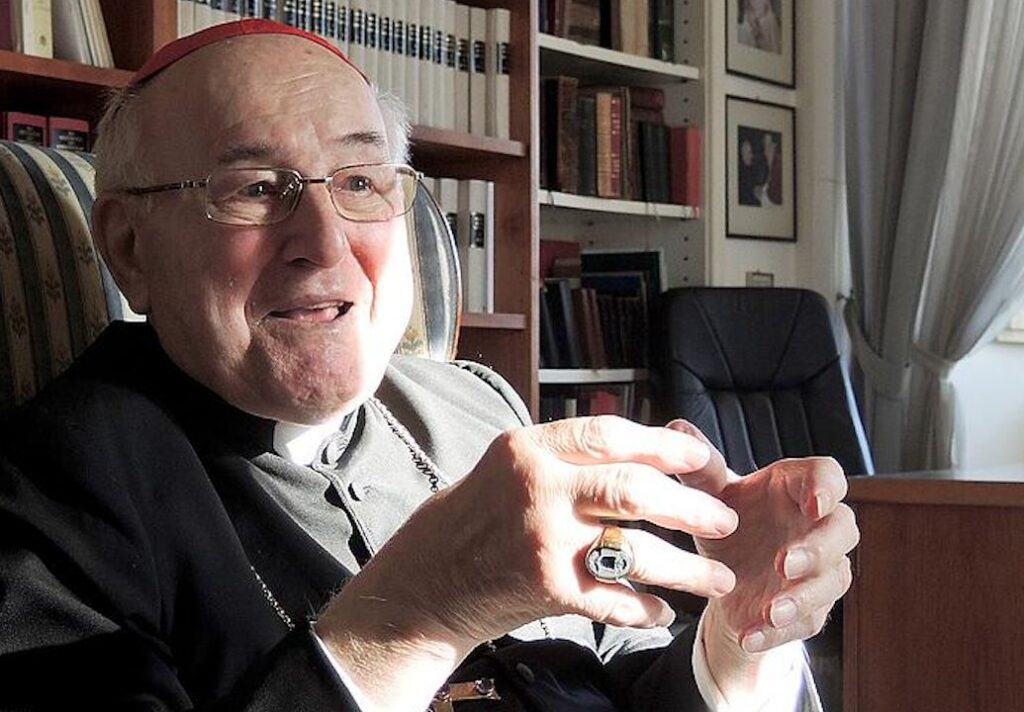
It is the authoritative voice of Cardinal Walter Brandmüller (in the photo by Lena Klimkeit, copyright Picture Alliance/Dpa), from the height of his magnificently borne 97 years and his recognized expertise as a Church historian.
Happy reading !
*
Regarding “Synodality”
by Walter Brandmüller
Beginning with Pope Francis, there has been more and more talk about “synodality,” in different contexts and with different meanings. But a clear and unambiguous definition of this word is still lacking. To the point of bringing to mind the famous dialogue between Mephistopheles, dressed as a professor, and the student in Goethe’s "Faust." Mephistopheles says : “All in all, keep to words ! Then you will go through the secure gate to the temple of certainty.” The student : “But a concept must accompany words.” Mephistopheles : “Fair enough ! Only one mustn’t worry too much about it, for just where concepts are lacking, a word comes along in good time.”
Precisely to avoid Mephistopheles’s traps, it is good to recall a clear definition of synodality, but above all of synod.
According to the classical Catholic understanding, the synod is a meeting of bishops for the purpose of jointly exercising their magisterial and pastoral service.
If all the bishops of the Church are invited to participate and they meet under the presidency of the pope or his delegates, it is a general, or “ecumenical” council, which – “cum et sub Petro” – holds the highest magisterial and pastoral authority and proclaims definitive and infallible doctrines, which must be accepted in obedience of faith.
If, however, those who meet are the bishops of a group of particular Churches – an ecclesiastical province, ecclesiastical region, etc. – that particular council has only a “magisterium ordinarium,” and its decrees require confirmation by the Holy See.
In both cases, the bishops act by virtue of the magisterial and pastoral power they received with sacramental ordination.
Paul VI, with the motu proprio "Apostolica Sollicitudo" of 1965, created what is called the synod of bishops – “Synodus episcoporum” – as a consultative body for the pope (1).
But without wishing to question the need or appropriateness of such a body, since the participants are convened individually by the pope each time and their task should be that of advising the pontiff and not of proclaiming doctrines, deciding or legislating, for the sake of conceptual clarity it would be appropriate not to use the term “synod” – which in this context can lend itself to misunderstandings – but to find a different and more appropriate name.
The same applies to recently established bodies, which, in addition to bishops, also include priests and faithful of both sexes, who are meant to represent the whole people of God (2). Also in this case one cannot speak of a synod, given that neither priests nor lay people can exercise the magisterial and pastoral ministry conferred only on bishops with the sacrament of orders.
Of course, it is possible to entrust a consultative role to competent laypeople. But if such collaboration were to be practiced, any misleading use of the terms “synod,” “synodality,” and the like should be carefully avoided, and instead a term should be found that adequately expresses the real situation.
It is evident that the establishment of bodies of the type just mentioned arises from the effort to more or less acritically adopt secular structures and democratic procedures in ecclesial life, in order to stay in step with the times.
But in fact a type of synod is being proposed in the Catholic sphere, inspired in part by the Protestant model, whose members are democratically elected from among pastors, men and women of various professional expertise and cultural contexts, all with an equal say. It was Luther himself who formulated these ideas in his polemical writings of 1520. Sharply denying the institution of the sacrament of orders by Jesus Christ, he asserted that baptism alone is sufficient to make a man or woman priest, bishop, and pope. It is clear that such a concept of synodality is incompatible with Catholic ecclesiology.
Moreover, one must not forget the other consequences – today recognizable as negative – that have resulted in the Church’s life from the acritical adoption of secular models and procedures that emerged over the course of its history.
The institution of episcopal conferences (3) is also set in this context. Their birth is closely linked to the end of the Ancien Régime, of the European system of throne and altar, and to the advent of the modern secular state. In fact, it is precisely there that the question arose of the Church’s position in the secular state and its relations with the latter.
When in the first half of the 19th century the episcopal conferences were born in Europe (4), their frame of reference was not the hierarchical structure of the Church but rather the respective state. Therefore the consultative and decisional activity of the conference was limited to questions concerning the position and action of the Church in the modern secular state. It did not concern questions of doctrine, liturgy, sacraments, etc. The only conflictual exception was posed by marriage, the legal regulation of which, according to the Napoleonic model, was also claimed by the secular states.
Given the authentic function of the episcopal conferences, it therefore appears highly problematic that Pope Francis should have attributed to them in the apostolic exhortation "Evangelii Gaudium" – beyond the 1983 Code of Canon Law – “also some authentic doctrinal authority” (5). In this regard it must be forcefully reiterated : “Also in doctrinal matters the episcopal conference is not an intermediate hierarchical body, nor an organ of the national Church that can enter into competition with the magisterium of the universal Church or even endanger the doctrinal primacy of the pope” (6).
Starting from the end of the 19th century, we can observe that, especially in Europe, the place of synods has been taken by episcopal conferences, whose form and procedures follow – as already stated – political models (7). It is difficult to ignore the fact that this is an expression of the growing secularization of the understanding of the Church. As has already been observed, it is precisely in this that one recognizes an ecclesiological neo-Arianism which, while not expressly denying the supernatural character of the Church, more or less ignores it : the Church as social entity.
In the face of these episcopal conferences corresponding to political boundaries, it would be necessary to restore to the synods of the particular Churches, as conforming to authentically ecclesial hierarchical structures, their original importance. This could take place in an even more effective way if – as witnessed from the 6th century onward – these assemblies of bishops were held in the renewed liturgical forms set forth in the Pontifical of 1986 (8).
In this way, it would also be possible to effectively counteract the process of secularization of the Church and take a decisive step toward its “de-secularization,” the necessity of which was forcefully reiterated by Benedict XVI (9).
*
(1) Cf. Paul VI, "Apostolica Sollicitudo," 1965.
(2) On the contrary, R. Cren, “Concilium episcoporum est. Note sur l’histoire d’une des actes du concile de Chalcedoine”, in : "Revue des sciences philosophiques et théologiques" 46 (1962) 45 – 62.
(3) It is noteworthy how much space (can. 447 – 459) is given to the episcopal conferences in the CIC of 1983.
(4) Cf. R. Lill, “Die ersten deutschen Bischofskonferenzen,” in : "Römische Quartalschrift" 59 (1964) 127 – 185.
(5) Francis, "Evangelii Gaudium" no. 32, with reference to John Paul II, Apostolos Suos no. 21.
(6) B. S. Anuth, “Lehramt der Bischofskonferenz”, in : M. Seewald, Th. Schüller, "Die Lehrkompetenz der Bischofskonferenz," Regensburg 2020, 81 – 118. Also A. Buckenmaier, "Lehramt der Bischofskonferenz," Regensburg 2013.
(7) W. Brandmüller, “Wenn ein Apparat den Episkopat entmachtet,” in : "Kirchengeschichte als Kirchenkritik," M. Feldkamp (ed.), Mainz 2020, 115 – 123.
(8) "Caeremoniale Episcoporum auctoritate Johannis Pauli P. P. II promulgatum. Editio typica", 1984, 277f.
(9) Benedict XVI, “Meeting with Catholics engaged in the life of the Church and society,” Konzerthaus, Freiburg im Breisgau, September 25, 2011.
(Translated by Matthew Sherry : traduttore@hotmail.com)
— — — —
Sandro Magister is past “vaticanista” of the Italian weekly L’Espresso.
The latest articles in English of his blog Settimo Cielo are on this page.
But the full archive of Settimo Cielo in English, from 2017 to today, is accessible.
As is the complete index of the blog www.chiesa, which preceded it.