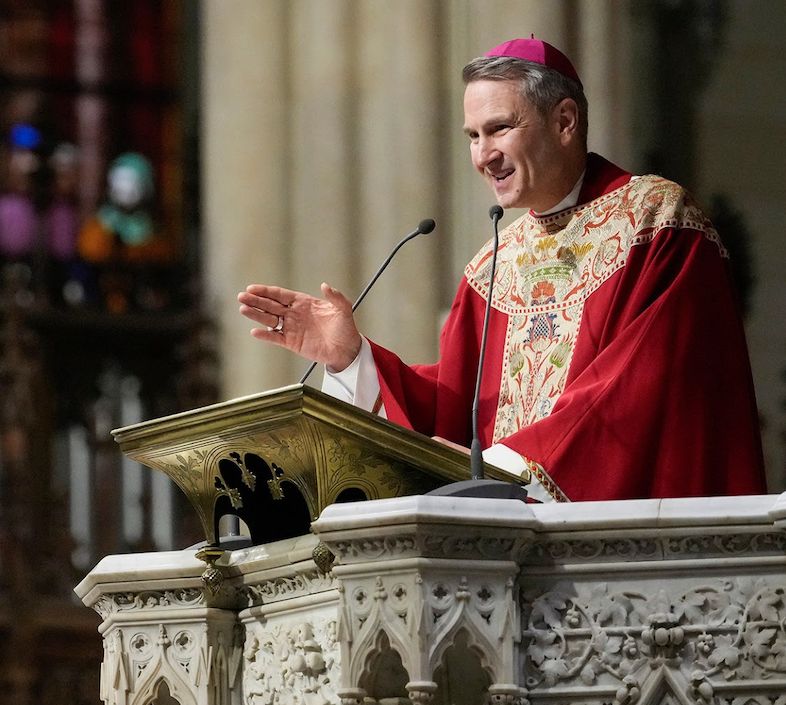
 On February 6 the new archbishop of New York, Ronald A. Hicks, made his solemn entrance into the cathedral named after St. Patrick, in the heart of Manhattan, and from the pulpit (see AP/Yuki Iwamura photo) he summarized his program, perfectly in line with Pope Leo’s guidance : “We are called to be a missionary Church, a Church that catechizes, evangelizes, and puts our faith into action. A Church made up of missionary disciples who go out and make disciples, passing the faith on from one generation to the next. A Church that takes care of the poor and the vulnerable. A Church that defends, respects, and upholds life, from conception to a natural death.”
Hicks’s appointment, among those made by Leo, is not the only one that will mark the path of the Catholic Church in the United States in the coming years. Because last December 19, just twenty-four hours after appointing the new archbishop of New York, the pope made another significant appointment, assigning the diocese of Palm Beach, Florida, to Manuel de Jesus Rodriguez.
Palm Beach is the site of Mar-a-Lago, the residence most dear to President Donald Trump, whose harsh immigration policies have prompted the unanimous protest from the United States Conference of Catholic Bishops. And the new bishop, Rodriguez, is himself an immigrant, born in the Dominican Republic, ordained a priest there, and until recently the pastor of a parish in the diocese of Brooklyn in New York City, whose 17,000 faithful are in large part Latino.
But Rodriguez is not one of those who take to the barricades. After his appointment, he said of Trump that “the president is doing really good things, not only for the United States, but for the world. But when it comes to the migrant, the immigration policy, we want to help.” He is knowledgeable in both civil and ecclesiastical law, as is Pope Leo, who greatly appreciates this legal expertise in assigning important roles, like that in the Vatican curia of prefect of the dicastery for the appointment of bishops, entrusted to the talented canonist Filippo Iannone.
Hicks, too, has proven himself capable of managing difficult situations, both in Chicago, where between 2015 and 2020 he served as vicar general and then auxiliary to the archbishop and cardinal Blase Cupich, and afterward as bishop of Joliet, Illinois, one of the states hardest hit in the past by the plague of sexual abuse. And now that he has arrived in New York, he will have to take charge of a $300 million victim compensation plan, left to him by his predecessor, Cardinal Timothy Dolan.
Hicks is from the same environs as pope Robert F.Prevost. Like him, he was born on the outskirts of Chicago, in a suburb called South Holland, just beside the pope’s native Dalton. “I grew up in the suburb right next door to Pope Leo, about 14 blocks away from each other,” he said. Yet they met for the first time only in 2024, at a talk Prevost gave in Illinois, which was followed by a brief conversation between the two. Hicks says today that he found him “clear, concise, creative, and – finally – humble,” and that he “takes more time to listen than to talk.”
Hicks’s proximity to Cupich, a leading figure of the progressive current of the United States bishops in the footsteps of Cardinal Joseph Bernardin (1928 – 1996), he too archbishop of Chicago and for a decade the historical leader of that current, has generated in some the impression of an identification between the two, under the banner of Pope Francis.
But in reality, Hicks’s true mentor was Cupich’s predecessor in Chicago, Cardinal Francis George (1937 – 2015), who led the much more substantial conservative current, as well as being president of the episcopal conference from 2007 to 2010. It was he who suggested to his successor the appointment of Hicks as vicar general. And above all, it was George who, in 2005, sent his young priest on a five-year mission to San Salvador, to take care of an orphanage called “Nuestros Pequeños Hermanos.”
Since then, Hicks has spoken Spanish perfectly, which is also the native language of a large segment of Catholics in the United States. And he wanted his installation Mass in New York to be in both English and Spanish. He gave the homily, too, alternating between the two languages. And one of the readings at the Mass, taken from St. Paul’s letter to the Galatians, he had proclaimed by Samuel Jimenez Coreas, one of the orphans he helped in San Salvador. In the archdiocese of New York, more than one million Catholics are Hispanic, out of a total of 2.4 million.
Hicks shares with Pope Leo a unified and coherent vision of the ethics of life, like the “seamless garment,” the tunic without stitching that Jesus wore : an image dear to Cardinal Bernardin. The right to life must be protected at all times, not only “from conception to a natural death,” but also against war, poverty, oppression, each however being addressed in its specific way. In Joliet, Hicks regularly attended the National Day of Remembrance for Aborted Children and blessed the graves of unborn children. But he also featured a sprig of “romero,” or rosemary, on his episcopal coat of arms, in homage to Oscar Romero, the archbishop of El Salvador martyred at the altar in 1980 by a death squad.
Hicks is also esteemed as a formator of young priests, perfectly in tune – it now emerges – with the challenging letter that Pope Leo sent on February 9 to the priests of Madrid, but in reality to the whole Church. In 2024 he was elected by the United States Conference of Catholic Bishops, with 68 percent of the vote, as president of the commission for clergy, consecrated life, and vocations. And in New York he will have much to do, given the steep decline of vocations to the priesthood in the diocese, in recent years.
He is very understanding and tolerant of those who celebrate Mass according to the old rite, but he is also far from the profile of a “cultural warrior,” as also from the neoconservative theological school of Richard John Neuhaus, Michael Novak, and George Weigel, to which his predecessor in New York, Cardinal Dolan, was instead close.
In short, Hicks makes mincemeat of the divisions between progressives and conservatives. As for Leo, for him too what matters most is being “in Illo uno unum,” united in the one Christ, as in the Augustinian motto of the papal coat of arms.
Leo’s important appointments are all of this type. Stanislav Pribyl, the new archbishop of Prague, one of Europe’s capitals most closed to the faith, appointed on February 2, immediately described the path he intends to follow : “Reconciliation within the Church is particularly close to my heart, and the first step must be precisely that of seeking to reach it. Christ is above all factions and interest groups, and only in him can we truly be one.”
Another exemplary appointment was made on October 6, 2025, for the Belgian diocese of Namur, assigned to Fabien Lejeusne, 52, former superior general in Europe of the Augustinians of the Assumption. As soon as he entered into service, his priorities were to streamline the diocese’s financial management, and above all to relaunch evangelization, with particular attention to young people. Keeping himself well clear of doctrinal controversies driven to excess.
Because this is the Church as beloved of Leo : united and missionary, welcoming to all but without ultimative internal conflicts. With a place for the Dominican cardinal Timothy Radcliffe, called by Leo to give the introductory meditations at the consistory of cardinals last January, and another for the Trappist bishop Erik Varden, called to preach the spiritual exercises at the beginning of Lent to the pope and the leaders of the Vatican curia, both refined theologians but with visions that certainly do not coincide.
Also between figures like these is the unity “in the one Christ” that Leo wishes to bring about in the Church. With a difference between the two that is worth noting right now, because while Radcliffe, 81, former master general of the Order of Preachers, is in the sunset of his career, for Varden, 52, bishop of Trondheim, Norway, and president of the Scandinavian bishops’ conference, the future is yet to be written. And what he has done and said so far – documented a number of times by Settimo Cielo – is full of promise.
(Translated by Matthew Sherry : traduttore@hotmail.com)
— — — —
Sandro Magister is past “vaticanista” of the Italian weekly L’Espresso.
The latest articles in English of his blog Settimo Cielo are on this page.
But the full archive of Settimo Cielo in English, from 2017 to today, is accessible.
As is the complete index of the blog www.chiesa, which preceded it.