 (s.m.) From October 7 to 14, Leo XIV summoned to the Vatican the heads of the Eastern Churches and the presidents of the episcopal conferences from all over the world, for a meeting on the occasion of the tenth anniversary of “Amoris Laetitia,” the apostolic exhortation with which his predecessor Francis concluded the 2014 – 2015 synod on the family.
That synod was a very hard-fought one. Above all on an issue that vertically divided the Catholic hierarchy : whether or not to allow Eucharistic communion for the divorced and remarried, until then always prohibited by the magisterium of the Church.
Francis showed, right from the preliminary consistory of cardinals in February 2014, a clear inclination toward the “yes.” But the opposition of many cardinals and bishops was such that, in summing up the synod in “Amoris Laetitia,” he limited himself to formulating an allusive “yes” in just two footnotes, no. 336 and no. 351, in which he hypothesized for the divorced and remarried “also the help of the sacraments,” and in particular of the Eucharist, which “is not a prize for the perfect, but a powerful medicine and nourishment for
the weak.”
With the result that the conflict between the two camps of yes and no did not subside, until Francis decided to end it in his own way, in September 2016, with a letter of praise for the Argentine bishops and their interpretation of Amoris Laetitia in favor of communion for the divorced and remarried, which Francis called the only correct interpretation, because “no hay otras,” there are no others : a letter ultimately published in the "Acta Apostolicae Sedis" with the qualification of “authentic magisterium.”
On that synod on the family and the heated debate that enlivened it, there is extensive documentation, both official and journalistic, available to everyone.
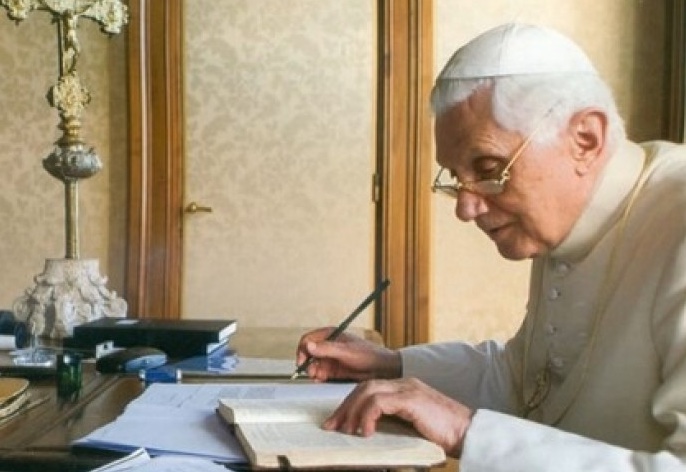
To which, however, should be added a contribution of great depth and the highest authority, yet until now never taken into consideration, in part because it went unknown for a decade : the homily given by Benedict XVI – who resigned as pope in 2013 but was still active in speech and writing – on the opening Sunday of the second and final session of the synod on the family, October 4, 2015.
That Sunday, the Roman Missal – by fortuitous but perfect coincidence – had as its Gospel passage the beginning of chapter 10 of the Gospel of Mark, the very one in which Jesus “was asked by some Pharisees if it is lawful for a husband to repudiate his wife.” And Jesus answered them, “Let not man divide what God has joined.”
Well, in the homily delivered that day at his Vatican hermitage, in the presence of no more than a dozen people – unpublished until December 2025 – Benedict XVI began by noting that “the liturgy offers us this Gospel on the very day the synod opens,” but immediately added that he did not wish to touch on “issues much debated today,” but rather their "foundation," namely, “what man is,” created by God as male and female, as a “being in relationship,” and precisely for this reason “image of God.” Moreover, in the final section of the same homily, an original reflection on the profound meaning of ecclesiastical celibacy.
It should be noted that on that same Sunday in October, the opening day of the second session of the synod, Pope Francis also delivered his homily. He too avoided alluding to communion for the divorced and remarried, which in effect found no support in the day’s Gospel passage (unless God’s leniency toward his people’s “hardness of heart,” on account of which divorce was permitted in the time of Moses, be extended to the time of the Church, as argued, for example, by the patrologist and biblicist Innocenzo Gargano, a Camaldolese Benedictine of the monastery of San Gregorio al Celio and professor at the Pontifical Biblical Institute).
The fact is that no one heard of the homily given that day by Benedict XVI at his hermitage on the Vatican hills, to meditate on and profit from it in the synodal debate.
And so here it is presented below by Settimo Cielo, on the eve of the “summit” convened by Pope Leo on the tenth anniversary of “Amoris Laetitia,” reproduced in its entirety with the authorization of the dicastery for communication and the Libreria Editrice Vaticana, which hold the copyright.
The homily is taken from pages 310 – 315 of the volume “God is the True Reality. Unpublished Homilies 2005 – 2017,” Libreria Editrice Vaticana, 2025.
*
Man, image of God. Man and woman He created them
by Benedict XVI
October 4, 2015 – XXVII Sunday in Ordinary Time, Year B
Readings : Genesis 2:18 – 24, Psalm 128, Hebrews 2:9 – 11, Mark 10:2 – 16
Dear friends,
on the very day the Synod opens, the liturgy proposes to us this Gospel, in which the Lord clarifies the Creator’s will for man, a will that must matter once again in the world of the Redemption. But I do not wish to speak now about issues that are much discussed today, but rather about the foundation of all this, which appears in the first reading and also in the Gospel : that is, about what man is.
This image of Creation seems to me very beautiful, so candid and profound, which appears at the beginning of the second chapter of Genesis, where the text says that God formed man from the dust of the earth and with a puff of His breath gave him life, and so he became a living being (cf. Gen 2:7). This shaping of man’s body from the dust of the earth implies the whole process of evolution, makes us understand how God, little by little – in the course of nascent life – shapes man, forms man, goes toward man, and then, at the right moment, puffs a breath of life into his nostrils. It is also a marvelous image. At the right moment, God gives a new breath of life, not only biological life as such, but His own life, in which He makes Himself present, so that this new being – this living being – bears in himself the breath of God.
Thus man is the being capable of knowing God. The humanization, the birth of the creature man, is presented at the moment in which the being is capable of understanding, of knowing God. God does not only offer useful things to do, but moreover offers the origin, offers Himself. And so also there emerges wonderfully the mission of man, who is the epitome of Creation, who bears in himself the whole material journey, from the being of matter to the highest point of life, where God finally meets man. Man bears this breath in himself and is precisely the epitome of Creation ; it is also man’s mission to bear the world in himself toward God, toward the resurrection ; to give, let us say, to matter the reality of the Creator’s presence and to the Spirit all the reality of Creation.
Second consideration. In the other text on Creation, that of the first chapter of Genesis, God says, “Let us make man!” (Gen 1:26). This is indeed another detail of an action that seems simple. God does not only say, “Let there be man,” but He has a soliloquy with Himself ; God speaks with Himself, He wills this creature as a creature willed in a special way, close to Him in a special way, and He created him – it says – “according to his image, his likeness.” What does “image of God, likeness of God” mean ? It is a great question, never definitively clarified, because it is too rich, too profound. Here I would like to mention just two elements.
The first is that the essence of an image is to lead toward another. The image is not a thing to itself, but indeed represents a person, goes toward the person, bears in itself the relation to this person. This is the primary essence of the image, which is relation, which goes beyond itself toward another, and bears in itself this relationality. So for man, precisely this is essential : that he does not remain in himself, is not closed in on himself, but is on a journey toward the other, is in relation to the other, must seek the other.
Then a second element, which reinforces the first. The text says, “As man and woman he created them.” Man never exists only as man in the abstract ; he is man and woman, therefore he exists only in this relationality between man and woman. Here too it appears once again that man is created as a being in relationship, one for the other, never as alone in himself.
The Fathers, speaking of man as image, also considered that in the Letter to the Colossians, Christ is called the “icon of God” (Col 1:15): therefore, in forming and shaping man, the Creator already has Christ Jesus in mind. So man is made according to the model of the future Jesus Christ. And the essential thing about Jesus Christ is that He is Son, who is not self-contained but is in permanent relationship with the Father ; thus in Jesus Christ it is essential that He is projected outside of Himself, is toward the Other, toward God. Now if man is created according to the image of Christ, he is created as son and daughter, as one who lives only by coming out of himself toward the Father, being always child, son. Therefore we say that man is created in different senses as a relational being, like God Himself, who is not a substance fixed in itself, but is relationship : the supreme reality itself exists only as relationship. Man, a being in relationship, is image of God.
The central name of being is Love ; relational man is created above all for love, created to come out of himself. And we say that the essence of sexuality is precisely that of the supreme gift, of bringing man out of himself, of creating attraction toward the other, openness to the other, and thus man really becomes co-creator with God. In other words, love integrates man in himself, and sexuality becomes human if it is personalized, if it serves love.
If we now look at the situation today, we see that precisely this vision of man is fundamentally denied. Let’s observe a sociological fact : in a big city like Munich, it is estimated that approximately 40 percent are single, that is, people who do not marry, who tend to go on only for themselves and thus end up denying this vision. And gender theories provide a foundation for this denial : man is not man and woman, he is what he makes himself ; man, the creator, makes himself ; man is no longer a creature of God, but a product of himself and decides who he wants to be. Man is no longer open in relationship ; he lives for himself, no longer recognizing and accepting a permanent bond. A bond would go against his freedom, and in the end love must be denounced, because in reality it would be a bond against his freedom ; a definitive decision would be incompatible with man’s freedom, which always remains unbound. Sexuality, therefore, no longer serves to open one to the other, but from early childhood education it is understood as a way to enjoy a bit of pleasure with oneself, that is, it is no longer openness, but closure in oneself, in which man lives only for himself. But in this way man denies his divine splendor, denies the very essence of his creativity with a concept of freedom that is false : that is, the freedom to always be able to do what one wants, to never be bound to anyone, to anything. This seems to be the cry of man’s true divinization, whereby man makes himself, is absolutely free, in permanent autonomy.
I do not want to enter into the discussion now, but there remains a question that we must answer. The Church did not, with celibacy, create the single. Celibacy is not exactly this ; it does not mean that man does not give himself to this bond of love. No ! It is the opposite.
First of all, celibacy is not a denial of definitive decision, in which man reserves the right to be forever free. Celibacy means, in the first place, the boldness, the courage of definitiveness : once and for all I decide, I give myself forever to the Lord and remain at His disposal. I recognize that I am free, but only in God’s will do I find myself and forever, and only in this bond, which is forever, can I truly grow and mature.
Second point. Celibacy is not the renunciation of love, it is not the renunciation of bonds, of ties, on the contrary : it is the availability, through the Lord, to be for everyone and to enter into this “being-for” through the Lord, in this existing not for oneself, but for others, always, in complete availability. And this is how these great gifts for the world have matured, people like Mother Teresa of Calcutta, like many others in many centuries, beginning with Saint Paul, many who really live by giving themselves to others in complete availability. All the work for the poor, for the excluded, for the helpless, all this effort for evangelization, for giving oneself and losing oneself, began precisely in this way, and precisely in this way this true love, this universal gift, was born, and it is true what the Lord says : “In giving you receive, not only in heaven but already on earth, a hundredfold” (cf. Mt 19:27 – 29).
Dear friends, this is very important, to see that celibacy is not closing in on oneself, but the opposite ; it is precisely the definitiveness of putting oneself in His hands and thus being free, so that He may use us as He wishes. We see the history of Christian love, of Christian missionaries, how they left everything, giving themselves for others in Africa, America, Australia, Asia ; only in this way was this union of love, faith, and truth created, which in all the darkness of the world remains as a light that encourages us to go forward.
At this moment, we can only pray to the Lord that He may open men to this mission of love, one toward another ; that He may help us to be steadfast in our donation to the Lord’s will ; that He may help us to truly be love, to serve, and thus, by giving ourselves, we receive true life. “Help us, Lord, to live in this hour of history!” Amen !
(Translated by Matthew Sherry : traduttore@hotmail.com)
— — — —
Sandro Magister is past “vaticanista” of the Italian weekly L’Espresso.
The latest articles in English of his blog Settimo Cielo are on this page.
But the full archive of Settimo Cielo in English, from 2017 to today, is accessible.
As is the complete index of the blog www.chiesa, which preceded it.