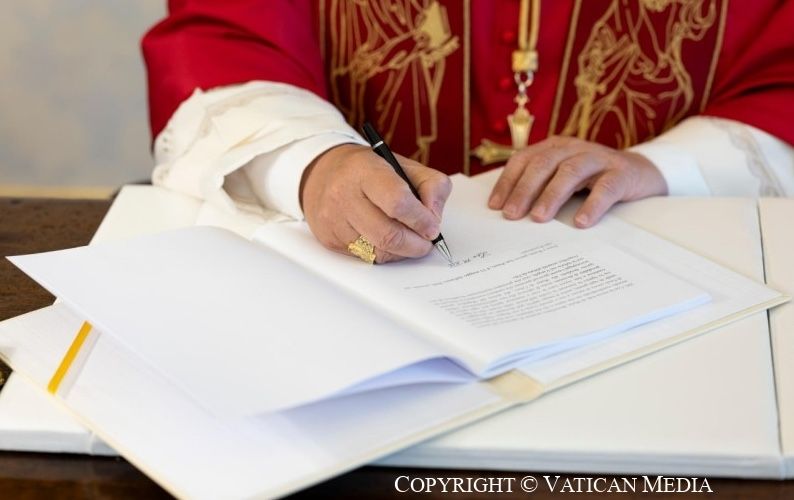
 “Disarmed and disarming”: this is also the artificial intelligence that Leo wants. In the encyclical “Magnifica humanitas” he has devoted an entire chapter, the fifth and final, to challenging the “culture of power” that pulls out all the stops on war, promoted as a “natural extension of politics” when instead technological developments are now such that “today, more than ever, without prejudice to the right to self-defense in the strictest sense, it is important to reaffirm that the ‘just war’ theory, which has all too often been used to justify any kind of war, is now outdated.”
In 240 pages of text, many of which are invectives against wars and weapons, there are only a couple of lines – in paragraphs 192 and 197 – dedicated to confirming that “armed force should be used only as a last resort in cases of legitimate self-defense,” which, however, would no longer even be considered “just.”
In support of this, in a footnote, number 182, Leo refers to the encyclical “Fratelli tutti” of Pope Francis, who was in fact the first to state in a pontifical document that “it is very difficult nowadays to invoke the rational criteria elaborated in earlier centuries to speak of the possibility of a ‘just war.’”
But Leo also refers, in the same footnote, to the Catechism of the Catholic Church, certainly of superior magisterial value, which instead, at no. 2309, firmly upholds “what is called the ‘just war’ doctrine,” lists “the strict conditions for legitimate defense by military force,” and summarizes the Church’s teaching at no. 2308, with the words of the Vatican Council II constitution “Gaudium et spes:” “As long as the danger of war persists and there is no international authority with the necessary competence and power, governments cannot be denied the right of lawful self-defense, once all peace efforts have failed.” A right – the Catechism specifies at no. 2265 – that can also be “a grave duty for someone responsible for another’s life,” since “preserving the common good requires rendering the unjust aggressor unable to inflict harm,” with “the right to repel by armed force.”
According to the Catechism, the “strict conditions” that justify a defensive war are four and must be met “at one and the same time”: 1. “the damage inflicted by the aggressor on the nation or community of nations must be lasting, grave, and certain”; 2. “all other means of putting an end to it must have been shown to be impractical or ineffective”; 3. “there must be serious prospects of success”; 4. “the use of arms must not produce evils and disorders graver than the evil to be eliminated.”
If this is what is read in the magisterial documents of the Church, it must therefore be recognized that on the question of “just war” and legitimate defense, the encyclical Magnifica humanitas poses more problems than solutions.
First of all, because of the contradiction between the “legitimacy” afforded to an armed defensive war that respects the conditions established by the Catechism and the denial of the qualification of “just” to such a war.
Secondly, because of the glaring disproportion between the quantity of invectives against all wars and weapons, not only in “Magnifica humanitas” but in countless written and oral statements of the current pontificate, and the rare and minimal references to the nonetheless recognized legitimacy of defensive war.
And thirdly, because of the contrast between Leo’s de facto support for the heroic war of defense fought by Ukraine against Russian aggression and the many words with which instead the pope himself condemns all wars and weapons, apparently without exception.
These are contradictions that have been brought to light with rare documentary accuracy by Luca Diotallevi, professor of sociology at the University of Rome Tre and at the Theological Faculty of Northern Italy, in a lengthy article in the latest issue of the authoritative journal “Il Regno,” presented in its entirety also for non-subscribers.
Diotallevi’s analysis shows how these contradictions have characterized the last decades of the Church’s life, at all levels up to the highest ranks of the hierarchy, while however remaining silent on the pontificate of Francis – judgment on which is called “premature” – and even more so on that of Leo.
In fact, a pacifism is spreading within the Church that systematically keeps quiet not only what is clearly stated in the Catechism, but also what Paul VI said at the United Nations on October 4, 1965, apart from the oft-quoted cry “never again war, never again war!”, relaunched in its entirety in “Magnifica humanitas,” namely that “so long as man remains the weak, changeable, and even wicked being that he so often shows himself to be, defensive arms will, alas, be necessary.”
Or, in the case of John Paul II, no one remembers anymore his 1992 appeal to the United Nations and Europe to “disarm the aggressor” in the war-torn Balkans : “The conscience of humanity, henceforth backed by measures of international humanitarian law, makes human involvement in situations that seriously jeopardize the survival of peoples and whole ethnic groups obligatory. This is a duty for nations and the international community.”
Also forgotten is Joseph Ratzinger’s clear statement of June 4, 2004, commemorating the Normandy landings, the beginning of the end of Nazi rule and the victory of the free world : “If ever in history there was a ‘bellum iustum,’ it is here that we find it, in the efforts of the Allies, because their intervention also worked in its outcomes for the good of those against whose country the war was conducted.”
On the terrain of facts, there is no doubt that Leo – unlike his predecessor, Francis, who had gone so far as to ask Ukraine to raise the “white flag” – deems the Ukrainian nation’s armed defense against Russian aggression “just.” His clear judgment on this conflict before being elected pope is well known. And it can be surmised that this judgment continues to hold true today, if one is willing to decipher his words and actions.
That holds true, for example, which he said on the fourth anniversary of the Russian aggression, at the Angelus on February 22, 2026 : “Four years have passed since the beginning of the war against Ukraine. My heartfelt thoughts remain focused on the tragic situation unfolding before the eyes of the whole world : so many victims, so many lives and families shattered, such immense destruction, such unspeakable suffering ! […] I invite everyone to join in prayer for the embattled people of Ukraine.”
Or what Leo said in last Wednesday’s general audience following the escalation of Russian attacks against the civilian population : “I am following with concern the war in Ukraine, which has intensified significantly in recent days. I wish to express my solidarity with all those suffering as a result of the recent attacks, which have also targeted civilians. […] Where missiles and drones fall, hopes are crushed, homes and places of worship are destroyed, and innocent lives are cut short.
But if Leo’s solidarity with the Ukrainian people fighting to defend freedom and life is unequivocal, it seems inconsistent that such support should be accompanied by frequent and generalized condemnations of arms spending, as if it were everywhere and always sinful.
The encyclical “Magnifica humanitas” is full of such condemnations. But all it takes to summarize them is to reread what Leo said last May 14 during his visit to the Sapienza University in Rome : ‘Over the past year, the growth in military spending worldwide, and particularly in Europe, has been enormous : let not the name of ‘defense’ be given to a rearmament that increases tensions and insecurity, depletes investments in education and healthcare, belies trust in diplomacy, enriches elites who care nothing for the common good. Attention must also be paid to the development and application of artificial intelligence in both the military and civilian spheres, so that it does not remove the responsibility for human decisions and worsen the tragic nature of conflicts. What is happening in Ukraine, Gaza and the Palestinian territories, Lebanon, and Iran illustrates the inhuman evolution of the relationship between war and new technologies in a spiral of annihilation. Let study, research, and investment go in the opposite direction : let them be a radical ‘yes’ to life ! Yes to innocent life, yes to young life, yes to the life of peoples who call for peace and justice!”
In these words of the pope there is much that can be embraced, but there are also passages that clash with reality. For example, the necessary military defense with which Europe must equip itself – all the more amid the growing disengagement of its American ally – to guarantee its security against aggression in the future, and indeed already underway for years on its eastern front in Ukraine, cannot be dismissed.
Nor can the technological innovations implemented by Ukraine itself to produce the most advanced defense and attack systems in the world using state-of-the-art drones, capable of blocking the Russian advance, be condemned “a priori.”
These inconsistencies in Pope Leo’s preaching have won the uninterrupted applause, sincere or calculated, of a large part of public opinion and the ruling classes, in the name of a generic invocation of peace.
But neither should they be kept quiet anymore, if the aim is truly a just peace, a “pax opus iustitiae.”
(Translated by Matthew Sherry : traduttore@hotmail.com)
— — — —
Sandro Magister is past “vaticanista” of the Italian weekly L’Espresso.
The latest articles in English of his blog Settimo Cielo are on this page.
But the full archive of Settimo Cielo in English, from 2017 to today, is accessible.
As is the complete index of the blog www.chiesa, which preceded it.