 (s.m.) The essay by political historian Giovanni Orsina, reported on September 1 by Settimo Cielo, with its stringent criticism of the “morality without politics” seen as constituting the limitation of Pope Leo’s preaching of peace, has animated a debate of great significance among scholars of politics and contemporary history.
Answering Orsina today is Antonio Caragliu, a lawyer of the Trieste bar, essayist, and member of the Union of Italian Catholic Jurists.
In analyzing “Magnifica humanitas,” Caragliu notes that – unlike how Orsina reads it – there is no lack of recognition of sovereign power on the part of the pope ; on the contrary, there is an exaltation of the state paradigm, including the coercion exercised against private actors, in the first place the creators of artificial intelligence, for the purposes of the common good.
In Caragliu’s judgment, state control is for Leo not the problem but the solution, unfortunately, however, “poorly developed in social doctrine à la ‘secretariat of state’: that is, suited for a dicastery so immersed in its relationship with states that it is no longer able to grasp their distorting ideological roots.”
To sum up, in Leo there would be an excess of statism instead of a healthy demystification of it in line with the “traditional political culture of the Christian Democrats.”
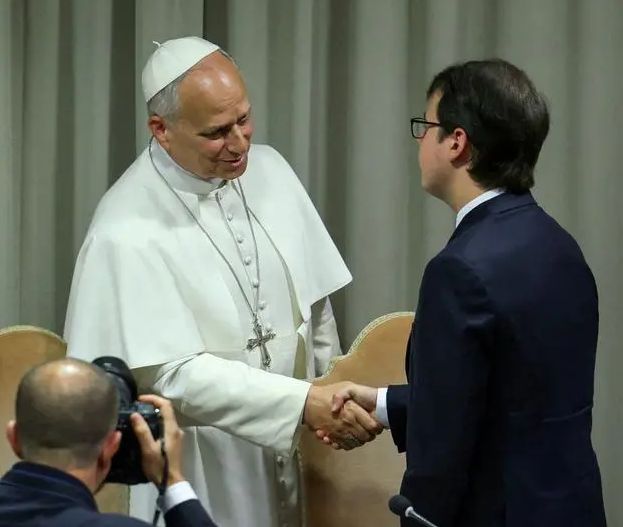
In the photo, the pope is with Chris Olah, co-founder of Anthropic, whom he called to the Vatican to present “Magnifica humanitas” and then met with at Castel Gandolfo.
Caragliu’s turn.
*
“Magnifica Humanitas:” Disarmed with States and Disarming for Private Actors
by Antonio Caragliu
Giovanni Orsina’s essay contains penetrating insights, but I maintain that his general reading of “Magnifica humanitas” is at least partly distorted by the adoption of a specific philosophical-political perspective, which I find illustrated in a brilliant essay by Giovanni Spadolini from 1950, “The Socialist Papacy.”
In this essay, Spadolini, then just over twenty years old, notes that social Catholicism and communism have liberalism as their common enemy.
To be precise, what he is referring to is the liberalism of the Risorgimento, imbued with a certain historicist Hegelianism, which conceives “the modern state as an autonomous and self-sufficient entity, endowed with its own conscience and moral law” and recognizes “in the nation the historical form of the state, in the world a permanent struggle of states.”
He saw this conception opposed by Catholic socialism, which, distinguishing itself from modern Marxist socialism, characterized by the class struggle, denies the very principle of struggle, which underpins both the modern state and capitalism, and “resolves the struggle, dissolves the state in itself.” The Church – Spadolini explained – has always opposed the reduction of existence to the categories of war, class struggle, competition, selection. It “aims to achieve its greatest victory by once again launching and imposing its message of peace, love, brotherhood, charity.”
In perfect harmony with the aforementioned theses, Orsina criticizes Leo XIV’s social thought for lacking prudence and healthy realism when it entrusts politics with the task of realizing the “civilization of love,” thus reducing to a transcendent morality the power relations and conflicts of interest that inevitably characterize the political arena, both national and especially international. Leo “exorcises power,” “flees into utopia,” admits power "only when it renounces itself, becomes weakness and service, disperses itself.” He places it “so subordinate to ethics that it finds itself deprived not only of legitimacy and autonomy but, ultimately, of the real possibility of acting.”
This is consistent with the traditional political culture of the Christian Democrats, which “has always handled the concept of sovereignty with suspicion and difficulty. It has considered the idea of a separate and transcendent power that would govern the political body from above as a more essentially theological than political error, seeing in the state a mere tool at the service of social pluralism.” Hence “the distrust of the state, the supranational vocation.”
Now, if I follow Orsina in his remarks on the lack of “healthy realism” (I say “Augustinian realism”) in the trust that the pope puts in “politics” (in fact, in the state), I do not however follow him in his denunciation of a veritable dissolution of power (he speaks of “authority fragmented so as to almost disappear within the logic of subsidiarity”). I do not think these are the substantial political effects of Leo’s loving political utopianism. Indeed, quite the opposite. In this respect, I maintain that it is Orsina’s analysis that loses its grip and, consequently, lacks realism.
So let us move on to examine the encyclical. The subtitle of “Magnifica humanitas” reads : “Encyclical on Safeguarding the Human Person in the Time of Artificial Intelligence.” But in truth, the specific ethical, legal, and anthropological problems posed by the development of artificial intelligence are addressed in a very peripheral and generic manner. The fundamental concern that animates the discourse of “Magnifica humanitas” is to recapitulate and consolidate the principles and categories of the social teaching of the pontiffs, from Leo XIII to the present, in their application to artificial intelligence, treated as a mere exemplification of the general category of technological innovation.
In the examination of the dangers introduced by artificial intelligence, what cannot fail to strike the reader is the pope’s almost absolute silence regarding the abuses that governments can (and do!) commit in the automated processing of personal data and in the monitoring of their citizens in violation of their fundamental rights to freedom (the glaring example is, as is well known, that of China, but abuses, as is equally well known, have also been perpetrated by Western governments).
The only exception is represented by the consideration of armed conflicts, in which the risks of deresponsibilization determined by the autonomy and automaticity of artificial intelligence systems applied to weapons are denounced (nos. 197 – 200). But outside this sphere, in Leo’s judgment, state control is not the problem, it is the solution. The true danger, in fact – he writes – comes from “private actors”: “In the past, it was largely up to the State to guide and direct innovation. Today, however, the main drivers of development are private, often transnational, parties that are endowed with resources and the capacity to intervene that surpass those of many Governments. Technological power thus takes on an unprecedented, predominantly ‘private’ aspect, which makes it even more challenging to discern, govern and direct such power toward the common good” (no. 5). Again : “When such power is concentrated in the hands of a few, it tends to become opaque and evade public oversight, increasing the risk of distorted forms of development that give rise to new dependencies, exclusions, manipulations and inequalities” (no. 95).
I wonder : is it really so ? Do these private actors have the power to arrest or tax me ? Can they exercise coercive power ? Do they have an interest in censoring my political and religious opinions ? Or do they perhaps engage in such operations in concert with governments to ward off retaliation from their regulatory power ?
Yet the true danger – the pope writes again – is the “de facto power over the conditions of everyday life” of every major economic and technological actor (no. 71).
If therefore, in Leo’s judgment, the problem is “almost automatic inequalities” (no. 79), “exclusion” (a generic concept that lends itself to abuse by any rabble rouser) and “technological and organizational processes outside of democratic control,” the solution can only be state control in the name of “social justice” and the “common good.” In what way ? With “progressive redistribution” (no. 153), “just laws and methods of redistribution […] for correcting imbalances” (no. 162).
In such a framework, taking refuge in timid acknowledgments of subsidiarity, “human creativity,” and ownership, according to the accommodating interpretative line of think tanks like the Acton Institute, I maintain is devoid of efficacy and meaning.
I now return to Orsina. Realism is lacking in “Magnifica humanitas,” but, unlike what Orsina claims, there is certainly no lack of recognition of sovereign power. There is coercion, and its exercise is recognized if it is exercised against private parties for their common good. In a socioeconomic reading that oscillates between Marxism and extreme Keynesianism, this is evident and inevitable.
In the encyclical, in the name of ensuring the satisfaction of everyone’s needs and of a healthy direction of economic development, we witness the exaltation of the state paradigm. Certainly, this is a non-warlike statism : pacifist, inclusive. Tendentially supranational : the project of the civilization of love, in fact, “consists in translating charity into structures of justice, giving institutional form to fraternity” (no. 186) and sets itself the task of “transforming this imposed interdependence into a willed and chosen solidarity” (no. 187). But here, power is not dissolved, weakened, or dispersed. Quite the opposite.
Of course, the problem is not new. That is, it is not unique to this encyclical : it would be ungenerous and incorrect to say so. The problem lies in the Church’s social doctrine, poorly developed in social doctrine à la ‘secretariat of state’: that is, a social doctrine suited for a dicastery so immersed in its relationship with states that it is no longer able to grasp their distorting ideological roots. One would expect the Church to have more of a sense of history, more realism, and, above all, more intelligence of the Gospel. The underlying problem, in fact, is one of theological intelligence.
The famous Gospel episode in which Jesus responds to the Pharisees to give to Caesar what is Caesar’s and to God what is God’s (mostly misinterpreted as a regulation of jurisdiction between civil and religious power) should be duly considered. This would provide a valuable demystification of power and a freedom of judgment that, today, are lacking.
The benefits would accrue to realism and fidelity to the Gospel.
(Translated by Matthew Sherry : traduttore@hotmail.com)
— — — —
Sandro Magister is past “vaticanista” of the Italian weekly L’Espresso.
The latest articles in English of his blog Settimo Cielo are on this page.
But the full archive of Settimo Cielo in English, from 2017 to today, is accessible.
As is the complete index of the blog www.chiesa, which preceded it.