by Sandro Magister
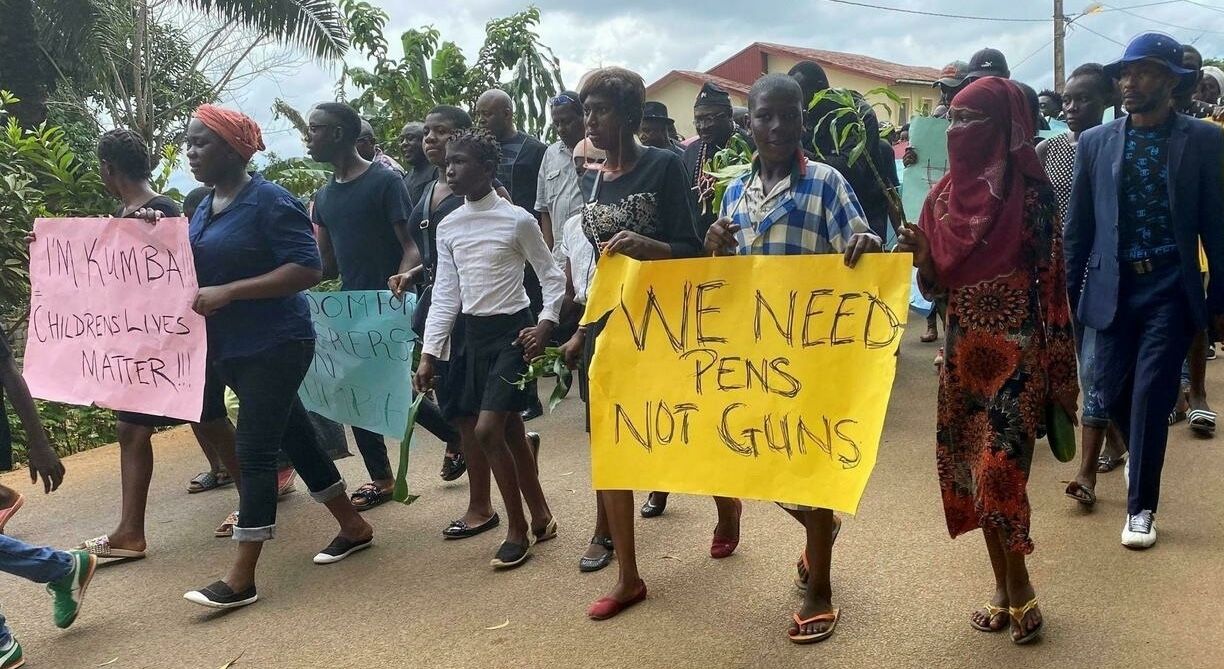 The Cameroon that Leo is preparing to visit on his upcoming trip to Africa is one of the countries at war most ignored by the media all over the world. But that may be one reason why the pope wanted to go there, with a visit on Thursday, April 16, precisely to the epicenter of the conflict, Bamenda, the capital of Cameroon’s Northwest region, where he will hold a “peace meeting” with the local community.
The Northwest region, together with the adjacent Southwest region that faces the Atlantic Ocean and, like the other on the border with Nigeria, has been since October 2016 the theater of a civil war aimed at the secession of both regions from Cameroon and the constitution of a new state, “Ambazonia” (named after Ambas Bay on the ocean), proclaimed independent in 2017 but so far without any international recognition.
But there are also other armed raids that are bloodying Cameroon, in the northernmost regions between Nigeria and Chad, where jihadist terrorism rages, with frequent guerrilla attacks by Boko Haram and Islamic State – West Africa Province (ISWAP) on villages, churches, schools, with massacres and kidnappings whose main victims are Christians, in a country where these are 60 percent of the population and the Muslims 20 percent.
While this jihadist terrorism is the same as that hitting other Sahel countries like Mali, Niger, and Burkina Faso, as well as Nigeria and Chad, the civil war underway since 2016 is instead exclusive to Cameroon, with both a proximate cause and a more remote one dating back to the colonial period, both of which are carefully reconstructed in an article by the Kenyan Jesuit Mathew Bomki in the latest issue of “La Civiltà Cattolica.”
From the late nineteenth century to the First World War, “Kamerun” was a German protectorate, before being assigned by the League of Nations to France and, to a lesser extent, for a fifth of its territory, to Great Britain.
French Cameroon gained independence in 1960, and the following year, on February 11, under the supervision of the United Nations, a plebiscite was held in British Cameroon in which English-speaking Cameroonians could choose between joining neighboring Nigeria or the newly formed French-speaking Republic of Cameroon.
The third option, that of independence, was excluded from the referendum, though in the judgment of the region’s bishops it was the most popular of the three.
The fact is that in the 1961 plebiscite the northern part of British Cameroon voted to join Nigeria, while the southern part chose to join Cameroon, which at the time had a federal structure but afterward was increasingly restructured by the central government into a unitary form, severely restricting the autonomy of the English-speaking area.
The bishops of that area wrote in a Memorandum of 28 December 2016, addressed to President Paul Biya, now 93 years old and uninterruptedly at the head of the country since 1982 :
“Anglophone Cameroonians are slowly being asphyxiated as every element of their culture is systematically targeted and absorbed into the Francophone Cameroon culture and way of doing things. These include the language, the educational system, the system of administration and governance (where appointed leaders are sent to lord it over people who cherish elected leaders), the legal system.”
When the bishops wrote that Memorandum, lawyers, teachers, and students from the English-speaking regions had just taken to the streets to peacefully protest (see photo © Teller Report) in defense of common law in judicial processes and the Anglo-Saxon-style school system. But the central government violently repressed those protests. And from there civil war broke out, with the entry into the field of separatist guerrilla groups, the “Amba boys,” and with kidnappings and massacres by both sides – sadly memorable, those of Kumba and Ngarbuh in 2020 – with mutual accusations of responsibility.
The explosion of violence has resulted in a high number of killings, arson attacks, and the destruction of property and innocent lives. Entire villages have been razed to the ground, and many schools devastated. Mathew Bomki, in “La Civiltà Cattolica,” quantifies the toll paid so far in this civil war :
“In the English-speaking part of Cameroon, the economy has been paralyzed. Over 6,000 Cameroonians have died in the conflict and hundreds of thousands have been displaced, 80,000 of whom have taken refuge in neighboring Nigeria. For the past seven or eight years, schools have been functioning in an utterly precarious way or have remained closed. According to the International Crisis Group, the education of over 600,000 students has been compromised by the conflict.
To this can be added the nearly 2,000 political prisoners and the influx of refugees from the turbulent neighboring Central African Republic.
And the Church ? On October 28, 2020, shortly after the Kumba massacre, Pope Francis weighed in with these words at the end of the general audience :
“I participate in the suffering of the families of the young students barbarically killed last Saturday in Kumba, in Cameroon. I feel great bewilderment at such a cruel and senseless act, which tore the young innocents from life while they were attending lessons at school. May God enlighten hearts, so that similar gestures may never be repeated again and so that the tormented regions of the north-west and south-west of the country may finally find peace ! I hope that the weapons will remain silent and that the safety of all and the right of every young person to education and the future can be guaranteed. I express my affection to families, to the city of Kumba and to the whole of Cameroon and I invoke the comfort that only God can give.”
But a few days later, on November 5, a few miles from Bamenda, a commando kidnapped a dozen people, including the leader of a local tribe, Fon Sehm Mbinglo II, and Cameroonian cardinal Christian Tumi (1930 – 2021), then archbishop emeritus of Douala. Released the following day, Tumi was considered guilty by some of fighting for the English-speaking population and by others of siding with the central government, and of having promoted an “All Anglophone General Conference” in 2018 aimed at promoting peace negotiations, which soon fell through.
The kidnappings have repeatedly targeted Catholic priests and missionaries, the latest of which was the parish priest John Berinyuy Tatah and his vicar, kidnapped not far from Bamenda last November 15 and freed on December 2, with Pope Leo not failing to make his voice heard at the Angelus on November 23 : “I was deeply saddened to learn of the kidnapping of priests, faithful, and students in Nigeria and Cameroon. I feel great pain, above all for the many young men and women who have been abducted and for their distressed families I make a heartfelt appeal for the immediate release of the hostages and urge the competent authorities to take appropriate and timely decisions to ensure their release. Let us pray for these brothers and sisters of ours, and that churches and schools may always and everywhere remain places of safety and hope.”
It is estimated that in 2023 alone, kidnappings generated over 7.8 million dollars in ransoms.
In January 2021, shortly after Cardinal Tumi’s misadventure, Pope Francis sent Cardinal Pietro Parolin to Cameroon on a peacekeeping mission. But to no avail. Upon the announcement of the visit, the secessionists even threatened reprisals against anyone who came to welcome the secretary of state, he too accused of siding with the government.
But now Pope Leo himself is traveling to Cameroon as a messenger of peace, overcoming the objections of those like Cameroonian Jesuit Ludovic Lado, an Oxford graduate, social anthropologist, and specialist in development economics, who told America magazine that he had advised the Vatican against Leo’s visit due to the country’s chaotic political situation and for fear that his visit could be interpreted as an endorsement of Cameroon’s political leadership.
The fact is that Bamenda airport, closed for six years, has been reopened for the arrival of Pope Leo and the entire city has been renovated, as ecstatically reported by the archbishop of the diocese, Andrew Nkea Fuanya, who is also president of the episcopal conference of Cameroon.
Many also hope that Leo’s visit will bring global attention and support to the people of Cameroon, among the hardest hit in Africa by Donald Trump’s freeze on aid to poor countries distributed by the United States Agency for International Development (USAID).
(Translated by Matthew Sherry : traduttore@hotmail.com)
— — — —
Sandro Magister is past “vaticanista” of the Italian weekly L’Espresso.
The latest articles in English of his blog Settimo Cielo are on this page.
But the full archive of Settimo Cielo in English, from 2017 to today, is accessible.
As is the complete index of the blog www.chiesa, which preceded it.