 If one truly wants to thoroughly understand Leo XIV’s judgment on the war in Ukraine, one absolutely must read the ten pages dedicated to it in the latest issue of “La Civiltà Cattolica,” the magazine of the Rome Jesuits that is published each time after prior examination by the secretariat of state and, often, by the pope himself.
The article is titled “Ukraine and the Human Costs of the Conflict.” And it has to do precisely with the effects on the population of the pivot that the Russian offensive has taken of late : with systematic attacks no longer just on the front line, but against the cities and villages of the whole nation, starting with the capital Kyiv, with incessant drone and missile launches targeting the daily lives of civilians, to break down their resistance.
So far, “without signs of an imminent capitulation emerging,” writes the article’s author, Jesuit priest and psychologist Norbert Frejek. Indeed, “the inhabitants of the areas hit continue to show considerable inner strength and tenacity,” after nearly five years of uninterrupted resistance to the Russian invasion, which “since February 2022 has conquered only 3 percent of Ukrainian territory,” in addition to that already forcibly annexed since 2014, for a total of 20 percent of the territory, including Crimea.
On the Russian invasion and the ensuing Ukrainian resistance, the judgment is plain. Ukraine “is fighting to preserve its independence within the internationally recognized borders.” And “military assistance” for the nation attacked, “as well as financial and humanitarian support from various parties, play an essential role in this setting.”
The indomitable resistance of the nation attacked, Frejek writes, “sets down its roots in the complex history of Ukraine, a country that had to fight for its independence and was marked by the great famine of the ‘30s, when the Soviet power left to die of hunger, in a systematic way, several million people.”
Ukraine, together with the Baltic countries, “was among the former Soviet republics that sought to take full advantage of the collapse of the Soviet Union and rapidly establish an independent state.” While on the contrary, Vladimir Putin’s Russia rekindled its neo-imperial ambitions, to the point of waging war on the nation that had escaped its rule. Frejek writes, “As Ukrainian researcher Mykola Riabchuk observed many years ago in his review of Zenon Kohut’s ‘Russian Centralism and Ukrainian Autonomy,’ the clash between the two political systems was inevitable : the Cossack republic could not coexist with the autocracy, just as the principles of Roman law could not be reconciled with Asiatic despotism.”
It is in light of these underlying judgments that Pope Leo’s words on the war in Ukraine are best understood, for example those spoken after the Angelus on Sunday, September 6 :
“With a sorrowful heart, I have followed the news of the latest violent attacks that have recently struck several cities and civilian infrastructures in Ukraine, causing the deaths of innocent people. My heart goes out to the suffering people, who for years have lived in anguish and fear.
“I renew my appeal to put an end to the violence, to stop the destruction and to open hearts to dialogue and peace!”
Frejek’s article in “La Civiltà Cattolica” is dedicated precisely to the “suffering people” mentioned by the pope. Together with other Jesuits, in the fall of 2024 Frejek founded in Chernivtsi, in Ukrainian Bukovina, with the name Space of Hope, a center of psychological and spiritual assistance provided for people hit by the war, who, “while maintaining their resistance and capacity for endurance, show severe psychological fatigue.”
In fact, “in addition to the anxiety generated by the frequent attacks, sometimes daily, with drones and missiles, many people in Ukraine also suffer from post-traumatic stress disorder.”
“Most of the victims,” Frejek writes, “are soldiers serving at the front ; however, the current war has shown that post-traumatic stress disorder also hits mothers and wives awaiting the return of their sons and husbands, as well as the relatives of those who will never return. This disorder is a form of response to a trauma, that is, to an extremely stressful event, which exceeds a person’s capacity to face it and adapt to the situation. In other words, the person is no longer able to integrate such a painful experience within himself.”
In particular, they feel anger and dismay who receive news of the death of a loved one. They feel “the sensation that an essential part of their life has suddenly disappeared.” And they withdraw into themselves, with “the idea that recounting their life to a stranger arouses mistrust”: this too is a legacy of the Soviet era, “which taught whole generations to be wary and to watch over what they communicate to others.”
“Among the most common sentiments among soldiers’ relatives,” Frejek continues, “besides fear, is the perception that these men bear a burden that could crush them. When faced with people who seem burdened by such an oppressive load, there is often a tendency to distance oneself, almost to flee, to keep that burden from being transferred to those close to them. This dynamic is reminiscent, in some ways, of the attitude that for centuries characterized the relationship with leprosy sufferers.”
And then there are the children, who “often only understand after a long time that their father has not simply left on a long journey, but will never come back home.”
In short, “the images of a young widow, a mother, or a teenage child firmly accepting the news of the death of a loved one fallen at the front belong more to cinematic fiction than to reality.”
Among the centers that offer psychological and spiritual support to the Ukrainian population struck by the war, Frejek mentions, in addition to Space of Hope, the Jesuit Refugee Service of the Lviv Jesuits, active above all with internal migration flows from regions hit by fighting or occupied by the Russian army. Then there are the military chaplains, approximately 500 in number and belonging to 13 religious confessions.
“In our work of accompaniment, we find inspiration in two biblical quotations,” Frejek writes. “The first is taken from Paul’s second letter to the Corinthians : ‘The merciful Father and God of all consolation consoles us in our every tribulation, so that we too may be able to console those who are in any kind of affliction with the consolation with which we ourselves are consoled by God’ (2 Cor 1:34). The second comes from the book of Isaiah : ‘By his wounds we have been healed’ (Is 53:5).”
And he concludes : “By working with these suffering people, we try to help them to rediscover a future, to bring meaning back to life.”
*
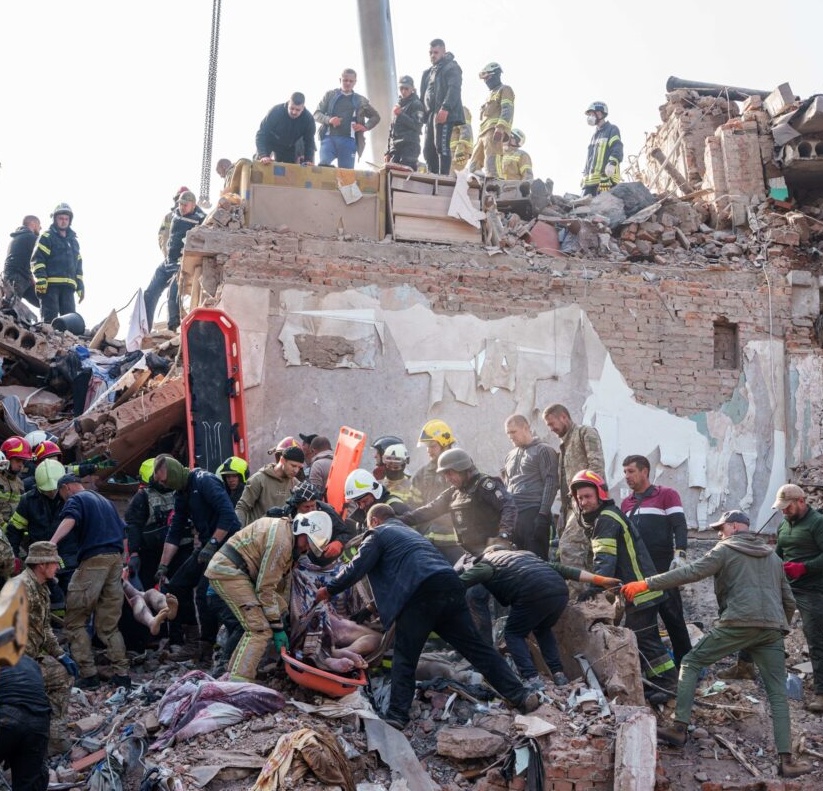
In the photo above, copyright Evgeniy Maloletks/AP, the five-story building destroyed on October 7 by a Russian missile in Pryluky, in northern Ukraine, with 22 dead, including five children, and 54 wounded.
(Translated by Matthew Sherry : traduttore@hotmail.com)
— — — —
Sandro Magister is past “vaticanista” of the Italian weekly L’Espresso.
The latest articles in English of his blog Settimo Cielo are on this page.
But the full archive of Settimo Cielo in English, from 2017 to today, is accessible.
As is the complete index of the blog www.chiesa, which preceded it.