 On China, Pope Leo said he was in no hurry. In the short term, he specified, he would abide by the secret agreement between Rome and Beijing in effect since 2018, while in the long term he would decide after hearing a bit from everybody, including those “Chinese Catholics who for many years have experienced some kind of oppression or difficulty in living their faith freely, and without choosing sides.”
Meanwhile, however, the Beijing regime runs amok, humiliating the Church. And Rome puts up with it. Even paying homage to its persecutors with unguarded statements.
This is what has happened with the latest appointment of a Chinese bishop, made public on December 5. Which is a duplicate of the one before it, the one that prompted the headline from Settimo Cielo : “China’s First Slap at Pope Leo. Who Suffers It in Silence.”
This second slap also had its genesis in the interregnum between the death of Pope Francis and the election of Leo, when, at the end of April, news leaked that the Chinese authorities had got assemblies under their command to “elect” two bishops for two important positions.
According to the agreement, it would have been up to the new pope to approve or reject these appointments. And in fact, on October 15, a statement from the Holy See announced that the first of the two had been accepted. This concerned the new auxiliary bishop of Shanghai, Ignatius Wu Jianlin, in a diocese that however already had two auxiliaries, but disagreeable to the regime and therefore harshly punished : the first, Joseph Xing Wenzi, forced into retirement some time ago, and the second, Thaddeus Ma Daqin, under arrest without interruption for thirteen years.
As for the second appointment, the silence was indeed broken on December 5. With the clarification, in the Vatican statement, that Leo had made it on August 11, the same day he had also signed the appointment of the new auxiliary of Shanghai.
At the same time, as always, the official agency of the Chinese Church, subservient to the regime, also issued its own statement : without even mentioning Pope Leo, meant to have exclusive responsibility for all appointments, and backdating to the fateful April 30, before the conclave, the “election” of the new bishop.
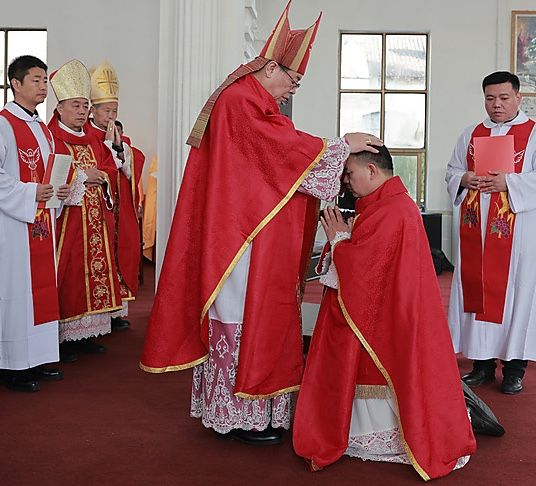
Whose name is Francis Li Jianlin, 51, ordained on December 5 (see photo) by Beijing bishop Joseph Li Shan – who is also president of the Chinese Catholic Patriotic Association and vice president of the Chinese episcopal conference, not recognized by Rome – and by other bishops in league with the regime. He now governs the diocese (or more properly, the apostolic prefecture) of Xinxiang. Where if truth be told there has already been a bishop since 1992, Joseph Zhang Weizhu, 67, who however was one of about twenty, out of a total of around one hundred, not officially recognized by the Beijing authorities because of non-submission to their dictates.
But the Vatican statement of December 5 gave out that the issue had been resolved, specifying that the pope had also “accepted the resignation from pastoral governance presented” by Zhang.
And on December 6 a statement from the director of the Vatican press office announced “with satisfaction” that the retired bishop had been “civilly recognized.”
With this overblown additional note : “This measure is the result of dialogue between the Holy See and the Chinese authorities and represents a new and important step in the communal journey of ecclesiastical circumscription.”
But if one goes to read the parallel Chinese statement, one learns that in the semi-secret ceremony of his “retirement” – so called, without any explicit reference to official recognition – Zhang also “gave a speech to express the need to adhere to patriotism and love for religion, to abide by the principle of independent and self-governing churches, to follow the framework of the sinicization of Catholicism in the country, and to contribute to the overall construction of a modern socialist country and the overall promotion of the great rebirth of the Chinese nation.”
This auto-da-fé is identical to the one put into the mouth of another bishop last June, he too forcibly “retired,” Augustine Cui Tai of the suppressed diocese of Xuanhua, despite the improbability of this act of submission by two bishops who have always heroically witnessed to their faith, at the cost of continuous arrests and persecution.
And this until the very end. Suffice it to say that the ousted bishop was unable to attend the ordination of his successor and is not even allowed to see his relatives.
Of an altogether different cast, however, is the track record of the new bishop of Xinxiang. On April 8, 2018, in his capacity at the time as secretary of the Commission for Church Affairs of Henan Province, he signed an ordinance banning all children and young people under the age of 18 from entering churches to attend Mass and forbidding priests from organizing any religious formation activities for children and young people, under penalty of arrest and the closure of the church.
It is not surprising, therefore, that in reporting the heartfelt reflection of an “underground” priest from the diocese of Xinxiang, the agency AsiaNews of the Pontifical Institute for Foreign Missions, which also publishes and is read in Chinese, should write that the appointment of the new bishop and the removal of his predecessor “are opening new wounds rather than healing old ones.”
The full text of the reflection – which many hope will reach the pope – is in this report from AsiaNews of December 6 :
> Xinxiang : Bishop Zhang and other Catholics silenced
And an excerpt is reproduced below.
*
Like a lamb led to the slaughter
(by a priest from China’s underground community)
Whatever the external narrative, one fact cannot be erased ; before this ordination, the Apostolic Prefecture of Xinxiang had a legitimate bishop appointed by the Holy See : Bishop Joseph Zhang Weizhu.
After years of surveillance, restrictions, and isolation, without ever publicly complaining, he was finally induced to submit his resignation. On the very day a new bishop was ordained, he, the pastor of the diocese, could not even cross the threshold of the church. He was excluded completely, silently, almost surgically, like a shadow that time wishes to erase.
But neither history nor the memory of the Church will forget him. He truly appears as “the lamb led to the slaughter,” silent, meek, obedient beneath the cross. If in all this there is a worldly victory, the victory of the Kingdom belongs instead to the testimony of Bishop Zhang.
This is not the first time, and it will not be the last, that the Church, under a system of strong control, finds herself forced into silence, humiliation, and suffering.
Yet, we continue to believe that the Church is not sustained by power, but by faith ; a bishop is not such by human will, but by the gift of the Spirit ; true history is not written in statements, but in testimony ; the forgotten, the excluded, the silenced are often the most profound signs of God in history.
Today Xinxiang seems to be opening a new chapter, but many wounds remain open and many questions unanswered. Perhaps the only way is this : to move towards the cross, towards the truth, towards Him who sees what people ignore and who never erases anyone from His heart.
What Xinxiang is experiencing is not just a religious or political issue, but a manifestation of the tensions and trials of our time. Yet we believe that God acts in the moments of silence of history, He manifests himself in the forgotten, He plants seeds of resurrection precisely in the darkest places.
May the new bishop be the guardian of these seeds. May the cross of Bishop Zhang become a light for the prefecture. May all those who have been excluded, silenced, forgotten know that for God, no one is an “empty place”.
We do not know what the future holds, but we know one thing : God will not abandon His Church.
(Translated by Matthew Sherry : traduttore@hotmail.com)
— — — —
POSTSCRIPT – And meanwhile, the Holy See continues its complete silence on Jimmy Lai, a heroic Catholic witness of faith, sentenced in Hong Kong on December 15 for crimes punishable by life in prison.
— — — —
Sandro Magister is past “vaticanista” of the Italian weekly L’Espresso.
The latest articles in English of his blog Settimo Cielo are on this page.
But the full archive of Settimo Cielo in English, from 2017 to today, is accessible.
As is the complete index of the blog www.chiesa, which preceded it.