 Christian Armenia and Muslim Azerbaijan, in the South Caucasus between Turkey and the Caspian Sea, were once part of the Soviet Union. But since their independence they have always fought each other, until the current simulacrum of peace signed in Washington last August 8, with Azerbaijan victorious and Armenia defeated and exhausted, also torn apart internally, in the political field as within the Church.
Armenia’s misfortune is that everything happening in the world today is working against it and in favor of its rival. Even at the highest levels of the Catholic Church, Azerbaijan has long enjoyed more favorable treatment.
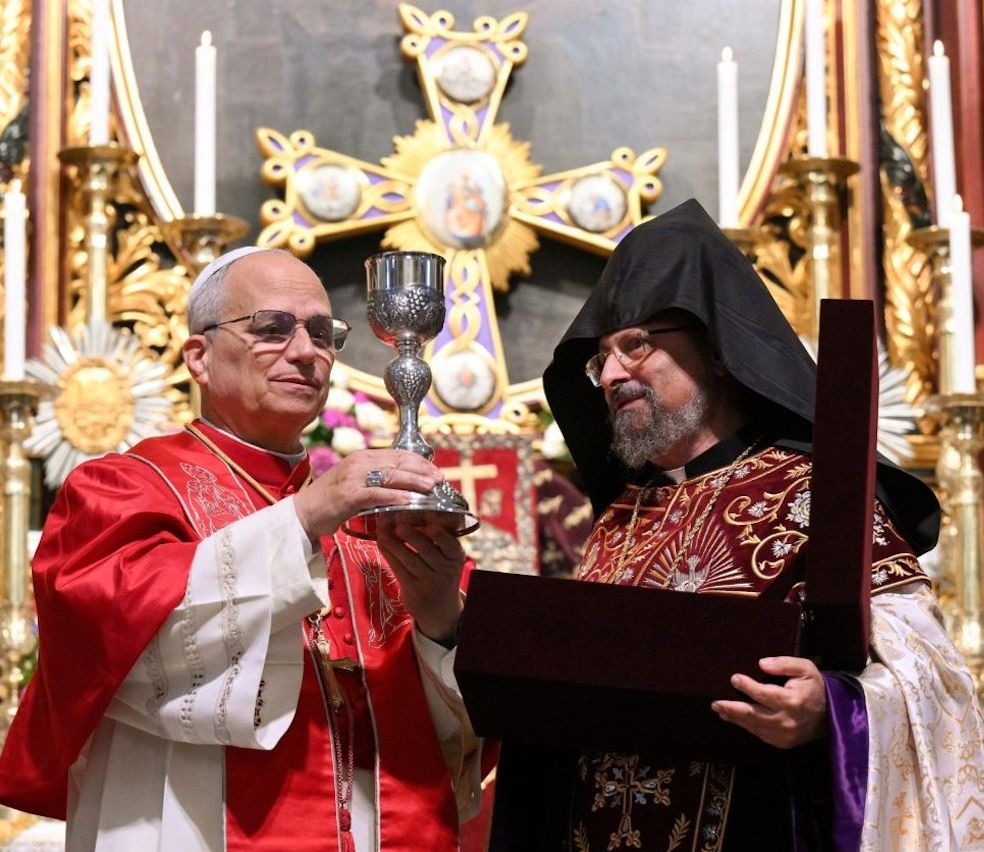
Pope Leo met with the Armenian patriarch of Constantinople, Sahak II (in the photo), in Istanbul on November 30, after having received Catholicos Karekin II, the supreme head of the Armenian Church, at Castel Gandolfo on September 16. But nothing has leaked of this latest audience, despite Karekin’s being at the center of ecclesiastical and civil conflict in his homeland due to his pro-Russian and anti-government positions.
Instead, the audience granted by the pope on October 17 to Azerbaijani vice president Mehriban Aliyeva, wife of President Ilham Aliyev, took place with the sumptuous ceremonial reserved for heads of state, complete with a statement on the “existing good relations,” especially in “collaboration in the cultural sphere.”
In effect, for many years Aliyeva, head of a wealthy foundation named after Heydar Aliyev, her husband’s father and the founder of the dynasty that has uninterruptedly and autocratically ruled Azerbaijan since 1993, has financed important restorations of Roman antiquities, in agreement with the pontifical commission for sacred archaeology and the cardinals who preside over the Vatican dicastery for culture – formerly Gianfranco Ravasi and now José Tolentino de Mendonça – most recently in the catacombs of Commodilla and of Sts. Marcellinus and Peter, and in the monumental complex of St. Sebastian outside the Walls, each time with solemn inaugurations.
Not only that. During Francis’s pontificate, Aliyeva – along with the Azerbaijani ambassador – was awarded the Grand Cross of the Order of Pius IX, the highest honor bestowed by the Holy See, the same one Leo gave last October 23 to Queen Camilla of England.
While on the contrary the Holy See has stood out for the coldness with which it has followed the conflict between Azerbaijan and Armenia, with only generic calls for peace : a coldness that French president Emmanuel Macron lamented after an audience with Pope Francis on November 18, 2022.
In reality, in the first years of independence after the collapse of the Soviet Union, the fate of the conflict for control of Artsakh, or Upper Karabakh, the region with a strong Armenian majority that in the Soviet era had been included in the territory of Azerbaijan, had been favoring Armenia, which had also taken command of other adjacent areas with Azeri populations.
But in the early 2000s, with the Aliyev dynasty in power, Azerbaijan was able to gain considerable credit in international relations, thanks to its substantial oil and gas deposits and the construction, in agreement with the United States, of an oil pipeline that exported these to the West through Georgia and Turkey, with a subsequent branch also in Italy, and no longer through Russia.
The capital, Baku, is marked by works of the most famous star architects and has hosted major cultural and sporting events, including the COP29 in 2024, the United Nations conference on climate change. And this despite the fact that accredited institutions like Freedom House and Transparency International have repeatedly denounced the country’s widespread corruption and systematic repression of human rights.
Meanwhile, already in the early 2000s and to general disinterest the Aliyev government carried out the complete destruction of Armenian churches, monasteries, and monuments in the Nakhichevan region, an exclave assigned to Azerbaijan in the Soviet era and separated from it by a corridor in Armenian territory called “Zangezur.”
In 2016 Azerbaijan resumed its offensive to conquer Artsakh, and in 2020 signed an armistice that returned to it all the territories with Azeri populations and a good half of the ethnic Armenian ones, including the city of Shushi.
Russia interposed its own peacekeeping force between Armenians and Azeris, but without intervening to stop continued violations of the armistice by Azerbaijan. Which in 2022 and even more so the following year first blocked the “Lachin corridor,” the only route between Armenia and Artsakh, halting all supplies of essential goods and reducing the population to famine, and then occupied the whole exclave militarily, forcing all 120,000 Armenians living there to expatriate in the span of a few days and here too initiating the destruction of churches and monuments.
All this with Russia, formally an ally of Armenia, acting as an inert spectator of its capitulation, stuck as it was and is in the quagmire of the contemporary war in Ukraine.
With the agreement signed in Washington last August 8, Armenia renounced all claims to reconquer Artsakh. But even more to the benefit of Azerbaijan – and of the United States – was the awarding to an American company, backed by Donald Trump, of the construction and future control of the so-called “Zangezur corridor,” which by connecting Azerbaijan to Turkey via Armenia would strengthen trade routes between Asia and Europe, cutting out both Russia and Iran.
Azerbaijan is even projected to play a significant role in the arduous resolution of the Israeli-Palestinian war. Seventy percent of its weapons are imported from Israel, which in turn is a major buyer of Azerbaijani oil. Azerbaijan is also meant to be part of the international stabilization force envisioned in Trump’s peace plan, partly because of its good relations with Turkey, one of the countries most hostile to Israel. And it is expected that Israel could sign precisely with Azerbaijan the first of a new series of “Abraham Accords,” after the resolution of the conflict.
Meanwhile, what is happening in Armenia ? Prime Minister Nikol Pashinyan, who is strongly pro-European and at odds with Moscow, faces opposition from Catholicos Karekin, who instead is pro-Russian and contests the surrender to Azerbaijan. The conflict between the two has reached the point where Pashinyan accuses Karekin of having fathered a daughter and therefore of no longer being worthy of his office, while Karekin and the clergy loyal to him call for the prime minister’s resignation and the excommunication of him and his wife.
An archbishop close to Karekin, Bagrat Galstanyan, has taken up active political militancy against Pashinyan. But after months of street demonstrations, complete with episcopal insignia and attacks on government buildings, the prime minister accused him of plotting a coup, and last June had him arrested along with another rebel archbishop, Mikael Adzpayan, and then two more archbishops, one Karekin’s nephew and another his chancellor.
One effect of all this is a dramatic fracture within the Armenian Church, which became public last January 4 at the residence of Prime Minister Pashinyan with his signing, together with ten archbishops and bishops, of a declaration “for the reform of the Holy Armenian Apostolic Church.”
The declaration, on the basis of “the failure of the de facto head of the Church and his inner circle to live and preach according to the principles of the Gospel,” announces Karekin’s removal from his role, the appointment of a new interim head, the approval of new statutes, and finally the appointment of a new catholicos.
The next day, Karekin and his followers reacted by contesting the legitimacy of the step taken by Pashinyan and the ten bishops who signed the declaration.
But once again the prime minister and the bishops allied with him reconfirmed their line of action, in the midst of Armenian Christmas celebrations on January 6, with a Mass in the capital of Yerevan in which Karekin’s name was omitted and with a crowded procession to the cathedral, crowned by an appeal from Pashinyan himself to “free the Holy Armenian Apostolic Church from schism and return it to the people.”
On January 13, at the historic see of the catholicos in Etchmiadzin, the Supreme Spiritual Council that governs the Church also condemned the attack launched by Pashinyan and the ten rebel bishops. And it convened a meeting of all 57 Armenian bishops for February.
With the result of further inflaming the dispute. At a press conference on January 15, when asked about the bishops who had “betrayed” the catholicos, Pashinyan replied : “In this affair, there is only one traitor, Ktrich Nersisyan [Karekin’s given name]. He is the one who has betrayed Jesus Christ, the Holy Armenian Church, his followers, and his flock of faithful. He is not the supreme patriarch. He is a common traitor who has betrayed Jesus Christ.”
New elections are scheduled in Armenia at the end of spring, with pro-Russian parties seeking payback against the pro-European Pashinyan. But also riding on the outcome of the vote is the future of the Armenian Church, it deeply divided, too.
(Translated by Matthew Sherry : traduttore@hotmail.com)
— — — —
Sandro Magister is past “vaticanista” of the Italian weekly L’Espresso.
The latest articles in English of his blog Settimo Cielo are on this page.
But the full archive of Settimo Cielo in English, from 2017 to today, is accessible.
As is the complete index of the blog www.chiesa, which preceded it.