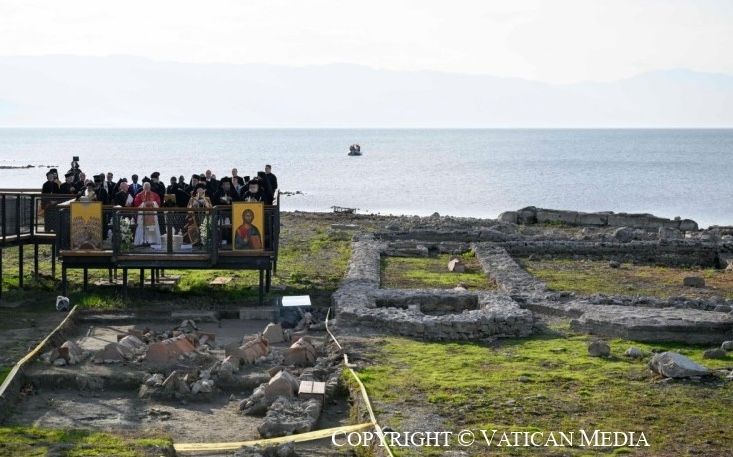
 “Magnificent, very simple and yet very profound,” for Pope Leo, was the celebration depicted in the adjacent photo, in memory of the first ecumenical council of Nicaea, on November 28 in Iznik, the modern name of the city.
But it is certainly striking that those who celebrated an event of such magnitude, which in 325 established forever the “Credo” of all the Christian Churches, should have been no more than two dozen representatives of these Churches, gathered on a small platform above the ruins of an ancient basilica, on the lonely shore of a lake.
The Turkish authorities themselves reportedly prevented a large influx of believers, in a country where the Christian presence has been almost annihilated over the last century, although the fractures and friction between the Churches have also contributed to the meager presence.
In the Orthodox camp, Ecumenical Patriarch Bartholomew of Constantinople had seen to sending the invitations : not to all the Churches but only to the historic patriarchates of Alexandria, Antioch, and Jerusalem, which together with Rome and Constantinople constituted the “pentarchy” of the first millennium.
And this narrow list of invitations already kept out the modern patriarchates of Russia, Serbia, Romania, Bulgaria, Georgia, as well as the autocephalous Churches of Greece, Cyprus, Albania, Poland, the Czech Lands and Slovakia, Finland, Ukraine, among which it was certain that not only would the patriarchate of Moscow reject the invitation, but so would the Churches most closely linked to it, in rupture with the patriarchate of Constantinople over the latter’s support for the new Ukrainian national Church.
But even among the historic patriarchates of the “pentarchy” the responses were cold. In the booklet for the celebration printed by the Vatican were the names of Theodore II, John X, and Theophilos III, the patriarchs of Alexandria, Antioch, and Jerusalem respectively, but of the three, only the first was present in person.
In place of the patriarch of Jerusalem – who hadn’t even responded to the invitation, as Bartholomew revealed – was Archbishop Nektarios of Anthedona, and in place of the patriarch of Antioch was Metropolitan Basil of Arcadia and Mount Lebanon. John X, patriarch of Antioch, had initially confirmed his presence, but a week before the event he canceled, preferring to welcome Pope Leo to Lebanon three days later at the ecumenical and interreligious meeting on December 1 in Martyrs’ Square in Beirut.
Also present at the celebration in Nicaea were the patriarch of the Syriac Orthodox Church of Antioch, the Catholicos of the Malankara Orthodox Syrian Church, and representatives of the Coptic Orthodox patriarchate of Alexandria, the Assyrian Church of the East, and the Armenian Apostolic Church.
And then there were individual representatives of Anglicans, Lutherans, Evangelicals, Reformed, Methodists, Baptists, Pentecostals, Mennonites, Old Catholics, of the World Council of Churches.
But all this did not prevent Leo from designating the celebration of Nicaea as the primary reason for his whole journey and from forcefully reiterating that at the heart of his mission as pope is precisely the same purpose as that of that first ecumenical council : the unity of the Church in faith in Christ, true God and true man.
In Leo’s judgment the Council of Nicaea is more relevant than ever. Twice during his journey he indicated a “new Arianism” (named after Arius, against whose heresy the council was convened) as a grave risk to today’s faith.
The first time in Istanbul on November 28, in the speech he gave to bishops, priests, and nuns in the Catholic cathedral of the Holy Spirit :
“There is a challenge, which we might call a ‘new Arianism,’ present in today’s culture and sometimes even among believers. This occurs when Jesus is admired on a merely human level, perhaps even with religious respect, yet not truly regarded as the living and true God among us. His divinity, his lordship over history, is overshadowed, and he is reduced to a great historical figure, a wise teacher, or a prophet who fought for justice — but nothing more. Nicaea reminds us that Jesus Christ is not a figure of the past ; he is the Son of God present among us, guiding history toward the future promised by God.”
And the second time a few hours later, in Nicaea itself, in the speech in commemoration of that first ecumenical council :
“The anniversary of the First Council of Nicaea is a precious opportunity to ask ourselves who Jesus Christ is in the lives of men and women today, and who he is for each one of us personally. This question is especially important for Christians, who risk reducing Jesus Christ to a kind of charismatic leader or superman, a misrepresentation that ultimately leads to sadness and confusion. By denying the divinity of Christ, Arius reduced him to a mere intermediary between God and humanity, ignoring the reality of the Incarnation such that the divine and the human remained irremediably separated. But if God did not become man, how can mortal creatures participate in his immortal life ? What was at stake at Nicaea, and is at stake today, is our faith in the God who, in Jesus Christ, became like us to make us ‘partakers of the divine nature’ (2 Pet 1:4).”
At Nicaea in 325 the council fathers also tried to agree on a common date for the celebration of Easter, but without success. This is what Leo has once again proposed today – together with Ecumenical Patriarch Bartholomew – in dialogue with the Eastern Churches above all, as already expressed as a hope in the appendix to the constitution on the liturgy of Vatican Council II, and with the two fundamental criteria recalled in the International Theological Commission’s document on Nicaea of a few months ago : that Easter be on Sunday, the day of Jesus’ resurrection, but also that it be close to the spring equinox, as it is for the Jewish Passover.
But above all, in Nicaea the fathers agreed on a text of the “Credo” which, confirmed at the subsequent ecumenical council of Constantinople in 381, has become to this day the untouchable “Symbol” of the Christian faith.
Untouchable, or almost. Because the “Credo” of Nicaea, which soon became part of baptismal liturgies and then also of Eucharistic liturgies, in the Carolingian era had the addition, in the Latin version, of a “Filioque” that has the Holy Spirit “proceed” not only from the Father – as in the original text – but also from the Son.
Leo III, the pope who crowned Charlemagne, did not approve this interpolation and did not admit it into the churches of Rome. But two centuries later, in 1014, Benedict VIII introduced it throughout the Catholic Church. Where it is still present today, with the sole exception of Masses at which the “Credo” is recited or chanted in Greek, respecting the original text.
And not in Greek, but in English, the pope and the other heads of Churches pronounced it together in Iznik on November 28, in a translation very faithful to the text of Nicaea and therefore without that “Filioque” on which Leo truly does not seem to want to be rigid.
In effect, the “Filioque” unilaterally inserted into the Latin “Credo” has been an age-old matter of conflict between the Catholic Church and the Eastern Churches, before and after the schism of 1054, despite the subtlety of the theological arguments on which it is based, explained in a very learned 1996 document from the Vatican dicastery for promoting Christian unity.
Nothing today prohibits the endorsement of the theological reasons in support of the “Filioque,” nor the continuation of dialogue between East and West on this subject. But it is its inclusion in the “Credo” that creates difficulties. And it is precisely on this that Leo has shown signs of wanting to intervene.
This much could be gathered from the apostolic letter “In unitate fidei” that he published on the eve of his trip to Nicaea, aimed precisely at explaining – with a simplicity and communicative effectiveness rare in papal documents – how much that first ecumenical council went to the “heart of the Christian faith.”
The letter devotes a few lines to the question of the “Filioque,” where it is written that in the “Credo” the article on the Holy Spirit was formulated at the subsequent Council of Constantinople in 381, and “consequently, the Creed took the name Nicene-Constantinopolitan Creed, and now states : ‘I believe in the Holy Spirit, the Lord, the giver of life, who proceeds from the Father, who with the Father and the Son is adored and glorified, who has spoken through the prophets’.” With a reference at this point to a footnote that says :
“The statement ‘and proceeds from the Father and the Son (Filioque)’ is not found in the text of Constantinople ; it was inserted into the Latin Creed by Pope Benedict VIII in 1014 and is a subject of Orthodox-Catholic dialogue.”
With this concluding hope : “We must therefore leave behind theological controversies that have lost their raison d’être in order to develop a common understanding and even more, a common prayer to the Holy Spirit, so that he may gather us all together in one faith and one love.”
Not a word more. But this was enough, along with Leo’s confident reference, in Istanbul, to the Joint International Commission for Theological Dialogue between the Catholic Church and the Orthodox Church – which has set up a subcommittee dedicated precisely to the question of the “Filioque” – to lead a website with very close ties to the ecumenical patriarchate of Constantinople to publish the headline, “Pope Leo XIV recognizes the ‘Credo’ Without the ‘Filioque’,” and to lead one of the world’s most authoritative scholars of the Eastern Churches, Peter Anderson, to predict “That the ‘Filioque’ will no longer be part of the Catholic Mass by the end of this pontificate.”
In Istanbul on November 29, after visiting the Blue Mosque, where he did not pray – and he made a point of making this known – Leo had a long, closed-door meeting at the Syriac Orthodox Church of Mor Ephrem with representatives of the Eastern Churches.
And there he expressed the hope that “new meetings like the one experienced in Nicaea may be generated, also with those Churches that could not be present,” alluding to the patriarchate of Moscow, as he had also done the day before in Nicaea with his firm rejection of the “the use of religion for justifying war, violence.”
But above all he launched another strong ecumenical proposal, summarized as follows by the Vatican press office :
“Leo urged that the spiritual journey leading to the Jubilee of Redemption in 2033 be traveled together, in the perspective of a return to Jerusalem, in the cenacle, the place of Jesus’ last supper with his disciples, where he washed their feet, and the place of Pentecost, a journey that may lead to full unity, citing his episcopal motto : ‘In illo Uno unum’.”
Leo was the first pope to visit Nicaea, where his predecessor at the time had merely sent two delegates in 325. But even more unprecedented in history was this meeting he proposed in 2033 in the Upper Room in Jerusalem.
(Translated by Matthew Sherry : traduttore@hotmail.com)
— — — —
Sandro Magister is past “vaticanista” of the Italian weekly L’Espresso.
The latest articles in English of his blog Settimo Cielo are on this page.
But the full archive of Settimo Cielo in English, from 2017 to today, is accessible.
As is the complete index of the blog www.chiesa, which preceded it.