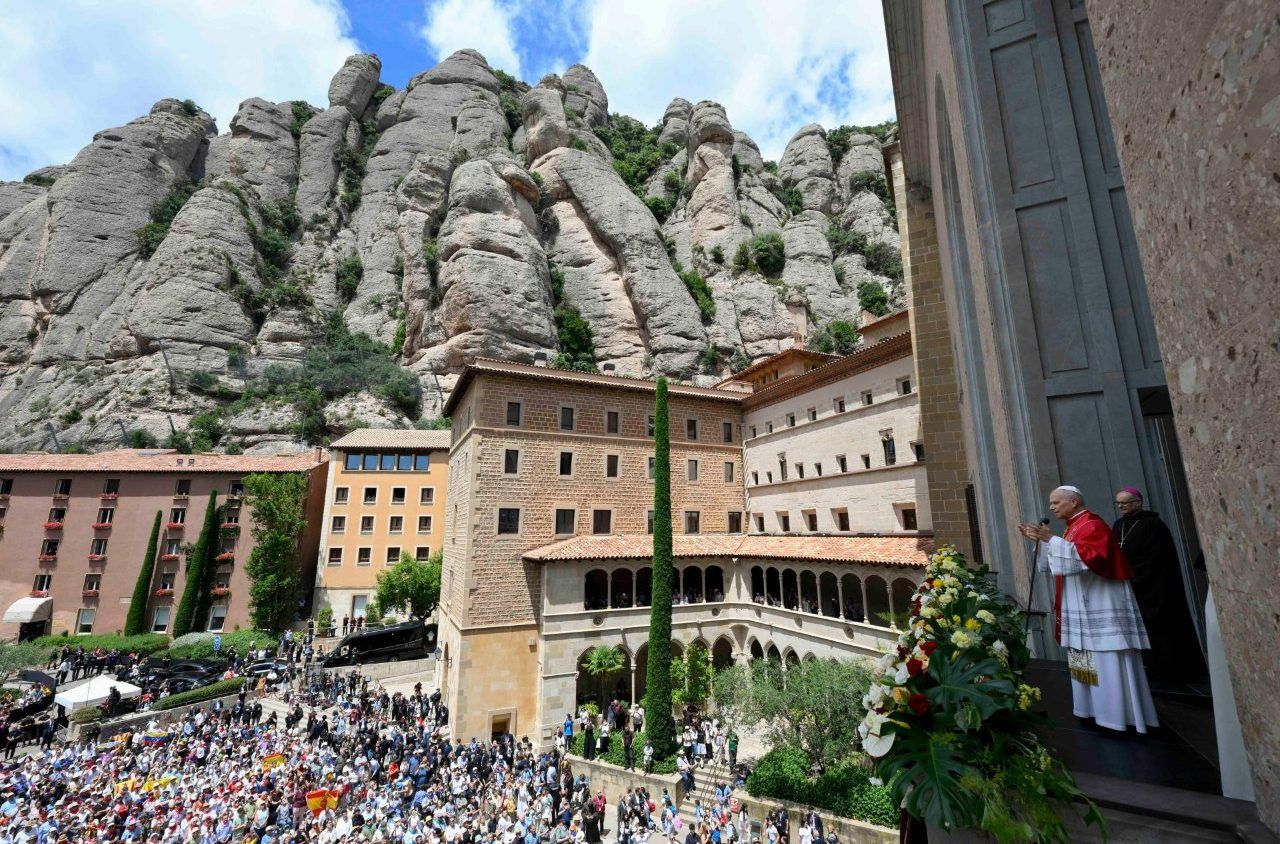
 During his trip to Spain, Leo XIV (in the photo from Vatican Media, visiting the Abbey of Montserrat) crossed paths with a plurality of life experiences, including one that is among the newest and most surprising in Europe today : that of the ever-increasing number of people baptized as adults on Easter night.
Responding to one of these newly baptized, at the Barcelona Olympic Stadium, Leo spoke of the healthy “restlessness” that pervades today’s secular city : a restlessness that is “a gift from God” to all of us “who are tailor-made for the infinite.”
Spain is not one of the European countries where the increase in adult baptisms is most marked. Nor is Italy, where most of the baptized are still children. But in France, where instead infant baptisms have plummeted, adult baptisms are strongly on the rise, and it is foreseeable that this will happen bit by bit in other countries as well, in step with the advance of secularization.
Marco Gallo, a priest living in Paris and director of the Institut Supérieur de Liturgie in France, has published a thorough analysis of the phenomenon in the latest issue of the “Rivista del Clero Italiano,“ supplemented with a curious testimony : the incredible crowds that for two years, on Ash Wednesday, have flocked to Parisian churches, including his parish of Saint-Germain-des-Prés, where this year “about a third of the overflowing congregation was made up of people who seemed never to have taken part in a Catholic ceremony.” A phenomenon that almost makes Gallo think of a mimesis of the start of Ramadan for Muslims, coinciding this year with the beginning of Lent.
They are certainly fooling themselves who think that adult baptisms will reverse the advance of secularization. In the 1960s in France, about 90 percent of the population were baptized, and 25 percent were practicing, while today the baptized under the age of 7 are 30 percent, and the practicing 2, “with a loss of about 200,000 baptisms per year compared to 2000.”
Yet the current numbers of adult baptisms are striking, statistically marginal compared with the mass of the unbaptized, but steadily increasing. In 2015 those baptized at Easter were 3,900, but ten years later, in 2025, that number had risen to 21,386.
Something similar is happening in the United States, where the Pew Research Center has ascertained that 1.5 percent of all adults have converted to Catholicism. But for every adult who converts, there are eight who abandon the Catholicism in which they were raised.
One feature that characterizes the newly baptized in France is that many of them do not have believing grandparents or parents. Instead of parents and family, they have as vectors of faith their friends and peers. It is the end of the vertical transmission of faith, from one generation to the next, which for centuries has been the typical model of Christianity.
The sociological profile of the newly baptized is decidedly young : those 18 to 25 were 20 percent in 2020, and are now 42 percent. 62 percent are women, and 71 percent live in urban areas. 46 percent declare that they come from a non-religious or atheist tradition, almost on a par with the 45 percent who come from families with a Catholic cultural tradition. And “this means,” Gallo observes, “that the phenomenon no longer concerns just a reawakening of dormant faiths, but also a first evangelization in the strict sense.” This implies that “ecclesial activities must no longer be aimed at reactivating a latent memory, but at building from the start a symbolic, narrative, and ritual universe in people who are structurally devoid of them.”
There are those who are tempted to see in this awakening a “renouveau catholique” similar to those that occurred in France and other European countries in the first half of the nineteenth century and even more so at the end of the century and in the early twentieth century, with a series of famous converts including established writers : in France, Georges Bernanos, Julien Green, François Mauriac, Ernest Psichari ; in Great Britain, T. S. Eliot, Graham Greene, Robert Hugh Benson, Evelyn Waugh, Hilaire Belloc, G. K. Chesterton ; in Norway, Sigrid Undset ; in Austria, Franz Werfel ; in Poland, Henryk Sienkiewicz ; in Russia, Nikolaj Berdjaev ; in Germany, Carl Schmitt and Romano Guardini.
But the current phenomenon is not comparable to previous ones. It is not yet consolidated, lacks leading figures, and quite a few neophytes, about a quarter of the total, seem to desert their communities and stop attending Mass within a year of their baptism.
Rather, the true novelty of these baptisms is that they arise from a horizontal transmission of faith, through friends and acquaintances : “It is no longer the ecclesiastical structure that generates the initial proclamation, but the human relationships that precede it and make it credible. The neophyte’s sponsor is often a peer, a college friend, a coworker.”
Gallo refers to Rodney Stark’s (1934 – 2022) studies on the first centuries of Christianity, in which this scholar identified a propagation of faith through networks of neighborhoods, artisan guilds, friendships. And he concludes his analysis as follows :
“The parallel with early Christianity is not simply an analogy : it has a precise diagnostic value. Stark had shown that the growth of early Christianity was possible because it operated in a context of religious pluralism in which the choice of faith was truly free and entailed a real social cost.
“The post-Christian condition of Western Europe structurally reproduces this configuration : faith is no longer something acquired by birth, but a choice that involves differentiating oneself from one’s environment, enduring the incomprehension of non-believing peers, building a new identity.
“In this context, the presence of believing friends who testify with their ordinary lives to the quality of their relation to the world becomes the decisive factor in the initial proclamation.
“Sociology and theology converge here on a common point : in a secularized society, the first place of mission is not the pulpit or social media, but friendship.”
(Translated by Matthew Sherry : traduttore@hotmail.com)
— — — —
Sandro Magister is past “vaticanista” of the Italian weekly L’Espresso.
The latest articles in English of his blog Settimo Cielo are on this page.
But the full archive of Settimo Cielo in English, from 2017 to today, is accessible.
As is the complete index of the blog www.chiesa, which preceded it.