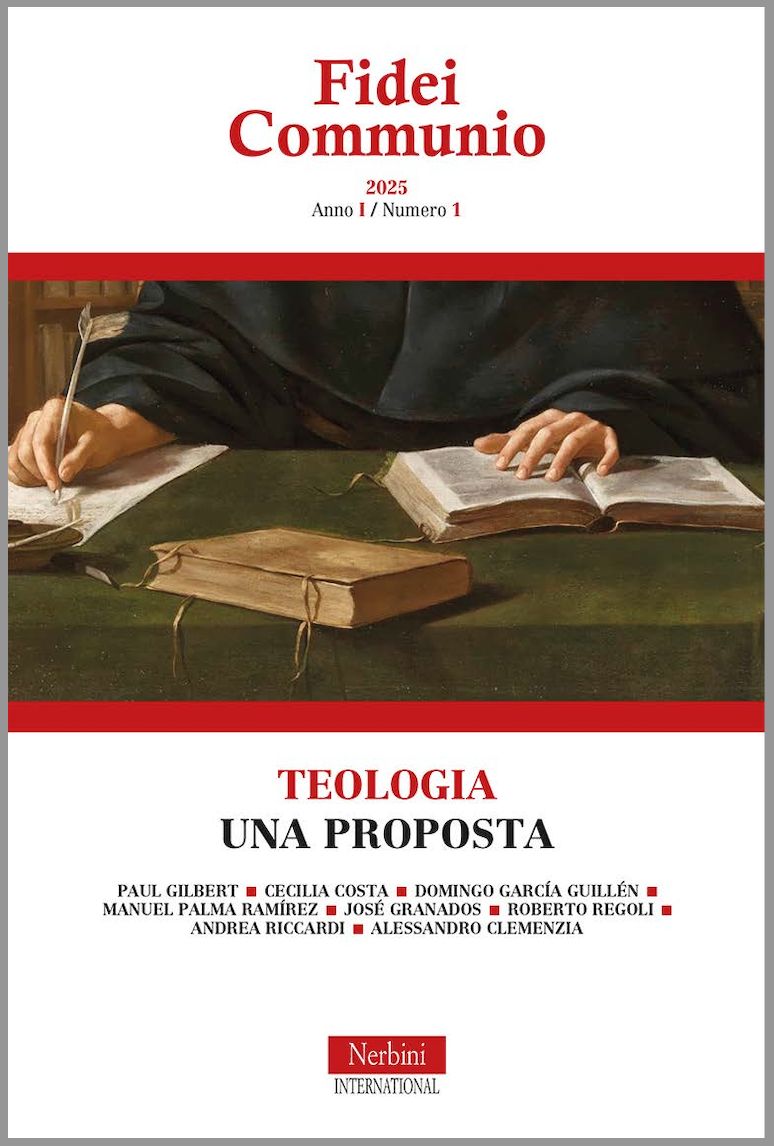
 It would be hard to give a new journal of theology a name more in keeping with Pope Leo’s vision than this : “Fidei Communio.” Yet the journal was conceived and born before the election of Robert Francis Prevost to the chair of Peter. Its founders were convinced that “if ‘communion’ was the horizon of post-conciliar challenges, ‘faith’ under crisis is the urgent current horizon of ecclesial thought.” Just as in the Augustinian motto of the current pope : “In Illo uno unum,” united in the one Christ.
Two substantial issues of “Fidei Communio” have been published so far, on a biannual basis, by a distinguished Italian publisher, Nerbini, of Florence. But its scope is international, with all the articles offered in their entirety and free on the web to readers around the world.
Its birth, in 2025, came about exactly fifty years after the launch of another famous journal of theology of nearly the same name, “Communio,” founded in 1975 by the talented theologians Hans Urs von Balthasar, Henri de Lubac, Joseph Ratzinger, and Louis Bouyer. Their intent was to offer the Church theological reflection in the wake of Vatican Council II, correctly interpreted with a “hermeneutic of reform, of renewal in the continuity of the one subject-Church” – as Ratzinger himself would say as pope – and not with the “hermeneutic of discontinuity and rupture” advocated instead by the preceding and rival theological journal Concilium, still published in several languages.
“Communio” also continues to be published in a dozen countries, but for ten years no longer in Italy and Spain. And the new journal has been brought to life precisely by Italian and Spanish theologians, among the most authoritative of the generations born after the founding of the forerunner journal.
The director of £Fidei Communio” is Alessandro Clemenzia, of the Theological Faculty of Central Italy in Florence. The executive board comprises two professors from the Saint Isidore of Seville Theological Faculty, Miguel Ángel Núñez Aguilera and Manuel Palma Ramírez ; Nicola Salato of the Pontifical Theological Faculty of Southern Italy, in Naples ; and Roberto Regoli, professor at the Pontifical Gregorian University in Rome.
It should be noted that Regoli, who is a talented Church historian, is not the only non-theologian who writes for the magazine, though he knows quite a bit of theology, given how he was able to intertwine both of these capacities in the most profound analysis yet published on the pontificate of Benedict XVI, released by Lindau in 2016 with the title : “Beyond the Crises in the Church.”
“Fidei Communio,” in fact, also means to provide a platform for religious studies, means to bring other fields of knowledge into dialogue with theology : philosophy, history, law, sociology, political science, literature, the arts.
For example, in the first issue of “Fidei Communio” the sociologist Cecilia Costa of Roma Tre University and the philosopher Paul Gilbert of the Gregorian write about Catholic religiosity in contemporary culture and about artificial intelligence, respectively. While the theologian José Granados sets Christology alongside the anthropology dominant today.
And this first issue also features an exchange, in a “Forum” on Ratzinger’s ecclesiological writings, between the magazine’s editor and the historians Regoli and Andrea Riccardi. With Regoli aiming straight at the major dispute that divides the Catholic Church today, between a democratic mode of evolution, complete with majority voting even on dogmas of faith, and on the other hand the thesis of Ratzinger – and of Regoli himself – that “truth cannot be put to a vote,” neither in a council, nor in a synod, nor much less in an episcopal conference.
That this latter is a serious issue in the life of the Church today, aggravated by the drift of the German “synodal way,” is also clearly noted in the second issue of “Fidei Communio,” with an article by its director Clemenzia on “Synodality and Church Reform : Some Viewpoints in Dialogue with Joseph Ratzinger” and with a “Forum” between the theologian Vito Impellizzeri and the illustrious canonist Geraldina Boni on the alarm raised by another great canonist, Carlo Fantappié, over the confused process toward a “synodal Church” initiated by Pope Francis.
But there’s another highly topical theme addressed in the second issue of “Fidei Communio.” It is the meaning of history, understood both as “Church history,” addressed by Regoli in an article with the seemingly paradoxical title “The Uselessness of Church History. Namely, Its Necessity,” and as “theology of history,” retraced by the French theologian and “Communio” director Jean-Robert Armogathe in an article entitled “Of the Need for a Theology of History,” in which he gives an account of the multiple readings of the “mystery of history,” in an existential vein as in Rudolf Bultmann, in a Christological vein as in Oscar Cullmann, in an eschatological vein as in Jean Daniélou, with the dialectic between the “already” of the salvation brought by Christ and the “not yet” of its definitive fulfillment, to conclude that in any case “a theology of history is the necessary condition of an authentic Christian theology”: an affirmation certainly shared by Pope Leo, with his Augustinian vision of the coexistence of the city of God and the earthly city.
They are all challenging topics, those addressed in “Fidei Communio.” But it must be said that they are deliberately presented in clear form, also readable for non-specialists, and at times even compelling. But always with impeccable scholarly accuracy, guaranteed by the prior peer review of each article.
Nor should another concordance be overlooked between the birth of “Fidei Communio” and Pope Leo, who last January 7 began a new cycle of his Wednesday catecheses, dedicated precisely to a rereading of Vatican Council II through its documents. That is, the true Council, not that of the media.
(On the cover, reproduced above, of the first issue of “Fidei Communio,” a detail of “St. Augustine in His Study,” attributed to Caravaggio).
(Translated by Matthew Sherry : traduttore@hotmail.com)
— — — —
Sandro Magister is past “vaticanista” of the Italian weekly L’Espresso.
The latest articles in English of his blog Settimo Cielo are on this page.
But the full archive of Settimo Cielo in English, from 2017 to today, is accessible.
As is the complete index of the blog www.chiesa, which preceded it.