 Islamism is seen and experienced by many as the most fearsome challenge to the West and Christianity, made up of wars, including religious ones, of ‘jihad’ pushed to the extreme, of waves of migration.
But a careful reading of what has happened in North Africa and the Middle East in recent decades shows both the rise, but then above all the decline of the Muslim threat, as well as the growing secularization of the Islamic faith, even more marked in a country with a theocratic regime like Iran.
A persuasive analysis of what Islam is today “between religion and politics” has been carried out by one of the most authoritative scholars on the subject, the Frenchman Olivier Roy, at a study meeting held at the Camaldoli monastery, organized by the Catholic magazine “Il Regno” and the Commission of the Episcopal Conferences of the European Community.
The lecture by Roy, who is a professor at the European University Institute in Florence and scholarly advisor for Middle East Directions at the Robert Schuman Centre for Advanced Studies, was afterward published by “Il Regno,” which authorized Settimo Cielo to reproduce the final part.
But before hearing from Roy, it is useful to retrace the key events of the last few decades, as he interprets them.
*
The rise of Islamist movements – Roy says – had its founding moment in the Six-Day War of 1967, in open contestation of the Arab nationalist regimes defeated by Israel. And from there the expansion of “Salafism” also took shape, understood as a return to the origins, as “a desire to re-Islamize Muslim society from below, through a return to strict religious practice, with the wearing of the veil and the beard, by individuals and independently of regimes.”
Then, starting in 1978, “the Iranian Islamic revolution tried to take the lead in global Islamist contestation” and to “also Islamize the alliance of opposition to Israel, which until then had been essentially based on Arab nationalism.”
But with the refusal of Sunni Islamist militants, particularly the Muslim Brotherhood, to subordinate themselves politically to the new regime of the ayatollahs, with the sole important exception of Hamas, Iran ultimately found itself at the head of an essentially Shiite coalition : in Lebanon with Hezbollah, in Syria with the Alawites of the Assad regime, in Yemen with the Houthis.
“One thus witnessed,” Roy writes, “a process of Iranianization of the Shiites, on both the doctrinal level (Twelver Shiism) and the clerical (clerical dress, training venues, religious ranks). In this sense, the Iranian Islamic revolution had a religious impact beyond its own borders, from Pakistan to Senegal : a homogenization of a Shiite world that until then had been very diversified.”
Only Hezbollah, nonetheless, fully embraced Tehran’s theocratic model. The Assads, in an already largely secularized Syria, “were quite careful not to integrate into Iranian Shiism.” As for Iraq, its Shiite militias obey Tehran, but “both the government and the Shiite clergy remain largely under the influence of the quietist, non-political current led by Grand Ayatollah Sistani,” with its uncompromising rejection of the principle of “velayat e faqih,” the rule of the religious judge, which is the essence of Iranian theocracy.
“The peak of Iranian influence,” Roy writes, “was reached in 2006. But what followed was only a long decline.”
A major turning point was the Arab Spring of 2011, which “denoted a marked secularization of political and social life in the Middle East. For the first time, Islam is no longer at the center of political contestation. Slogans like ‘The solution is Islam’ and ‘The Quran is our constitution’ are gone. The Muslim Brotherhood is absent from the demonstrations, which instead include many young women and, in Egypt, many Christians, despite the reticence of the Coptic clergy. Young people are demanding an end to corruption, and democracy. The protest is directed against the regimes in power. It is not articulated in the traditional causes defended in the past in the Arab streets : rejection of Israel, support for the Palestinians, denunciation of American imperialism.”
In Syria, the Arab Spring was followed by a civil war, with Iran forced to intervene to defend the Assad regime. And meanwhile, ISIS emerged, conquering Mosul in 2014 and establishing an Islamic state in northern Iraq and Syria.
But ISIS does not fall within the scope of the Middle Eastern conflicts. It is first of all, as Al Qaeda was, an expression of a “global jihad,” demanding hegemony in the Sunni world and the annihilation of Shiites and Christians, rejecting any alliance with states and other Islamic movements in the region, at war with everyone. To the point that the anti-ISIS coalition brings together almost everyone : Iranian and non-Iranian Shiites, the Muslim Brotherhood, Americans and Europeans, Jordanians, Kurds, Turks.
“The ‘jihad’ of ISIS,” Roy writes, “represented a paroxysmal radicalization fascinated by death, and ultimately proved nihilistic.” But even in the Middle Eastern states, “the Islamic factor, and therefore the religious one, has ceased to be decisive in explaining political upheavals and geostrategic alignments.”
The latest major turning point was the massacre of Jews by Hamas on October 7, 2023, and the subsequent war in Gaza. In just a few months the axis of anti-Israeli resistance headed by Iran was destroyed. And “it is clear that the collapse of the axis of resistance is part of a process of loss of influence by Islamist parties. The Iranian model is contested in its country of birth ; Hezbollah in Lebanon has not managed to be anything more than the political party of a segment of the Lebanese Shiite community ; the Muslim Brotherhood lost elections in Tunisia and Morocco, was crushed by the army in Egypt, no longer has any role in Sudan, disappeared from the political scene in Libya and Syria, and was marginalized by the monarchy in Jordan. Only Hamas maintained a solid popular and military position in Gaza, but it was crushed by the Israeli offensive in the Strip.”
Roy also notes that “the close cooperation between the Wahhabi clergy and the Saudi monarchy, which had fueled Salafi networks around the world, was brutally broken off by Crown Prince Mohammed bin Salman, without provoking any negative reaction : on the contrary, young people flocked to the new venues for secular concerts and entertainment, on the verge of the irreverent.”
Another revealing episode occurred last September in Morocco, where “Ibtissame Lachgar was sentenced to just 30 months in prison for wearing a T‑shirt with the slogan ‘God is lesbian,’ when twenty years earlier tens of thousands of radicals would have taken to the streets to call for her death.”
In short, “the Arab Spring certainly lost on the political level, but since 2011 all the uprisings and demonstrations by young people in the Arab world have been conducted on the same basis of demanding justice, without reference to Islam.” And even “the demonstrations for Gaza around the world are conducted more within an anti-colonialist tradition than with reference to ‘jihad’: in the West, they bring together young students, not immigrant neighborhoods with strongly Muslim populations.
“This political defeat of the Islamist and Salafi movements coincides with a complex phenomenon of secularization affecting the entire Middle East. One cannot speak of a clear cause-effect relationship, but there inevitably exists a certain correlation.”
Iran is at the most advanced stage of this wave of secularization. And here is how Roy describes it, in the final section of his report.
*
Iranian Society, Champion of Secularization
by Olivier Roy
In Iran, the regime’s Islamic legitimacy has disappeared, and it now appears only as a dictatorship. A first turning point came in 2009, when conservative president Ahmadinejad was re-elected under dubious circumstances, provoking a violent popular reaction whose main slogan was “Where is my vote?” It is the regime’s authoritarian nature that is denounced in the streets. Civil society rejects the concept of “God’s sovereignty” and sees at the helm just an authoritarian leader like so many others in the Middle East.
This revolt is certainly political, but above all it denotes an important change : the secularization of civil society. Reference to Islam no longer mobilizes, and is even becoming counterproductive. The regime retains a social base, probably around 20 percent, for both ideological and clientelistic reasons. But the clergy is no longer an effective channel of communication between the regime and society, as the system, by its very nature, has prevented the emergence of great independent spiritual figures within a now nationalized clergy.
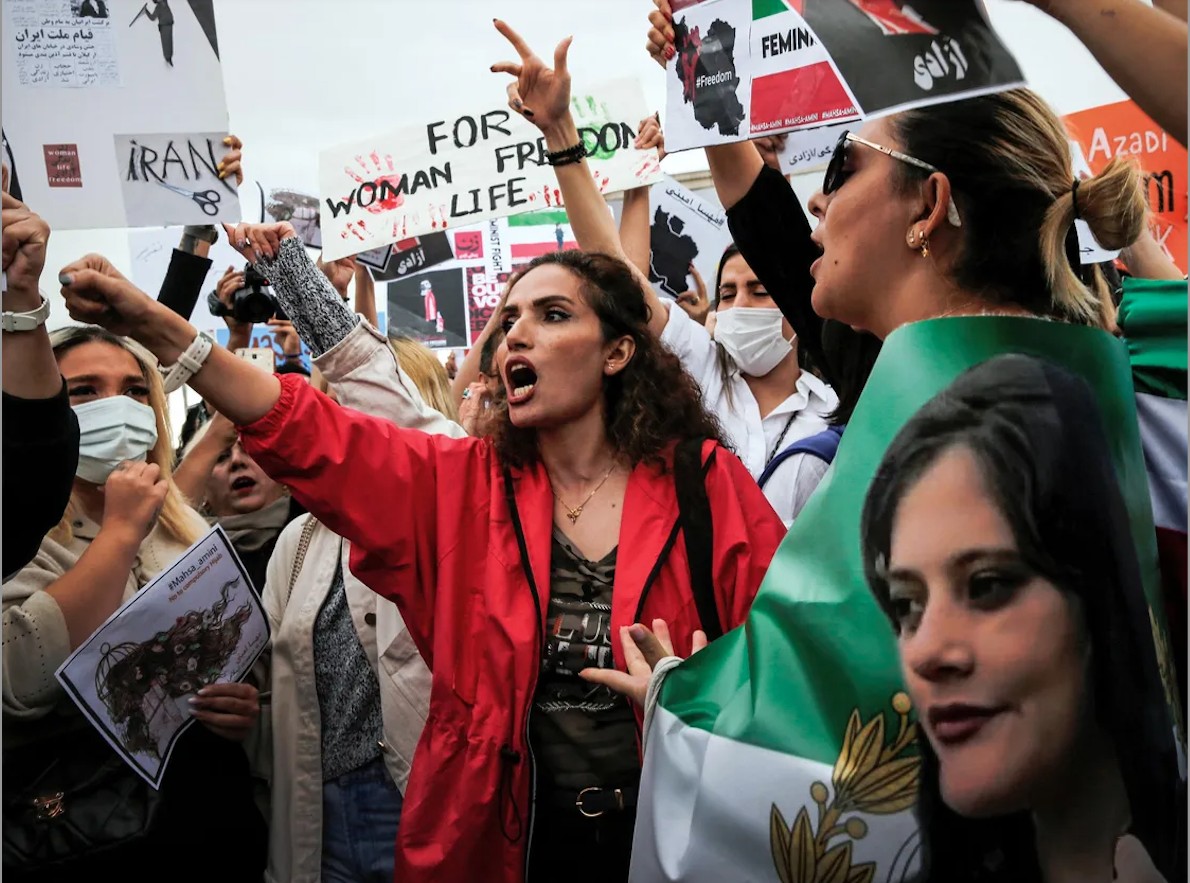
The neighborhood mullahs have lost all prestige and are nothing other than officiants at ceremonies attended only on important occasions, primarily funerals. At the same time, the influence of the Revolutionary Guards prevails over that of the clergy. But the Guards, the “pasdaran,” are laymen who have a purely ideological relationship with religion. The movement to reject the veil takes on a dimension both political – “zan azadi zendegi”: woman, freedom, life [as in the photo above, by Dilara Senkaya/Reuters] – and social : women are simply ceasing to wear the veil in public, despite the risks.
The discrediting of the regime ends up striking at Islam as such, not just political Islam. Iranian society has undoubtedly become the most secularized in all the Middle East. There are no statistics on religious practice in the country, but testimonies agree on the disaffection for official Islam, if not indeed for Islam tout court.
Today we are witnessing an individualization of the relationship with religion more accentuated than ever. Atheism, the pursuit of other forms of spirituality – Sufism, or even conversion to Christianity – or simply religious lukewarmness are now commonplace. Conversions to religions other than Islam are obviously prohibited, but just looking on the internet at the number of sites that reference Persian-language Christian churches based in Turkey – home to millions of Iranians, who can travel there visa-free – confirms a real movement of conversions to Christianity, above all Evangelical.
We are moreover witnessing a phenomenon also found in Catholicism : a growing disconnect between faith and identity. Religious symbols, like the veil, represent both an affirmation of oneself and one’s faith, and a sign more cultural than religious. In Europe, they indicate belonging to a minority that defends recognition of and respect for its identity, but does not raise the question of faith and belief.
The debate does not hinge on theology, which explains why reformist Muslim intellectuals like Abdolkarim Soroush, Abdelmajid Charfi, Mahmoud Mohamed Taha, etc., are little read by young Muslims today. This identitarian tendency readily allies itself with the far left in the defense of multiculturalism and not of religious freedom.
Conversely, many young “born again” Muslims, instead of setting out on jihad, emulate young Christians their age. And vice versa : this is why Christian young women are seen wearing the veil or fasting, not because they are fascinated by Islam itself, but in emulation of a spirituality that is prevalent among young Muslims in their neighborhoods, at school, or at university. This complex interplay between identity and spirituality often also unfolds in a virtual space, that of the internet, and remains detached from political references.
The identity polarizations dominating political life – from the MAGA movement in the United States, which brings together Protestant Evangelicalism and white identity movements, to the traditionalist Catholics in Europe defending a Christian Europe against immigration – cannot hide deeper and more complex movements. Which demonstrate that the search for spirituality among young people no longer takes the ideological forms known to the previous generations.
(Translated by Matthew Sherry : traduttore@hotmail.com)
— — — —
Sandro Magister is past “vaticanista” of the Italian weekly L’Espresso.
The latest articles in English of his blog Settimo Cielo are on this page.
But the full archive of Settimo Cielo in English, from 2017 to today, is accessible.
As is the complete index of the blog www.chiesa, which preceded it.