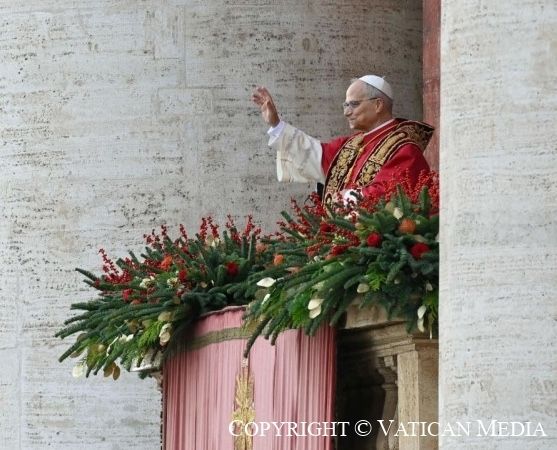
 It is not easy to fully understand Leo XIV when he speaks of peace. He invoked it as “disarmed and disarming” in his first greeting after his election as pope, and numerous times thereafter. An evocative pairing, but difficult to apply to the many wars underway in the world.
But he also invoked it as “wildpeace,” in the solemn “urbi et orbi” message on Christmas Day (in the photo), quoting the Jewish and Israeli poet Yehuda Amichai (1924 – 2000) from one of his anthologies published in the United States : “Let it come like wildflowers, suddenly, because the field must have it : wildpeace.”
“Amichai does not believe in peace as a miracle,” commented Sara Ferrari, a professor of Hebrew at the University of Milan and a scholar of the poet. “True peace is not born from innocence, but from the awareness of knowing how to do evil. It is a radically biblical message.”
And that evil is invading the earth is a reality that Leo does not diminish. In his Christmas homily, on the day when “the Word has pitched his fragile tent among us,” he continued right after :
“How, then, can we not think of the tents in Gaza, exposed for weeks to rain, wind and cold ; and of those of so many other refugees and displaced persons on every continent ; or of the makeshift shelters of thousands of homeless people in our own cities ? Fragile is the flesh of defenseless populations, tried by so many wars, ongoing or concluded, leaving behind rubble and open wounds. Fragile are the minds and lives of young people forced to take up arms, who on the front lines feel the senselessness of what is asked of them and the falsehoods that fill the pompous speeches of those who send them to their deaths.”
It comes as no surprise that many of Pope Leo’s words, like these latter regarding the many soldiers senselessly forced into combat or those against the unbridled arms race, should be taken up and relaunched by pacifist currents, Catholic and not, to support their own theses. In particular, the papal message for the World Day of Peace on January 1, packed with invectives against a rearmament driven “far beyond the principle of legitimate defense,” has been a particularly fertile field for pacifists.
But precisely this reference to “legitimate defense” is enough to bring Leo’s condemnation of weapons back within the limits of the Church’s two-thousand-year-old doctrine on peace and war.
Just as the Ukrainian soldiers who have heroically sacrificed their lives for four years to defend their nation and Europe from aggression cannot be charged with the “falsehoods of those who send them to their deaths,” which are instead attributable to the aggressor, Russia.
In his speeches and homilies, Pope Leo avoids naming those to whom he addresses his harsh criticisms. But there is no doubt that when he forcefully denounced, in his homily on New Year’s Eve, those “strategies aimed at conquering markets, territories, spheres of influence ; armed strategies, cloaked in hypocritical speeches, ideological proclamations, and false religious motives,” he was not referring to Ukraine or Europe, but to Russia, to Vladimir Putin and Patriarch Kirill, as well as to those in power in the White House.
To dispel any misunderstanding about his thinking, Leo has adopted an accessory form of communication that takes place almost every Tuesday evening, upon his return to Rome after his day off at Castel Gandolfo. In a quick and deliberate meeting with journalists before getting into his car, he presents himself for questions about current events. To which he responds with sober but clear words, or sometimes even with silence, but providing the reason for it.
For example, on December 9, after receiving Ukrainian president Volodymyr Zelensky at Castel Gandolfo, the pope said with regard to the Ukrainian children deported to Russia that the Holy See’s work “is done behind the scenes” and “is very slow, unfortunately.” And “so I prefer not to comment more than, we continue working on that, to try and get those children back to their homes, to their families.”
While regarding the initial 28-point peace plan proposed by Donald Trump, in evident agreement with Vladimir Putin, he replied that he had not read it in full, but, “I think, unfortunately, some parts of it that I have seen make a huge change in what was for many, many years a true alliance between Europe and the United States. In fact, I think Europe’s role is very important, especially in this case. Seeking a peace agreement without including Europe in the discussions is unrealistic. The war is in Europe, and I think Europe must be part of the security guarantees being pursued for today and in the future. Unfortunately, not everyone sees it this way.”
It is clear that the “security guarantees” that Leo invoked for Ukraine and Europe largely involve weapons and armies. But the pope also refers often to another way to peace, which he evoked, for example, at the Angelus on the feast of St. Stephen, the protomartyr : “Today, those who believe in peace and have chosen the unarmed path of Jesus and the martyrs are often ridiculed, excluded from public discourse, and not infrequently accused of favoring adversaries and enemies.”
So in Leo’s preaching there is a fundamental distinction between an “unarmed” peace, understood as a strictly personal choice that can lead even to self-sacrifice as Jesus did on the cross, to the derision of the world, and a “disarmed and disarming” peace which is instead to be sought within the civil sphere, for the good of all, so that the force of law may prevail over the force of arms.
Flavio Felice, president of the Tocqueville-Acton study center and professor of the history of political doctrines at various universities in Europe and America, including the Pontifical Gregorian University, clearly illustrated this distinction in a commentary in Il Foglio on January 2. In it he wrote, among other things :
“Martyrdom is a supreme act of conscience that engages the person who chooses it, the consequences of which cannot help but fall upon him. Therefore one cannot choose the martyrdom of others. If a brother is under attack, failing to help him in the name of peace simply means condemning him to defeat. There is no nobility in such a failure to provide assistance, and the outcome of such an omission will not be a ‘disarming’ peace but a criminal and cemeterial order in which the executioner will have got the better of the victim.”
From a civil perspective, instead, and in light of the Church’s social doctrine, the “disarmed and disarming” peace invoked by Leo “can also arise from legitimate defense and deterrence, so that the executioner may not get the better of the victim, and in working for an institutional framework that would make recourse to war unlikely and replace brute force with law.”
These considerations of Professor Felice coincide with those of another renowned political analyst, who in the latest issue of the authoritative progressive Catholic magazine Il Regno, which he has directed since 2011, concludes his editorial thus :
“When the Christian message affirms peace as the synthesis of all messianic goods, it does not deny history and its reality. And when the reality is a reality of evil, that evil must be opposed with every morally and legally licit means. There is a right to life, starting with oneself. It is legitimate – the magisterium of the Church affirms this – to enforce one’s right to life. And this right becomes a duty toward others, above all for those with public responsibilities, as Gaudium et Spes teaches. For this reason, legitimate defense, in addition to being a right, can also be a grave duty for those institutionally responsible for the lives of others. The defense of the lives of entire populations – due to their weakness and powerlessness – requires rendering the aggressor harmless, with recourse, if necessary, to force. Not intervening, being able to do so, constitutes complicity by omission and therefore a fault. A Christian cannot collaborate in evil. We experienced what happened in Europe in the 1930s because of opportunism, omissions, and fears : it has an acrid smell and an ash-gray color.”
Pope Leo is under no illusions. But neither is he pliant. He has reaffirmed several times, including in his interview with journalists on December 9, that “the Holy See is available to offer space and opportunities for negotiations.” And when this offer is not accepted – as indeed happens – he has reiterated that “we are available to seek a solution and a lasting and just peace.”
Because the Holy See has a special role, for a “disarmed and disarming” peace, and Leo certainly does not want to give it up. “The Holy See does not present itself as one geopolitical actor among the others, but as a conscience critical of the international system ; it is the sentinel in the night that already sees the dawn, that calls to responsibility, to law, and to the centrality of the person,” as Archbishop Paul Richard Gallagher, Vatican secretary for relations with states, the Holy See’s foreign minister, was also keen to point out in a January 1 interview with the SIR news agency of the Italian bishops’ conference.
But above all, valid for Pope Leo is the grandiose vision of St. Augustine’s De civitate Dei, of the two cities that coexist in history and in the conscience of every man : the city of God, “which is eternal and characterized by God’s unconditional love ('amor Dei'), as well as love for one’s neighbor,” and the earthly city, “centered on pride and self-love ('amor sui'), on the thirst for worldly power and glory that leads to destruction.”
Leo spoke extensively about the two cities in his annual address to the diplomatic corps, which he gave on Friday, January 9. Augustine, the pope said, “emphasizes that Christians are called by God to dwell in the earthly city with their hearts and minds turned towards the heavenly city, their true homeland. At the same time, Christians living in the earthly city are not strangers to the political world, and, guided by the Scriptures, seek to apply Christian ethics to civil government.”
Humanitarian law respected even in war, truthfulness of words in relations between states and in communication, freedom of expression, freedom of conscience, religious freedom as the “first of all human rights,” the inviolability of life from its birth to its death are the fruits of this gaze upon the heavenly city, to which, however, “our era seems somewhat inclined to deny the right of citizenship,” the pope told diplomats.
On each of these points, as on many others, Leo expressed himself with his typical transparency. On the persecution of Christians – “one in seven” – he did not keep quiet on “jihadist violence.” On the “short circuit of human rights,” he denounced the “restriction in the name of other so-called new rights” of the fundamental freedoms of conscience, religion, and “even the right to life.” On freedom of expression, he warned that “a new Orwellian-style language is developing which, in an attempt to be increasingly inclusive, ends up excluding those who do not conform to the ideologies that are fueling it.” On the Israeli-Palestinian conflict, he called for peace and justice for both peoples in their own lands. And on Ukraine, he denounced “the suffering inflicted on the civilian population,” with “the destruction of hospitals, energy infrastructure, homes,” following “the use of force to violate the borders of others.”
A speech well worth reading, almost a manifesto of his pontificate, this of Leo for January 9, with his rereading of the great Augustine applied to today’s world, in which “war is back in vogue and a zeal for war is spreading.”
(Translated by Matthew Sherry : traduttore@hotmail.com)
— — — —
Sandro Magister is past “vaticanista” of the Italian weekly L’Espresso.
The latest articles in English of his blog Settimo Cielo are on this page.
But the full archive of Settimo Cielo in English, from 2017 to today, is accessible.
As is the complete index of the blog www.chiesa, which preceded it.