 In Israel, voting was on Tuesday, October 27, and in the United States, voting will be tomorrow, Tuesday, November 3. With what sway of the Catholic electorate, in the one and the other case ?
In Israel, Catholics are around 140,000 out of a total of 184,000 Christians, 1.9 percent of the whole population. The majority are Greek Catholics of the Melkite rite, and 80 percent are of Arab ethnicity. They live mostly in Galilee and the north of the country, in and around Haifa, while Jerusalem and Tel Aviv have larger numbers of non-Arab Christians, those of the Latin rite or other Eastern rites, including a small Israeli-born and Hebrew-speaking community.
Ahead of the October 27 elections, polls indicated a prevailing inclination among Israeli Christians in support of Arab parties, with a preference for the party of communist origin, but historically led also by Christians, named Hadash, now in coalition with the Joint List led by Yousef Jabareen. There appeared to be less approval for the second Arab party in the running, Ra’am, led by Mansour Abbas, originally with a strong Islamist profile that, however, has recently diminished to the point of its giving second billing to the Jew Yoav Segalovitz, with a past as a police commander.
Moreover, that part of the Christian electorate which is most integrated into academia, healthcare, the judiciary, the economy, has shown its support for the parties in coalition against Benjamin Netanyahu, in particular Gadi Eisenkot’s Yashar and Yair Golan’s Democrats, heirs of the laborists who founded the state of Israel.
And this is what happened on October 27, in the wake of the unprecedented increase in turnout at the polls among Arab citizens – who in total are more than 2 million, 21 percent of the Israeli population – and the strong advance of their two parties, the Joint List and Ra’am, which won 11 and 8 seats respectively.
The coalitions of Netanyahu and Eisenkot secured, respectively, 53 and 48 seats in parliament, where at least 61 are required to govern. The Arab parties, with their 19 seats, two of them won by Jews, could therefore support an anti-Netanyahu government. The Joint List has offered external support ; Ra’am has said it is ready to join a governing majority, as in 2021 with Prime Minister Naftali Bennett, but Eisenkot’s coalition also includes the hawk Avigdor Lieberman, firmly hostile to any agreement “with supporters of terrorism,” and without the 7 seats held by his party, Yisrael Beiteinu, the anti-Netanyahu coalition would halt at 60 seats, one short of the minimum threshold. To get past this obstacle, on the evening of October 31 Eisenkot included among the conditions of an agreement with the Arab parties – initially with their external support – the recognition of Hamas as a terrorist organization and the need to destroy its military and political rule in Gaza.
A first field test of an agreement with the Arab parties will take place on November 10 with the election of the speaker of parliament, with the candidacy, for Eisenkot’s coalition, of Yair Lapid, together with Bennett the leader of the Beyachad party, 12 seats strong.
The formation of a new government, therefore, appears uncertain and toilsome. Also seemingly very arduous is the possibility of a grand coalition between Eisenkot and Netanyahu, without the Arab parties and above all with the exclusion of the ultra-extremist parties of Itamar Ben Gvir and Bezalel Smotrich, who came out losers in this election.
As a result, voters’ expectations also remain uncertain. Which for the most part do not coincide at all with the issues discussed at the international level. The solution, for example– systematically brought forward also by the Holy See – of two states for the two peoples, Jews and Palestinians, is far from being at the center of political debate in Israel. Among the parties, apart from the Arab ones, only the Democrats continue to include it in their platform, but for a distant future, warning that they consider it “harmful” to recognize a Palestinian state today
And the same goes for the war against Iran and its proxies, from Hezbollah to Hamas. The differences between Netanyahu and his opponents are only in the modalities of the conflict, not in the substance. Eisenkot, former chief of staff, is a more pragmatic hawk, not a dove.
Rather, what most voters want is to block the reconfirmation of Netanyahu’s far-right government, with its extremist ministers Ben Gvir and Smotrich. Among the objectives most called for are mandatory conscription for ultra-Orthodox Jews, until now exempted from military service, and the establishment of an independent commission of inquiry into the failure to prevent the October 7, 2023 massacre.
On the part of Arab voters, there is also the demand for greater security, given the wave of crime affecting them. But above all, there is the expectation – not only among Arabs but in a large part of the electorate – of a distinct breakthrough in the West Bank, one that would put an end to the violence of extremist settlers against Palestinians and block the creation of new Jewish settlements.
Naturally, with Christians at the forefront in upholding this demand, brought forward repeatedly also by their religious leaders, headed by the Latin patriarch of Jerusalem, Pierbattista Pizzaballa. In effect, there has long been a crescendo of violence, desecration, mistreatment against Christians, at the hands of extremist Jews left free to act by law enforcement, not only in the West Bank but also in Israel, particularly in the Old City of Jerusalem.
This in Israel. But in the United States, what is the outlook of the Catholic electorate ?
In the United States, Catholics are not a small minority as in Israel. They are more than 70 million, between one fifth and one fourth of the whole population.
In 2024, 55 percent of Catholic voters voted for Donald Trump, and only 43 percent for Kamala Harris, thus subverting the traditional prevalence among Catholics of the vote for the Democratic Party.
But over the next two years, Catholic approval for Trump’s performance declined drastically. A survey conducted by the Washington-based Pew Research Center a few weeks before the November 3 midterm elections measured a decline from 59 to 39 percent among white Catholics, from 47 to 30 among all Catholics, and from 31 to 18 among Hispanic Catholics, the “Latinos.”
Asked to say for whom they would vote on November 3, 50 percent of white Catholics responded for the Republican candidate, compared to 32 percent for the Democratic candidate. But among Catholics overall, only 39 percent would vote for the Republican, versus 42 percent for the Democrat. And among the “Latinos,” the gap was even bigger : 19 percent for the Republican versus 42 percent for the Democrat.
Among Christians overall, white evangelical Protestants are the only group of voters who in the majority said that they will vote for the Republican candidate : 73 percent versus 12 percent for the Democratic candidate. But among black Protestants, the leanings are reversed : 74 percent for the Democrat versus 8 percent for the Republican. And even among white evangelicals, approval for Trump’s performance has declined over the past two years, from 78 percent to 58 percent.
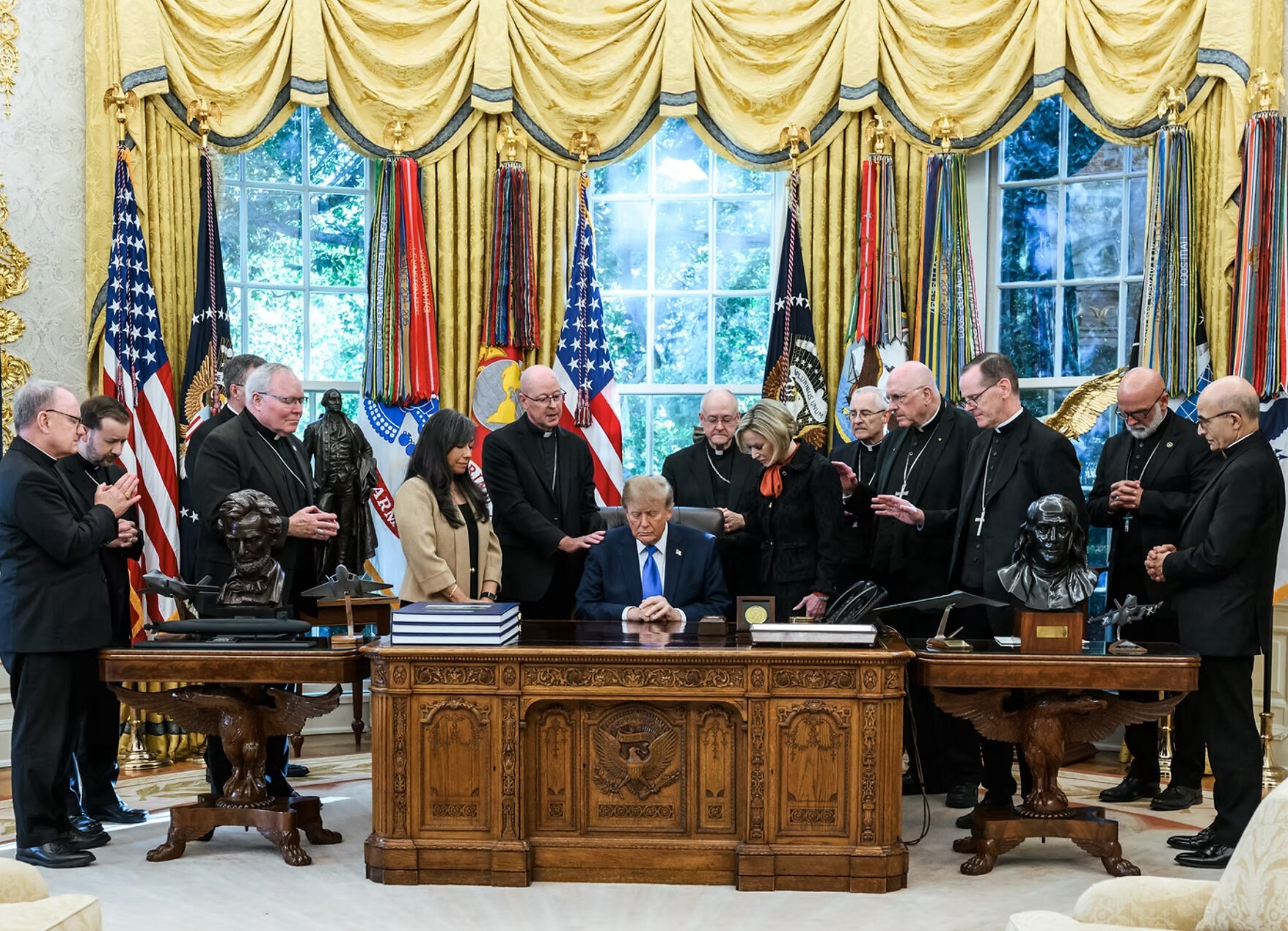
In the face of this strong and growing friction between Trump and American Catholics, like a thunderbolt came the photo reproduced at the top of this page, released by the White House on October 22, twelve days before the vote, with twelve Catholic bishops, some of them prominent, gathered in prayer around the president.
Beside Trump one notes the presence, in dark attire, of Paula White, president of the Faith Office, active at the White House since February 2025 and made up almost entirely of evangelical pastors and preachers of untarnishable Trumpian faith.
Taken by surprise and hit with criticism, the twelve bishops sprinkled ashes on their heads, blaming the White House for the improper release of the photo of that moment of prayer with the president, requested, to their surprise, at the end of a meeting arranged by the Heritage Foundation on immigration and human dignity.
And indeed, this photo did not at all signal a patching up with Trump by the Catholic Church in the United States, which remains distant from him on at least three major issues : immigration policy, the war against Iran, and the protection of fundamental rights in a democratic state. Not to mention, more recently, the Catholic Church’s uprising against the live television broadcast – later called off – of the capital execution of a condemned man.
The latest to distance itself from Trump is the leading magazine of conservative intellectual American Catholicism, First Things. Nor has no note been taken of the coolness of Vice President JD Vance, a fervent Catholic and likely future White House candidate, regarding the war against Iran, in which he has never believed.
In the background there is also the verbal clash between Trump and Leo XIV, up to now overwhelmingly won by the pope both for the things said and the way in which they were said, as well as for the eloquent silences.
Trump often plays on Robert F. Prevost’s older brother, Louis, the last time a few days ago : “His brother’s a friend of mine, who’s a great, he’s a fantastic guy. And his wife, you know, they’re big Trump supporters, they have MAGA all over their house.”
But that this could turn the Catholic vote in support of Trump in the November 3 elections remains entirely to be seen.
As a U.S. citizen, Pope Leo also voted. In an October 30 statement, the Holy See confirmed that “he has submitted his mail-in ballot in Chicago.” And this by virtue of “his belief in the right and duty of citizens to participate in democratic processes.”
(Translated by Matthew Sherry : traduttore@hotmail.com)
— — — —
Sandro Magister is past “vaticanista” of the Italian weekly L’Espresso.
The latest articles in English of his blog Settimo Cielo are on this page.
But the full archive of Settimo Cielo in English, from 2017 to today, is accessible.
As is the complete index of the blog www.chiesa, which preceded it.