 (s.m.) Summer is a time for reading. And it is to a great book of fiction that Settimo Cielo dedicates its last post before the August break : to “Life and Fate” by Vasily Grossman, in Anne-Marie Pelletier’s skillful rereading of it in the latest issue of “Vita e Pensiero,” the magazine of the Catholic University of Milan.
Vasily Grossman (1905 – 1964), a Jew, was born in Berdychiv, the Ukrainian city that in recent days received a visit from Pope Leo’s envoy, the archbishop and Vatican foreign minister Richard Gallagher, a tenacious supporter of Ukraine’s resistance against Russian aggression.
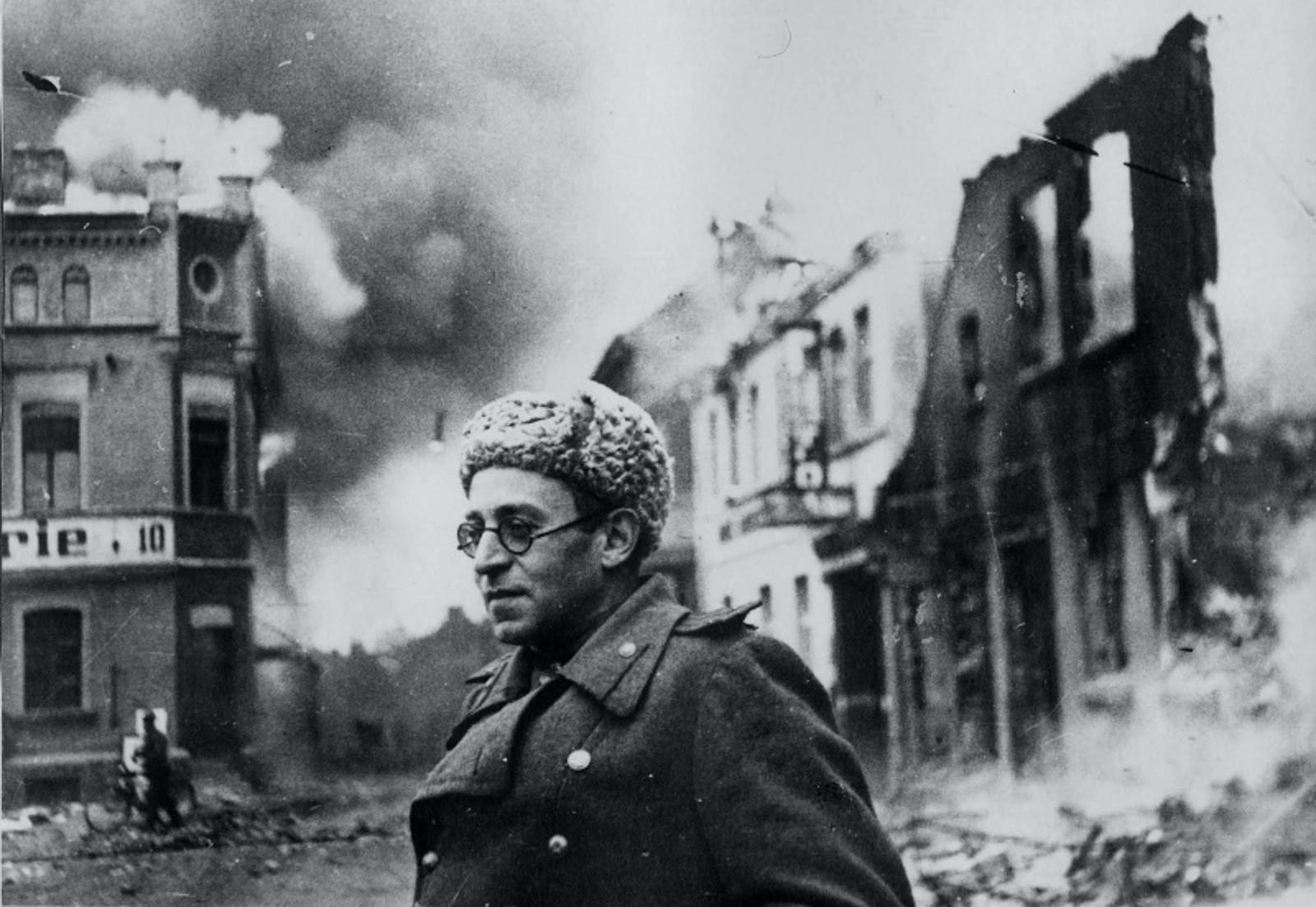
There is a disturbing similarity, as Pelletier points out, between Vladimir Putin’s Russia and Stalin’s Soviet Union. And Grossman, in his youth a supporter of the communist revolution and a war correspondent on the fronts from Stalingrad to Berlin (see photo, copyright Alamy Stock Photo), converted precisely to a radical critique of Stalin’s regime, soon ending up an outcast, under constant threat of arrest and prevented from publishing the books he had dedicated himself to.
In 1961 the KGB confiscated the manuscript and typewritten copies of the nearly one thousand pages of “Life and Fate.” Grossman died three years later, but miraculously one copy survived and reached Andrei Sakharov, the great physicist and hero of dissent, Nobel Peace laureate in 1975, arrested several times, who managed to get it to the West and have it published in 1980.
Anne-Marie Pelletier, the author of the evocative rereading of “Life and Fate” reproduced here, teaches Sacred Scripture and biblical hermeneutics on the Faculty of Notre-Dame at the Collège des Bernardins in Paris. She was the first woman to receive the Ratzinger Prize for theology, in 2014.
*
Rereading Vasily Grossman to Strengthen Hope
by Anne-Marie Pelletier
What need is there to read Vasily Grossman today ? A Russian writer from the last century, who died in 1964, whose life can be largely defined as “Soviet,” whose inspiration draws upon the history of two totalitarianisms that we would like to believe are now behind us. Yet the great surprise is that this work immediately resonates with our current situation. It even seems written for us, so much does the order that reigns in Moscow today reproduce, feature by feature, that of Soviet Russia.
In this sense, and to begin with, Grossman helps us decipher the logic of the destructive violence unleashed in Ukraine over the past four years and now threatening all of Europe. But there is more to learn from him, and we will deal with this further on : he offers his support for the resistance that we must put up against the blackmail of evil, which is increasingly dragging our societies toward despair and nihilism.
Sixty years of Soviet history
To appreciate the relevance of Grossman’s work, it is necessary to briefly recall its historical context. He was born in 1905 in Berdychiv, in that part of Ukraine which, until the Nazi policy of extermination, was home to the shtetls, the rural centers of Hasidic Judaism, where daily life was as fervent as it was meager. He belonged to an assimilated Jewish family of scholars and notables. He began by supporting the October Revolution, in which he confidently placed his hopes. After studying chemistry, which led him to work for a time in the Donbas, he finally devoted himself entirely to literature.
Times were hard. The regime’s diktats increasingly limited cultural life. Socialist realism, in the service of the dictatorship of the proletariat, became the selection criterion for compliant writers. Like it or not, Grossman submitted to the regime’s demands. Until the war, in a society under the yoke of Stalinist terror, he faced life with prudence, but without qualms of conscience. In the 1930s he saw on the streets of Kiev, without really seeing them, the walking corpses of kulaks reduced to famine by Stalin. He emerged unscathed from the Great Terror of 1936 – 38, albeit at the cost of a compromise that would haunt his conscience forever. In 1941 he became a war correspondent for the newspaper “Krasnaya Zvezda” (Red Star). And so he followed the Russian troops to the bloodiest fronts, from Stalingrad to Treblinka, all the way to Berlin.
It was at the end of these dreadful years that the “Soviet man” within him would turn into a fearless denouncer of the evil doubly embodied in Soviet and Nazi totalitarianism. In the autumn of 1941 his mother was murdered by the Nazi troops that had entered Berdychiv. In the following months the killings were multiplied in all the territory of Ukraine, justifying the chilling observation that he would make in 1945 in “The Black Book:” “There are no more Jews in Ukraine.”
It was precisely during these years that his forgotten Jewish identity recurred to him. The experience of this infernal history profoundly struck him and, naturally, his work, in which a fundamental break took place. The past came back to him, with all that he had ignored in it. The horror of Stalinism became undeniable. This clarity of vision would become ever more explicit in his work, so much so that Stalin’s death in 1953 came just in time to save him from arrest.
It was his novel “Life and Fate” that would embody the work of truth to which Grossman would devote himself from then on. Placing itself within the narrative tradition of “War and Peace,” this novel delves into the memories of the war years, sometimes broadening the view to the utmost, sometimes narrowing it to the tiniest details of individual fates, where humanity in resistance is concealed. From then on, nothing could stop Grossman’s inner urgency of truth. “Life and Fate” highlights the twinning between Nazism and Sovietism in an evocative scene that brings together a Nazi camp commander and an elderly Menshevik, his prisoner, about to be murdered.
The same boldness emerges in the pages of his last manuscript, “Everything Flows,” which tells the sorrowful story of the return of a political prisoner, a zek, a gulag inmate, who upends the peaceful life of his accuser and his family, who had managed to save their hides. In addition to denouncing Stalin and his predecessor, Lenin, he attacks the myth of the “Russian soul” in its disturbing complicity with slavery. This makes him an absolute traitor to the Cause. In 1961 the manuscripts of “Life and Fate” were confiscated by the KGB. The work disappeared into the bowels of the Lubyanka, where it would remain for two hundred years, as he was told with scorn. He died three years later, an outcast, without seeing the publication of this work to which he was so attached.
Yesterday and today : the denouncement of evil and nihilism
It is this past, today rehabilitated and brought back to life by the Kremlin, that now constitutes the Soviet present of the 21st century. Since the year 2000 the past has not ceased to return at the behest of a leader trained in the school of the KGB, who considers the collapse of the USSR “the greatest geopolitical catastrophe of the 20th century” (address to the nation, April 2005). The institutions of the military indoctrination of young people, which forged the “red man,” have been reactivated and imbue students with warmongering from kindergarten on. Statues of Stalin, once pulled down, have been put back. The mental economy of the totalitarian system, implemented by the Bolshevik Party, is being recycled at full capacity. The “Memorial” association founded by Andrei Sakharov in 1989, which meticulously documented the traces of crimes during the Soviet years and monitored the still fragile human rights in the post-Soviet era, was dissolved in 2021.
On the religious front the change is only superficial. The defense of Christianity is now strongly invoked by Kremlin ideologues, with the support of Kirill, the patriarch of Moscow. In fact, the last century’s physical persecution of persons is perversely perpetuated by the enlistment of the Russian Orthodox Church in the service of the state’s criminal policies, which are nothing but a grotesque inversion of Christianity. A terrible deception. It is understandable, therefore, that this situation should make Grossman’s work a powerful tool for critical analysis of the reality of our present.
But there is another, equally decisive, way in which this work should draw our attention. In effect, it is both an appeal and a denunciation. It is at the service of both trust and lucidity. Ultimately, it is a stubborn defense of humanity’s resources, in opposition to contemporary history, which has brought the reign of inhumanity to its extreme.
A new theology of goodness
This is the core of the theme of the “little goodness,” which once drew the attention of the philosopher Emmanuel Levinas, who called “Life and Fate” a “primordial book.” An unusual character in the novel, a certain Ikonnikov – who, in reality, represents Grossman’s voice – is the cantor of this singular goodness, which, though often derided by the intellectual elite, is for Grossman the last bastion of hope. An entire chapter, Chapter 16 of part two of the book, centered on “Ikonnikov’s Notebooks,” lays bare the thoughts of this man, a sort of fool for Christ, who languishes in a Nazi camp for having brought aid to Jewish women and children and who, before then, had been the dazed witness to the atrocities committed in this “black land” (T. Snyder) at the eastern edge of the European continent.
Ikonnikov has traversed the circles of hell, from dekulakization to the horrors of the Nazi invasion of Belarus. Faced with an arrogant and therefore ambiguous good, he supports the cause of a modest goodness, without pomp or pretension. The visibility of this little goodness is fragile ; it is that of “the old woman who brings a piece of bread to a prisoner, the goodness of the soldier who gives a wounded enemy a drink from his canteen, the goodness of youth that pities age, the goodness of the farmer who hides an old Jew in the barn.”
The crucial point, which sums up the paradox to be accepted, is that this almost invisible goodness, so interwoven with the daily fabric of life, so manifestly vulnerable and powerless in the face of the “wicked” – to use the term from the Psalms – is in reality the only true strength in this world. Ikonnikov expresses this conviction as a matter of experience : “I have seen that it is not man who is powerless in the struggle against evil, but that the powerful evil is powerless when it struggles with man. In the powerlessness of goodness as an end in itself consists the secret of its immortality. It is invincible.”
We tremble to believe this, given the abysses of evil that open up at every turn of human history. The blackmail of evil speaks too loudly for us not to fear clinging to a dream. Yet this is the truth for which Grossman fought : “The history of man is the battle of the great evil that seeks to grind the seed of humanity.” And he added : “But if even now the humanity in man has not been extinguished, this means that evil cannot carry off the definitive victory.” It is worth noting that it is not entirely coincidental that Ikonnikov is portrayed as a fool for Christ. We are very close, here, to the mystery professed by the Christian faith, which proclaims the victory over evil seized from the heart of darkness. We are very close to faith in the impossible, which means that this is not about optimism, but about spiritual struggle.
Of course, we do not mean to Christianize Grossman. Besides, don’t his Jewish roots have something to do with his conviction that – more than evil destroys – there exists a humanity that does not capitulate, and that this is the promise of our future ? In any case, this stubbornness in setting against the forces of evil the omnipotence of a disarmed “little goodness” is what makes Grossman’s words, for us, an incomparable lever of resistance against the current events that so fuel pessimism and nihilism among our contemporaries.
Ultimately, Vasily Grossman’s legacy is that of a gaze. The gaze of a man who knew how to adapt to the reality of life, where humanity rises invincible, in its singularity, the polar opposite of the standardization of “totalitarian man,” and where it is ready to die in defiance of lies and tyranny. Thus his work is punctuated by touches of humanity, evoked without grandiloquence or sentimentality, that pierce the darkness of war and shake off the cloak of tyranny. All these observations, within a society brought up in indifference, mistrust, and hostility, were highly transgressive for their time. And they are so again today, amid the imposition of ideologies of force against law, the exaltation of a predatory omnipotence that has no regard for justice.
Of course, Grossman’s personal life was far from free of weaknesses. But through his wayfarings he came to know fallibility and, with his very fallibility, a fundamental goodness. That which the theologian Maurice Bellet spoke of when he stated this simple truth : “What remains when nothing remains ? This : that we be human with humans, that among us there dwell the ‘among us’ that makes us men.”
(Translated by Matthew Sherry : traduttore@hotmail.com)
— — — —
Sandro Magister is past “vaticanista” of the Italian weekly L’Espresso.
The latest articles in English of his blog Settimo Cielo are on this page.
But the full archive of Settimo Cielo in English, from 2017 to today, is accessible.
As is the complete index of the blog www.chiesa, which preceded it.