 Today in Spain Leo XIV begins his second big international journey of this year. But meanwhile, important developments are being registered in Africa, the destination of his previous journey.
On Monday, June 1, the pope received in audience the nuncio to Mali, Ivorian archbishop Mambé Jean-Sylvain Emien, undoubtedly in part to get more information from him on what is happening in that country of the Sahel.
Pope Francis had called attention to Mali after the Regina Coeli on Sunday, May 10, saying he was concerned about “the increase in violence in the Sahel region, particularly in Chad and Mali, hit by recent terrorist attacks.”
In fact, in the previous days 40 victims had been recorded in Chad and 70 in Mali, here at the hands of jihadist fighters of the JNIM, an acronym for Jama’at Nusrat al-Islam wal-Muslimin, or Group for the Support of Islam and Muslims, affiliated with al-Qaeda.
But both in Mali and in all of the Sahel, much more is happening than a simple increase in Muslim terrorist raids. The Islamic State, ISIS, on a par with al-Qaeda and its armed formations, is consolidating a dominance over ever-expanding areas not much unlike that which it exercised in Syria and Iraq in the years of the Caliphate.
Last February, ISIS even occupied the international airport of Niamey, the capital of Niger, for several hours, humiliating the military in power and its allies, the Russian mercenaries of the Africa Corps, the heirs of the Wagner Group who have taken the place of international and French troops – which withdrew definitively in 2022 – in defending the local governments from Islamist attacks.
The only defeats suffered lately by ISIS and its allies were dealt by elite troops sent by the United States to Nigeria and the Lake Chad area. Here, in mid-May, the Islamic State’s second in command was identified and killed, Abu Bilal al-Minuki, the architect of ISIS’s expansion from Nigeria to other Sahel states, in particular Mali, Niger, and Burkina Faso.
In Mali, whose population is almost entirely Muslim and where Christians are just over 2 percent, Islamist rule now extends to much of the country and has for months laid siege to the capital Bamako itself, paralyzed by an almost total blockade of fuel supplies.
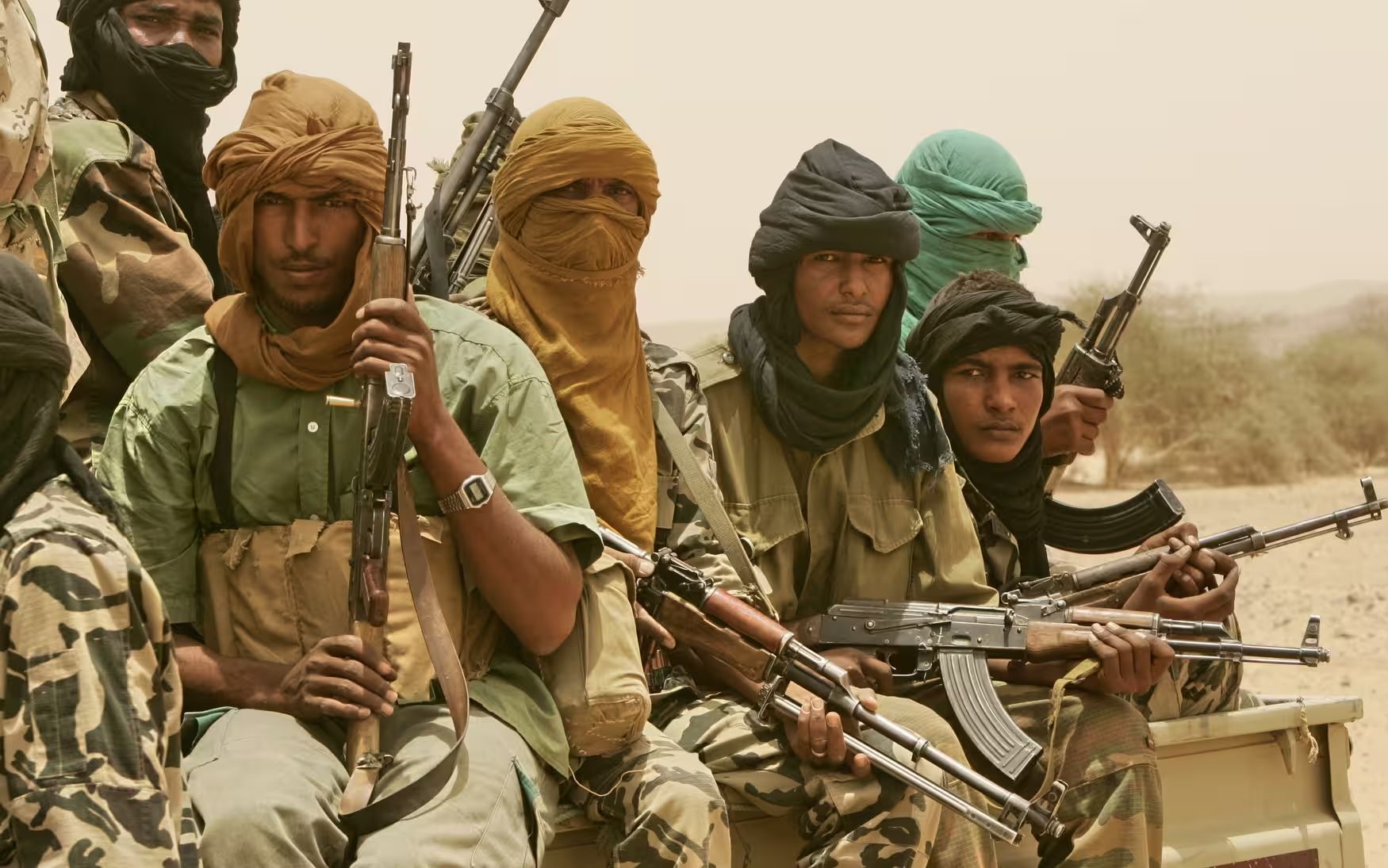
The offensive is being launched above all by two armed groups, the jihadists of the JNIM and the Tuareg separatists (in the photo from Getty Images) of the National Movement for the Liberation of Azawad, MNLA, who have been fighting for years for the independence of their lands in the north of Mali, with its epicenter in the historic caravan hub of Timbuktu, on the upper course of the Niger.
In 2021, a military junta led by General Assimi Goïta seized power in Mali. But since November, when the capital of Bamako came under siege, this junta has registered only defeats, including the assassination of its defense minister, Lieutenant General Sadio Camara. Recently, the rebels’ advance has been so overwhelming as to force the retreating Russian mercenaries to negotiate with them to be escorted back across the front lines.
But there’s more. Because the big news in recent weeks is that the political opponents of the coupist junta, who include Marxist, Christian, and Sufi exponents under the acronym CFR, Coalition of Forces for the Republic, have agreed that to oust the military men who came to power with Moscow’s approval, it is necessary to forge an alliance even with the Islamists of the JNIM and the Tuareg of the MNLA.
In a May 2 interview with France 24, the spokesman for these political opponents, Étienne Fakabo Sissoko, said that negotiations are underway with the Islamists and the Tuareg over the acceptance of sharia, the Islamic law already in force in vast areas of the country. “And I, as a Catholic Christian, certainly cannot be accused of wanting sharia,” he said, but it is precisely a matter of “having to face reality,” and “with the JNIM, the goal is to replicate the model already in place in many regions. In Gal, Timbuktu, and Kidal, the qadis, or Islamic judges, play an important role in all judicial matters, in all civil cases. Instead of allowing all this to take place in a state of general chaos, we must sanction it in a constitution that will allow us to resolve, once and for all, the issues relative to territorial claims and the role of religious figures in the national system of government.” The same logic of compromise, Sissoko added, must be applied to the Tuareg, to grant them the much-desired autonomy in the north of the country, through a constitutional amendment.
What until recently seemed unthinkable is thus taking shape in Mali : an alliance between the political opposition and a network of Islamist guerrillas extending to al-Qaeda. Notwithstanding, Sissoko cautioned, that “everything must come about within a framework that safeguards the spirit of the republic, in which democracy is reborn, in which territorial integrity is preserved. These are red lines for us.”
Reporting on this incipient alliance on May 4, the Vatican agency “Fides” gave the headline : “A possible ‘Syrian scenario’ for Mali?”
And in fact there is a similarity between this scenario and what happened in Syria at the end of 2024 with the overthrow of the pro-Russian Assad regime by Ahmed al-Sharaa, formerly the leader of a jihadist group affiliated with al-Qaeda but now a promoter of a government open to the various components of Syrian society.
Of course, among Syrian Christians, skeptics have many facts in their support, especially after the terrible attack a year ago on the Church of St. Elias in Damascus by Muslim suicide attackers, with 30 dead and 60 injured. Al-Sharaa is blamed for failing to control extremist Islamic groups.
But one must also take into account the historic meeting on Sunday, October 26, 2025, between al-Sharaa and the patriarch of Antioch, John X, in the Mariamite cathedral in Damascus. In which the Syrian president took his cue from a passage from the Quran to express his desire for reconciliation : “You will discover that those closest in affection to [Muslim] believers are those who say, ‘We are Christians.’ Damascus is the first place of coexistence for humanity. And its promise is a pact and a duty, with all my love.”
And in his turn, at that same meeting, Patriarch John X recalled the Ashtiname of Muhammad, the letter addressed in 623, the year after his flight from Mecca to Medina, to the monks of the monastery of Saint Catherine of Sinai, in which the Prophet pledged to defend Christians’ freedom of worship and their property.
(Translated by Matthew Sherry : traduttore@hotmail.com)
— — — —
Sandro Magister is past “vaticanista” of the Italian weekly L’Espresso.
The latest articles in English of his blog Settimo Cielo are on this page.
But the full archive of Settimo Cielo in English, from 2017 to today, is accessible.
As is the complete index of the blog www.chiesa, which preceded it.