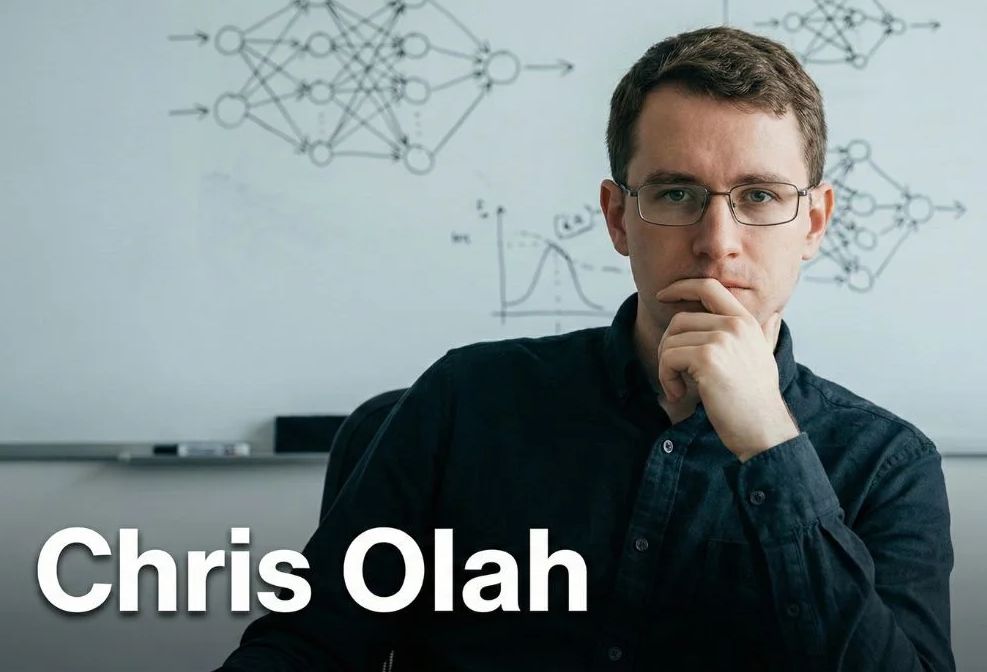
 The experts who, alongside the pope, on Monday, May 25, will present to the world “Magnifica Humanitas,” Leo XIV’s first encyclical, feature the English theologian Anna Rowlands of Durham University, recipient in 2023 of a Joseph Ratzinger-Benedict XVI Foundation award, and the American entrepreneur Christopher Olah (pictured), co-founder of Anthropic, both among those most committed to addressing the crucial issues raised by artificial intelligence, to which the encyclical is dedicated.
Signed by Leo on May 15, exactly 135 years after his predecessor and namesake Leo XIII signed the first, historic encyclical “Rerum novarum” dedicated to the social doctrine of the Church, “Magnifica humanitas” also aims to respond to the existential questions posed by the current new revolution in human society : the one created precisely by artificial intelligence.
Anthropic is not the only big company active in this field. One need only think of Alexander Karp and Peter Thiel’s Palantir, Sam Altman’s OpenAI, Elon Musk’s xAI and Grok, each conveying a different techno-philosophical vision.
Thiel made a stir with his appearance in Rome last March for a series of closed-door conferences on the Antichrist. But more than his apocalyptic vision inspired by René Girard, what carries weight on the political terrain is his proximity to JD Vance, the vice president of the United States, a convert to a Catholicism of rupture with the prevailing trends of the Church and a scornful critic of a Europe that, with its AI Act passed in 2024, presumes to regulate artificial intelligence through legislation, classifying and sanctioning its risks preemptively – an illusory undertaking in a constantly evolving field.
Anthropic, instead, is the expression of a highly original vision to which the Church of Rome pays close attention. And that is precisely why Pope Leo called on Olah to present “Magnifica humanitas.”
To better understand this vision, it is worth repeating word for word the description of it given in the May 18 edition of "Il Foglio" by a great expert on the subject, Carlo Alberto Carnevale Maffè, professor of business strategy at Bocconi University in Milan and brought in to teach at some of the most prestigious universities in the world, from Columbia University to the Wharton School, from Steinbeis University in Berlin to St. Mary’s College of California.
Together with Olah, the Anthropic co-founders include Dario Amodei, currently its chief executive officer, and his sister Daniela. And it is the essay “Machines of Loving Grace,” which the two published in 2024, that best expresses their vision, which is also political.
“It is fifteen thousand words worth reading in their entirety,” writes Carnevale Maffè, “before expressing any judgment on Silicon Valley. Their thesis is clear : ‘We see no structural reason why AI should preferentially favor democracy and peace.’ It is an admission that none of their colleagues has had the courage to formulate with such clarity, and that on its own would merit a political philosophy seminar.”
“Amodei recognizes,” Carnevale Maffè continues, “that AI can enhance propaganda and surveillance, the two classic tools of the autocrat, and that democracies must therefore play actively to gain a structural advantage, not being able to trust in technological inertia. It is a position that separates Amodei from the optimistic determinism that dominated Californian thought in the nineties : the idea, that is, of vaguely Clintonian derivation, that the internet would automatically export democracy (we all remember the ‘arab springs’ and the illusions that followed them). Amodei explicitly demolishes that narrative : ‘The internet has probably benefited authoritarianism, not democracy.’ This is an important and surprising historical correction for an American CEO in this sector.”
Hence Amodei’s operational proposal, what he calls an
“entente strategy.” “It is a coalition of democracies that would ensure primacy in AI through control of the chip supply chain and strategic military action (‘the stick’) combined with the distribution of benefits (‘the carrot’) to shift the global balance.”
In a subsequent essay from 2025, “The Adolescence of Technology,” Amodei expanded on this line, “adding an unease that has become his theoretical trademark,” Carnevale Maffè further writes. “The risk he warns against is not only that autocrats will use AI against democracies, but that democracies themselves, in the name of efficiency, will slide toward forms of domestic techno-authoritarianism. The ‘country of geniuses in a data center,’ an Amodeian phrase that has now entered the common lexicon, is a conditional utopia : it is only valid if the institutional geometries can withstand the blow of the concentration of computational power.”
Of all the positions in the field, Carnevale Maffè comments, “Anthropic’s is the most recognizably Kantian in form and Churchillian in substance. It is no coincidence that it is also the most respected in Western academic circles and the only one, it must be said, that has taken the trouble to seek critical commentary, prompting public debates like that at Cambridge’s Leverhulme Centre for the Future of Intelligence, which produced a stern but constructive reading of Amodei’s essay.”
Anthropic’s co-founders are not the only ones acting on the basis of a techno-philosophical vision. Alexander Karp, CEO of Palantir, holds a PhD in social theory from the University of Frankfurt, and in his 2025 essay, co-authored with Nicholas Zamiska, “The Technological Republic : Hard Power, Soft Belief, and the Future of the West,” he writes with the tone of a former student of Jurgen Habermas and the Frankfurt School. Translated into practice, his thesis is that the West needs to build an AI-industrial complex analogous to the military-industrial complex of the Eisenhower era if it wants to withstand cognitive competition with autocratic regimes.
But if Karp, with Palantir, wants to maintain and indeed strengthen the historical collaboration with the American government, this is not the case with Olah and Amodei, whose company, Anthropic, was banned by Donald Trump last February precisely because of its refusal to allow the United States military unlimited use of its AI technology.
It is no surprise, then, that Pope Leo, already at odds with the White House, should have wanted none other than Olah to present “Magnifica humanitas.” There is an undeniable consonance, on the subject of artificial intelligence, between the vision of Anthropic’s co-founders and that of the Church of Rome, already discernible in that preview of the new encyclical which was the document “Antiqua et Nova,” published by the dicastery for the doctrine of the faith in January 2025.
New technological products, in fact, as one reads in “Antiqua et Nova,” are not neutral : they “reflect the worldview of their developers, owners, users, and regulators, and have the power to shape the world and engage consciences on the level of values.” And this, Carnevale Maffè observes, “is exactly the same criticism that Habermas and the Frankfurt School would have made.” Leo XIV, the mathematician pope from Villanova University, “is not playing against Silicon Valley. He is playing with intelligent Silicon Valley against its more crude, chauvinistic, and idolatrous version.”
In other words : “If one accepts this cartography, the distance between Leo’s Augustinian personalism and Anthropic’s cautious democratism is, in terms of goals, much smaller than the distance that separates both from Vance’s Trumpism and Musk’s libertarianism.”
But then there are also the visions of Karp and Thiel, more questionable but not to be ignored, with a view to a critique of authoritarian technocracy to be carried out in alliance with the healthy part of techno-politics.
“This is what the Church has always been able to do when it has worked well,” Carnevale Maffè concludes. “Keeping together Thomists and Franciscans, Jesuits and Dominicans, in the name of a truth greater than all schools. Different means, different liturgies, different cathedrals : Karp’s data center and St. Peter’s Basilica. But the enemy is the same. And History, when it wants to be malicious, backs the most surprising alliances into the most unexpected corners.”
(Translated by Matthew Sherry : traduttore@hotmail.com)
— — — —
POSTSCRIPT — The proximity between Leo and Anthropic was confirmed by a meeting between the pope and Christopher Olah, a co-founder of the company, at Castel Gandolfo the day after both had presented the encyclical on artificial intelligence Magnifica Humanitas. And on the evening of that same Tuesday, May 26, speaking to the journalists waiting for him outside Villa Barberini, Leo discussed the work that the Dicastery for Promoting Integral Human Development is carrying out with Anthropic. “I believe that it is very important to continue this dialogue and to truly seek a disarmed artificial intelligence,” he said, noting that “war today is conducted with AI,” as “in Lebanon” and in “other parts of the world,” “without considering the human lives that are truly the victims of all this.”
Olah, 34, is Canadian. And on the evening of May 29, a Vatican communiqué gave the news that “this afternoon, a telephone conversation took place between His Holiness Pope Leo XIV and His Excellency Mr Mark Carney, Prime Minister of Canada, on the occasion of the publication of the Encyclical Magnifica Humanitas.” During the conversation, “the importance of developing artificial intelligence from an ethical perspective and with a human-centred approach was discussed,” but “the conversation also touched upon questions of mutual interest at the regional and international levels, with particular reference to efforts in promoting peace, especially in the Middle East and in Ukraine.”
— — — —
Sandro Magister is past “vaticanista” of the Italian weekly L’Espresso.
The latest articles in English of his blog Settimo Cielo are on this page.
But the full archive of Settimo Cielo in English, from 2017 to today, is accessible.
As is the complete index of the blog www.chiesa, which preceded it.