 (s.m.) Tomorrow, May 7, Leo XIV’s audience with Marco Rubio, secretary of state of the United States of America, a Catholic, will focus on the crucial issue of peace and war, already touched upon by President Donald Trump’s crude and reiterated verbal attacks on the pope and by the ill-mannered theological lesson on the subject of “just war” also given to the pope by Vice President JD Vance, he too a Catholic.
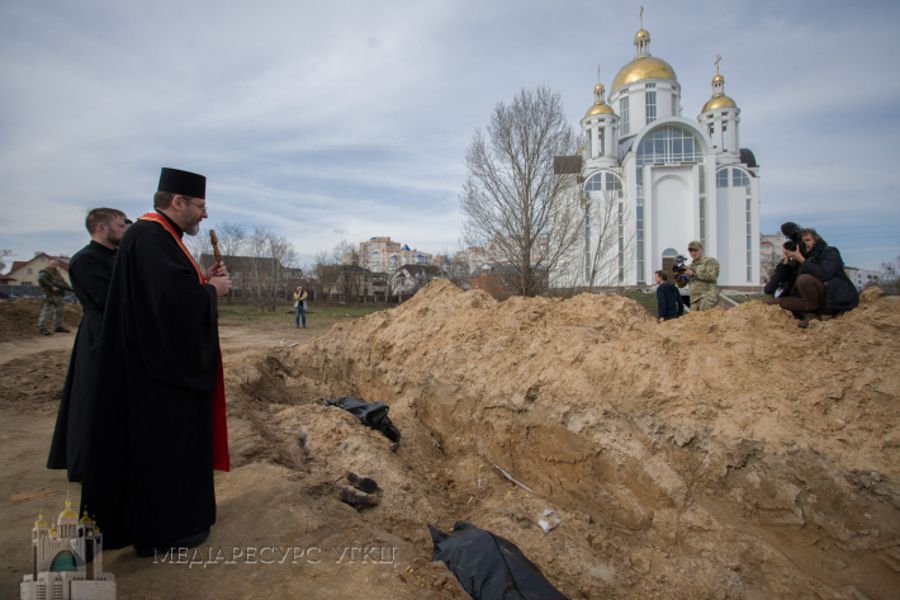
On how Leo preaches peace, as a personal choice that can lead to martyrdom and as a public choice that implies the right – and for the state the duty – to defend freedom and life, even with weapons (in the photo, the major archbishop of the Ukrainian Greek-Catholic Church, Sviatoslav Shevchuk, praying in Bucha after the massacre committed by the Russian invaders), Settimo Cielo weighed in on January 12, citing in support of these two paths to peace, among others, Flavio Felice, professor of the history of political doctrines at the Pontifical Lateran University.
But right away Professor Daniele Menozzi, former professor of contemporary history at the Scuola Normale Superiore in Pisa and author of an impressive volume precisely on Church, peace, and war in the twentieth century, contested this exegesis of Pope Leo’s teaching, ascribing it to the “unyielding supporters of the ideology of ‘just war’” and arguing instead that – in line with what Pope Francis preached – “war is always a mistake” and therefore the doctrine of “just war” no longer holds up.
For Menozzi, if anything should be promoted today it is a “pedagogy of nonviolence” that would teach how to “respond to the evil of injustice without resorting to the evil of weapons,” as if the excessive love of weapons and war were precisely the disease from which society and the Church’s faithful themselves must be cured.
When instead all the surveys agree in identifying – particularly in Italy – a dominant sentiment that is completely opposed to warmongering, a sentiment that Professor Ernesto Galli della Loggia, former professor of political history at the University of Perugia, has called “the syndrome of the unarmed,” thoroughly criticizing it in an editorial in “Corriere della Sera” of May 4.
A few days earlier, also in “Corriere,” another authoritative scholar, Angelo Panebianco, professor of political science at the University of Bologna, had taken note of this widespread sentiment, identifying its serious limitations, in an editorial entitled “Defending oneself to have peace,” which culminated in an appeal to the Church “to help Italians” to “let go of pacifist excuses and dangerous ideologies.”
And it is this appeal by Panebianco that gives impetus to the commentary published below, written by another authoritative scholar, Sergio Belardinelli, professor of sociology of cultural processes at the University of Bologna and scientific coordinator of the Cultural Project Committee of the Italian Episcopal Conference when Cardinal Camillo Ruini was its president.
Belardinelli also cites another commentary published on May 1 in “Corriere della Sera,” signed by Andrea Riccardi, founder and head of the Community of Sant’Egidio, according to which Pope Francis was right when he said that “it is very difficult nowadays to invoke the rational criteria elaborated in earlier centuries to speak of the possibility of a ‘just war.’”
Riccardi’s pacifism is the same as that fostered by the Italian episcopal conference presided over by Cardinal Matteo Zuppi, also a member of the Community of Sant’Egidio, as is a recent stance against arms manufacturers and dealers by cardinal and theologian Roberto Repole, archbishop of Turin and former president of the Italian Theological Association, also polemically cited by Belardinelli.
Whose commentary, in addition to being published on Settimo Cielo, also comes out today in the newspaper “Il Foglio.”
*
The Duty of Every Society to Defend Itself, if Necessary Even With Weapons
by Sergio Belardinelli
In “Corriere della Sera” of Tuesday, April 28, Angelo Panebianco launched a sort of appeal to all Italian political forces, that they understand the importance of “defending oneself in order to have peace.”
In an international landscape increasingly characterized by war, it is curious and tragic that our political elite, rather than facing seriously the issue of the country’s military defense, should limit itself to getting rid of it, delegating it, as convenient, now to the UN, now to Europe, now to NATO, cynically reserving for itself only the love of peace, as if this were enough to defend us from potential aggressors. A terrible civic pedagogy that, though cloaked in noble ideals, actually fuels fear among citizens and leaves the country defenseless, not only militarily but also culturally.
It is because of this general disorientation, I believe, that in the final part of his editorial Panebianco addresses the Church directly.
“The Church,” he writes, “can do much to help frightened and confused Italians not to bury their heads in the sand, but to become more aware of the risks to which the present times subject everyone. It’s true, we live in a largely secularized society. But that doesn’t change the fact that the Church remains, for many Italians, a very important moral guide. It is essential that the Italian bishops, while rightly calling for peace, should help Italians understand that there is no contradiction between wanting peace and defending oneself from potential dangers, no contradiction between maintaining a peaceful attitude, not aggressive toward anyone, and at the same time recognizing not the right but the duty of governments to do everything in their power to defend their countries from potential aggression by others. If the diagnosis of those who think the dangers are destined to grow, not diminish, is correct, Italians must be helped to become aware of them. Which means, first of all, letting go of excuses and dangerous ideologies.”
I believe the Italian Church should welcome this appeal without hesitation, if only because it offers a splendid opportunity to reiterate what Pope Leo XIV recalled on the very day of his election : that is, that the peace the Church speaks of is that of Jesus, not that of the many forms of pacifism that, perhaps unintentionally, contribute to sowing fear and often even hatred in society.
Let it be clear, this is not about legitimizing anyone’s political action, nor simply reaffirming the validity of the age-old doctrine of just war. As Andrea Riccardi emphasized in the May 1 edition of “Corriere della Sera,” nothing prevents this doctrine from being updated, in consideration of what modern warfare has become.
But neither is it about bringing the Church’s magisterium into line with positions that, in homage to nonviolence, end up disavowing the sacrosanct right of self-defense on the part of those who are attacked (usually the weakest). It is precisely this right, and this right alone, that justifies those who would invest resources in armaments. It is important to reiterate this, especially if the intention is to defend the radical nature of the evangelical message, without dissolving it into unreality.
In a world in which there no longer seem to be any limits on the ambitions of the mighty, with all the more reason the Church must speak in favor of peace and justice, something it has indeed been doing with great vigor for some time now. But this cannot be confused with the pacifism of those who, failing to even recognize the right/duty of states to defend their citizens when the enemy is at the gates, cry out that it is simply immoral to buy weapons and that investment should go instead to healthcare and education.
Who wouldn’t want that ? Who wouldn’t want all conflicts to be resolved with the arms of diplomacy ? War is horrendous, and what’s more, as Riccardi emphasized, no one wins today’s wars. But this is not a reason not to invest in defense and security ; if anything, it’s the opposite.
There is, in fact, only one way to convince the mighty of the futility of war, and that is for the potential object of attack to show itself capable of defending itself, either because it has an adequate defense system or because it can count on a military alliance with others.
Just as Panebianco says, it would therefore be more desirable than ever for bishops to “help make it understood that there is no contradiction between wanting peace and defending oneself from potential dangers.” This, indeed, contrasts with a certain pacifist sentiment that has undoubtedly taken hold also in Catholic circles, as it has in Riccardi himself. But precisely for this reason, clarity is needed. The peace of Jesus does not coincide with the silence of arms ; it has to do above all with our hearts and our ability to bear witness to it in the most disparate situations.
In his message to workers for May 1, the archbishop of Turin, Cardinal Roberto Repole, rightly gives the exhortation “not to become accustomed to the horrors of war.” But when, taking up the words of Pope Leo XIV, the cardinal reiterates that it is not enough to talk about peace and that “there must be the will to stop producing instruments of destruction and death” so that Turin, “the motor city,” may not become “the city of weapons,” I fear he is entering a veritable minefield. I have no sympathy for arms dealers, but it must be recognized that they are often the only hope for those who don’t have weapons and find themselves attacked by those who have produced them in abundance.
I know well that for Christians, as Benedict XVI also reiterated, “non-violence is not merely tactical behaviour but a person’s way of being, the attitude of one who is so convinced of God’s love and power that he is not afraid to tackle evil with the weapons of love and truth alone.”
But we are speaking precisely of “a person’s way of being,” not society’s. The Christian knows well that fidelity to Jesus Christ might require him to sacrifice his life. But never that of another. For this reason, he is also able to recognize the right/ duty of every society to defend itself, even with weapons if necessary, doing everything possible to prevent this from happening. Reaffirming this, especially today, could certainly count as an important service rendered to peace.
(Translated by Matthew Sherry : traduttore@hotmail.com)
— — — —
Sandro Magister is past “vaticanista” of the Italian weekly L’Espresso.
The latest articles in English of his blog Settimo Cielo are on this page.
But the full archive of Settimo Cielo in English, from 2017 to today, is accessible.
As is the complete index of the blog www.chiesa, which preceded it.