by Sandro Magister
 Pope Leo never mentioned it during his recent trip to Africa, but he knew quite well what the African bishops thought about the blessing of homosexual unions : by an overwhelming majority, opposed both to the December 18, 2023, declaration “Fiducia supplicans” from the dicastery for the doctrine of the faith, which authorized such a blessing for the first time, and to the subsequent glosses of cardinal prefect Victor Manuel Fernández, who sought to attenuate its impact by explaining that it is not for the couple but for individuals, and in any case must be cursory, administered in no more than 10 – 15 seconds.
Cameroon, one of the four countries visited by the pope, was the epicenter of this continental opposition, with the learned Guinean cardinal Robert Sarah having traveled there in April 2024 to dictate guidelines to the assembled bishops. Entirely the opposite of what is happening in other areas of Catholicism, particularly in Germany, where the blessing of homosexual unions is a cornerstone of the Church reform desired by the large majority of the episcopate, led by Cardinal Reinhard Marx, archbishop of Munich and Freising.
And in fact, as soon as the papal flight headed north again, returning from Africa to Rome, a question from a German journalist about the blessing of same-sex couples arrived punctually, at the inevitable high-altitude press conference at the end of every trip :
“Holy Father, how you assess the decision of Cardinal Marx, that he gave permission to the blessing of same-sex couples in his diocese, and in light of different cultural and theological perspectives, especially in Africa, how do you intend to preserve the unity of the global Church on that particular matter?”
To which Leo replied :
“First of all, I think it is very important to understand that the unity or division of the Church should not revolve around sexual matters. We tend to think that when the Church is talking about morality, that the only issue of morality is sexual. And in reality, I believe there are much greater, more important issues, such as justice, equality, freedom of men and women, freedom of religion, that would all take priority before that particular issue. The Holy See has already spoken to the German bishops. The Holy See has made it clear that we do not agree with the formalized blessing of couples, in this case, homosexual couples, as you asked, or couples in irregular situations, beyond what was specifically, if you will, allowed for by Pope Francis in saying all people receive blessings. When a priest gives a blessing at the end of Mass, when the pope gives a blessing at the end of a large celebration like the one we had today, they are blessings for all people. Francis’ well-known expression “Tutti, tutti, tutti” [everyone, everyone, everyone], is an expression of the Church’s belief that all are welcome ; all are invited ; all are invited to follow Jesus, and all are invited to look for conversion in their lives. To go beyond that today, I think that the topic can cause more disunity than unity, and that we should look for ways to build our unity upon Jesus Christ and what Jesus Christ teaches. So that is how I would respond to that question.”
This response from Leo is a further clarification of how he intends to bring the Church to unity, even on an issue so divisive at this time.
Meanwhile, Leo knows that not even among the progressive German bishops is there full agreement on how to implement the document entitled “Blessing Gives Strength to Love,” with which their episcopal conference approved the liturgical blessing of homosexual unions. Along with Cardinal Marx, only 14 of the 27 dioceses have so far adopted and implemented it, knowing they are going beyond what is permitted by "Fiducia supplicans" and despite being aware that some of their clergy are opposed to it.
But now there are also the criticisms from Leo, who in his response to the German journalist made it clear that he wants a further clampdown on what is permitted by "Fiducia supplicans," excluding any “formalized blessing” of couples, for whom the blessing given to everyone at the end of Mass or at any other celebration is already sufficient, also providing a restrictive exegesis of what Pope Francis said in this regard.
Pope Leo knows the German Church well, starting from when he was prefect of the dicastery for bishops. His signature, along with that of cardinal secretary of state Pietro Parolin and Cardinal Fernández, was at the bottom of the letter with which Rome, on February 16, 2024, called a halt to the announced approval in Germany of a committee that would in turn pave the way for a “Synodal Conference” with a majority of lay representatives endowed with decision-making power equal to that of the bishops.
The fact is that the statutes of the new “Synodal Conference” were approved all the same in Stuttgart on January 31, 2026, by the Central Committee of German Catholics, concluding the hard-fought “Synodaler Weg,” synodal way, which the German Church has been engaged in since 2019. It will consist of 81 members : 27 bishops, 27 lay delegates from the Central Committee of German Catholics, plus 27 other participants, including two members of the Conference of Religious Superiors and two members of the Advisory Committee for Victims of Sexual Violence. Of the remaining members, at least 13 must be women, at least five must be under 30, and at least three must belong to different linguistic groups, all with equal voting and decision-making power.
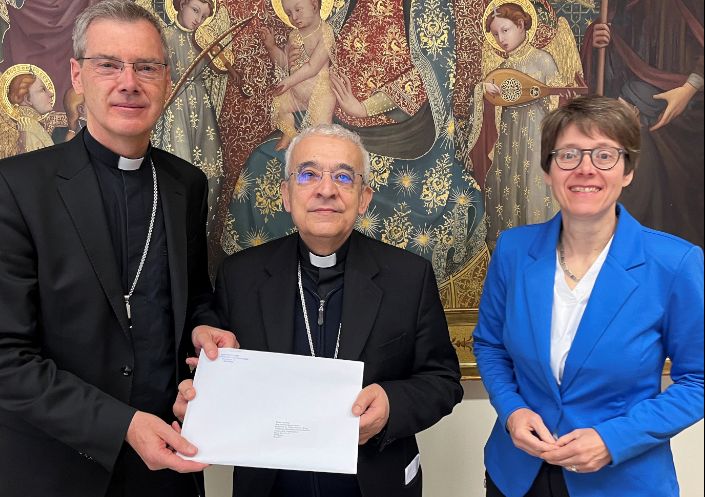
At that point, the only thing missing for the approval of the statutes of the “Synodal Conference” was the bishops’ vote, which came at the end of February (see photo), with the text subsequently being delivered to Rome on March 31 for final approval. However, this is far from a given.
Pope Francis, in fact, had already expressed his strong reservations about the announced creation of this body in February 2023, in a letter to four authoritative theologians who had appealed to him after resigning from the “Synodal Way”: Marianne Schlosser, Hanna-Barbara Gerl-Falkovitz, Katharina Westerhorstmann, and Dorothea Schmidt. For Francis, this body, as it was delineated, “cannot be harmonized with the sacramental structure of the Catholic Church.”
But then the Holy See had repeatedly warned the German bishops against continuing down this path without substantial correctives, with then-cardinal Robert Francis Prevost among those most committed to applying the brakes.
And now, as pope, he does not appear to have set aside his reservations. On the contrary, he has made them clear, even before the press conference on the flight from Africa to Rome, already on the return flight from his previous trip to Turkey and Lebanon :
“I am aware that many Catholics in Germany believe that certain aspects of the Synodal Way that has been celebrated in Germany up until now, do not represent their own hope for the Church or their own way of living the Church. So there is need for further dialogue and listening within Germany itself, so that no one’s voice is excluded, so that the voice of those who are more powerful does not silence or stifle the voice of those who might also be very numerous but don’t have a place to speak up and to allow their own voices and own expressions of Church participation to be listened to. At the same time, as you know, I am sure, the group of German bishops has been meeting, for the last couple of years, with a group of the cardinals from the Roman Curia. There is an ongoing process there as well, to try and make sure the German Synodal Way does not, if you will, break away from what needs to be considered as the pathway of the universal Church. I’m sure that will continue. I suspect there will be some adjustments made on both sides in Germany but I’m certainly hopefully that things will work out positively.”
Meanwhile, however, the German bishops, meeting in Würzburg at the end of February, elected as their new president one of the most groundbreaking reformists : Heiner Wilmer, 64, bishop of Hildesheim, formerly superior general between 2015 and 2018, based in Rome, of the Congregation of the Priests of the Sacred Heart, called Dehonians from the name of their founder, Léon Gustave Dehon (1843 – 1925).
But about forty days later, on April 9, Leo also made a key appointment : the new nuncio to Germany, the Dutchman Hubertus van Megen. He is certainly no progressive ; on the contrary, his last posts as nuncio were in Kenya and South Sudan, precisely in the Africa most opposed to the German Church’s headlong rushes. His words, spoken in 2024 during an episcopal consecration in Nairobi, are remembered : “Western society’s teachings on gender theory are clear symptoms of a society that has lost its inner compass and is drifting helplessly in the stormy sea of human desires, tossed about and weakened in every respect.”
The nuncio plays a key role in the selection of new bishops. And from the first appointments, it will be clear whether the four bishops of the current conservative minority – Rainer Maria Woelki of Cologne, Gregor Maria Hanke of Eichstätt, Stefan Oster of Passau, and Rudolf Voderholzer of Regensburg – will remain alone or swell their ranks.
Nor must what Leo said on the flight back from Africa be overlooked, when he contested the centrality given to sexual issues in the controversies dividing the Church. In the social sphere, the unity of the Church, in his judgment, must be built on “much greater, more important issues, such as justice, equality, freedom of men and women, freedom of religion.” These are the issues that must be "prioritized." That is, implicitly, not the sexual ones in which the German Church is bogged down : homosexuality, abuse, celibacy, women’s ordination…
(Translated by Matthew Sherry : traduttore@hotmail.com)
— — — —
Sandro Magister is past “vaticanista” of the Italian weekly L’Espresso.
The latest articles in English of his blog Settimo Cielo are on this page.
But the full archive of Settimo Cielo in English, from 2017 to today, is accessible.
As is the complete index of the blog www.chiesa, which preceded it.